

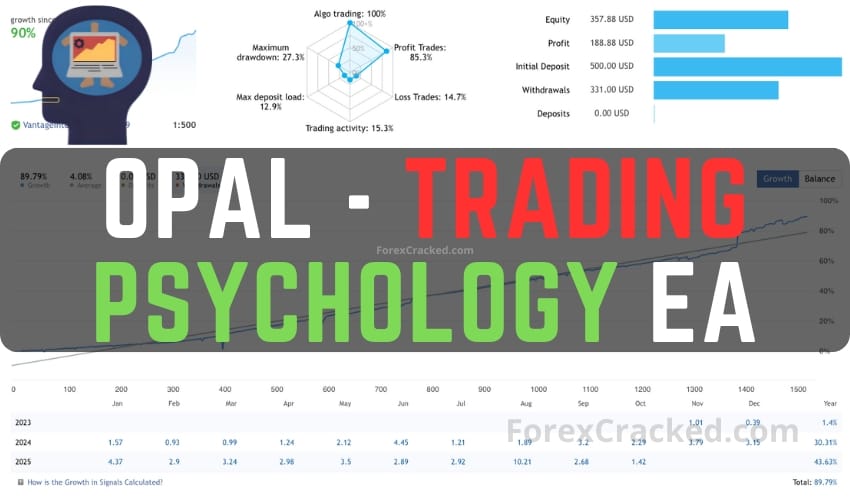
Opal EA is a fully automated Expert Advisor for MetaTrader 4 (MT4) that trades EURUSD on the H1 timeframe using a recovery (grid) system built around psychological price levels. Its hook is the way most traders cluster their orders at round numbers like 1.2000, and the EA looks to trade the behaviour that forms around those levels. The vendor markets it under the “trading psychology” banner, but underneath the branding it is a round-number grid robot with a money management module, a news filter, and a time filter.
TL;DR – Free MT4 EURUSD robot that trades round-number levels with a grid-style recovery system. Its 2-year live signal returned 89.79% with an 85.32% win rate and a 1.85 profit factor, but balance drawdown of 3.14% sat against an equity drawdown of 27.30%, which is the classic grid tell. Survived two years without a blow-up, but size for the floating drawdown, not the win rate. Needs a low-spread ECN account and a VPS.
What Is the Opal EA?
Opal EA is a free MetaTrader 4 robot that trades EURUSD on the H1 timeframe around psychological round-number price levels. It uses a recovery (grid) system instead of a fixed stop loss, adding positions to average a losing basket back to profit, and ships with a money management module, a news filter, and a time filter. It is built for live trading rather than curve-fitted backtests.
Core Strategy and Logic
The marketing leans on trading psychology, but the trading logic comes down to two ideas: round-number levels and a recovery system. Most traders place stops and entry orders at whole numbers, so liquidity bunches up at levels like 1.2000 or 1.1050. Opal looks for the price behaviour that forms around those levels and trades it. If you want the standalone version of this idea, the Grid Round Numbers indicator for MT4 plots the exact levels Opal is built around.
- Round-Level Entries – The EA identifies psychological price zones (round numbers where order flow clusters) and uses them to time entries. Investopedia’s note on round-number psychology explains why these levels act as support and resistance.
- Recovery (Grid) System – The vendor’s “recovery system” is grid trading. When a trade goes against it, the EA opens further positions at intervals to average the entry price and close the basket in profit rather than at a loss. This is what produces the high win rate, and also the floating drawdown.
- Money Management Module – Position size is scaled relative to balance and market movement, which is what lets the account compound over time.
- Two-Step Trailing Stop – Winning positions are managed with a trailing stop that locks in gains as price moves favourably.
- News and Time Filters – The EA can pause around high-impact news releases and restrict trading to chosen hours, both aimed at avoiding the volatility spikes that hurt a grid system most.
A grid recovery system has a well-known trade-off. It wins often because it refuses to close losers until they come back, but the rare times a trend runs against the basket, the floating loss balloons. The same shape shows up in the Multi-Currency Grid Robot review and, in its most aggressive form, the Undefeated Triangle martingale EA. Opal’s live record shows the milder end of that spectrum, but the mechanism is the same.
The vendor’s own line is worth keeping in mind: they say they build for stable live trading, not curve-fitted backtests that produce unreal results. That is a fair point, and it is why the live signal below matters more than any tester run. For the difference between a real edge and an over-fitted one, see our guide on Forex EA vs manual trading.
Please test in a demo account first for at least a week. Also, please familiarize yourself and understand how this trading psychology based robot works, then only use it in a real account.
Recommendations for Opal EA
- Minimum account balance of $100 (more is safer for a grid system).
- Works best on EURUSD. (Work on any Pair)
- It works best on H1. (Work on any TimeFrame)
- Opal EA should work on VPS continuously to reach stable results. So we recommend running this Trading Psychology EA on a reliable VPS (Reliable and Trusted FOREX VPS – FXVM)
- A low-spread ECN account with fast execution is recommended (Find the Perfect Broker For You Here).
Performance Review: Live Data Analysis
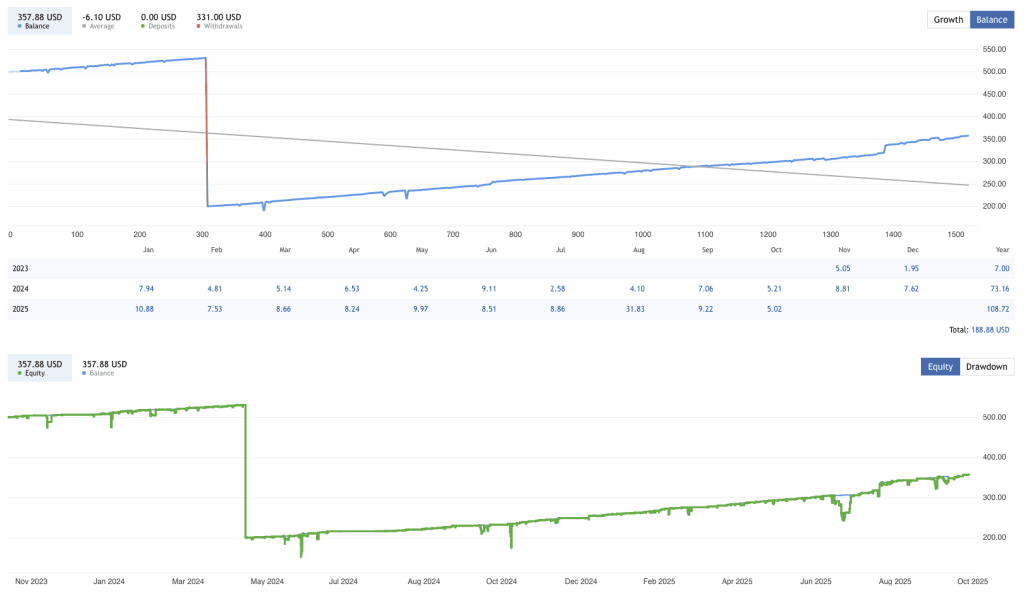
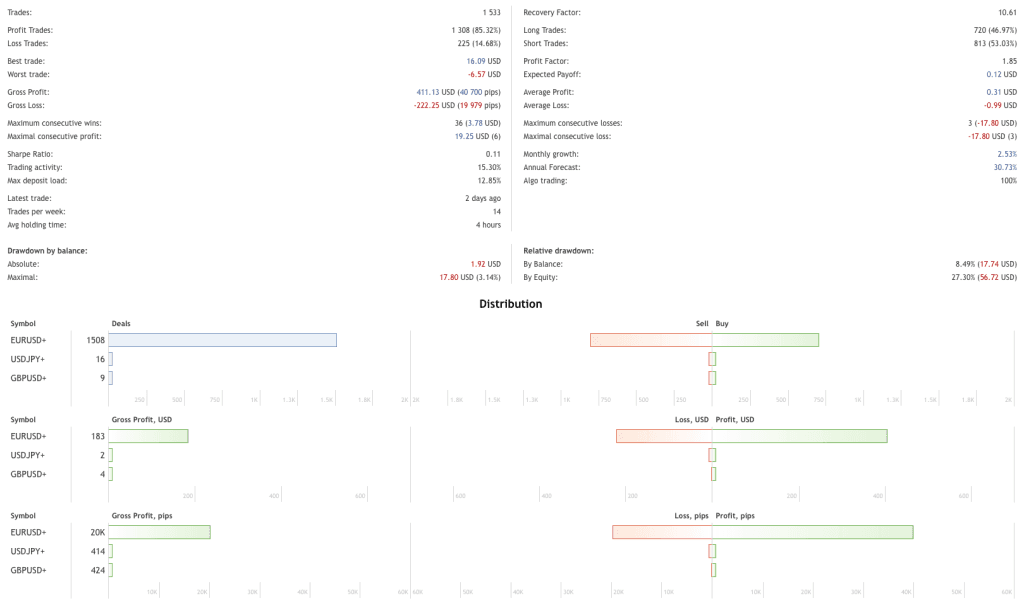
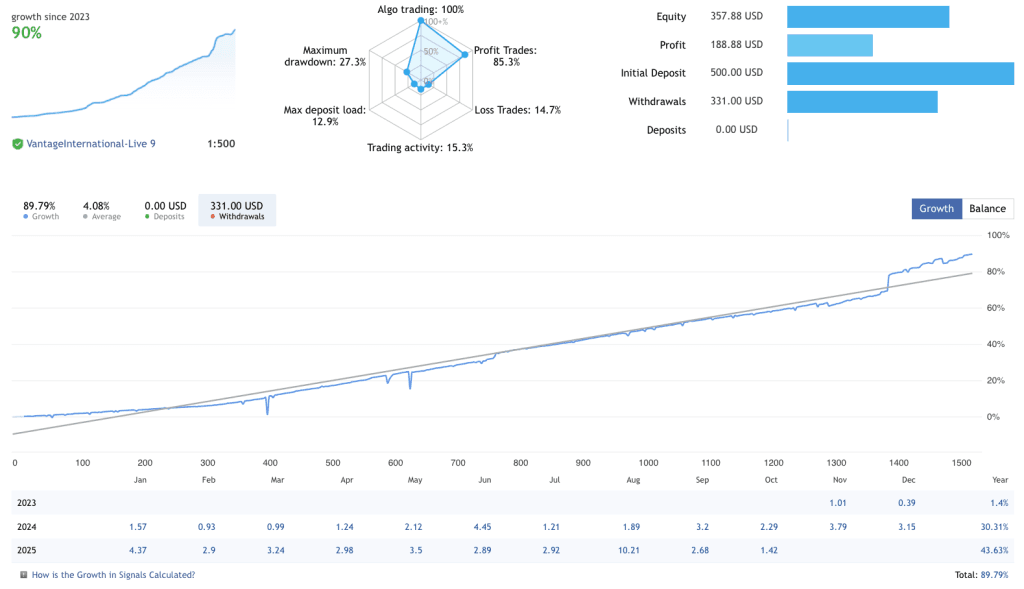
The numbers below come from Opal’s live MQL5 signal, a real Vantage account at 1:500 leverage that ran from November 2023 to October 2025 (screenshots captured October 2025, when the signal was still live). The signal has since been deleted, so these are the archived figures. About two years of continuous live trading is a longer real-money record than most free EAs ever publish, which is the single best thing this EA has going for it.
| Metric | Value |
|---|---|
| Verified live period | Nov 2023 to Oct 2025 (~2 years) |
| Broker / leverage | Vantage, 1:500 |
| Total growth | 89.79% |
| Net profit | $188.88 (after $331 withdrawn) |
| Initial deposit | $500 |
| Total trades | 1,533 |
| Win rate | 85.32% |
| Profit factor | 1.85 |
| Recovery factor | 10.61 |
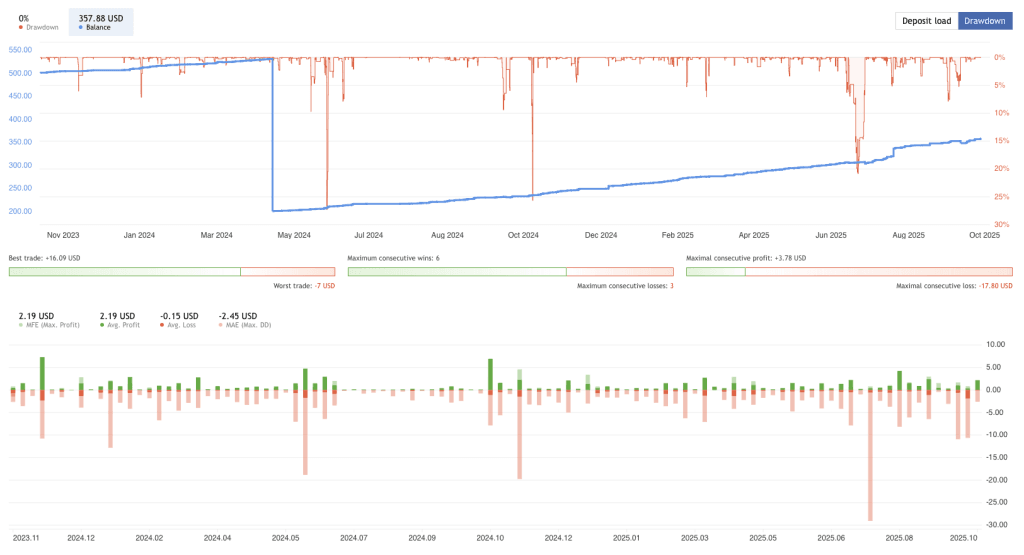
| Max balance drawdown | 3.14% |
| Max equity drawdown | 27.30% |
| Avg monthly growth | 2.53% |
| Avg holding time | 4 hours |
1. The balance chart misreads as a crash; it is a payout
The one thing on this signal that fools people is the steep cliff on the balance chart in early 2024. It looks like the account blew up. It did the opposite. The equity curve underneath runs straight through that drop without a matching dip, which is only possible if the fall was a withdrawal, not a losing streak. The owner pulled $331 out (more than the original $500 stake) while the system kept trading. Once you add that back, the real return is about $189 of profit on a $500 base over two years, with the principal already returned. The takeaway a glance at the balance line hides: this EA paid for itself and then paid its owner, which is the opposite of the “great curve, never withdrawn, then gone” pattern that marks a fake signal.
2. The edge only has a 9-point safety margin before it loses money
Here is the number the signal page does not show you. With an average win near $0.31 and an average loss near $0.99, the win rate this EA needs just to break even is 0.99 / (0.31 + 0.99), which is about 76%. It actually ran at 85.32%. So the entire profit of this system lives in a roughly 9-percentage-point gap between the win rate it achieved and the win rate it had to hit to stop losing money. That is a thin cushion, and it is fragile in a specific way: the wins are tiny (about 3 pips each at the lot sizes used), so anything that shaves those small wins (wider spread, slippage, a worse fill on a recovery leg) pushes the real win rate toward that 76% floor. This is why a low-spread ECN broker is not a nice-to-have for Opal, it is the difference between the 9-point cushion and no cushion. Our 12-point EA scam checklist calls out this exact shape: a high win rate sitting on a profit factor of just 1.85.
3. The losing baskets carry bigger lots than the winners
Cross-check the dollar figures against the pip figures and the grid’s behaviour falls out. In pips, the account won 40,700 and lost 19,979, a ratio of about 2.04. In dollars, it won $411 and lost $222, a ratio of 1.85. The dollar ratio is lower than the pip ratio, which can only happen if the losing pips were traded at larger lot sizes than the winning pips. In plain terms, the recovery system adds size as a trade goes against it, so a losing basket is heavier than a winning one. That is the mechanism behind the headline risk: balance drawdown stayed at 3.14% because losers are not closed until they recover, but equity drawdown reached 27.30% because the floating loss on those scaled-up baskets gets deep before it does. The lone 10.21% month (August 2025, against a 2-3% norm) is almost certainly one of those deep baskets finally closing, which is what a recovery system’s “big month” usually is. A 0.11 Sharpe ratio confirms the ride is lumpy relative to the return. The practical rule: a 27% floating drawdown with lots that grow into losers is exactly how a grid hits a stop-out on an under-funded account, even while it is “winning.” Size the account for the equity drawdown, not the smooth balance line, and run the figure through the drawdown calculator before you fund it.
The honest comparison here is to other EURUSD systems that take a hard stop instead. A robot like EuroPips Pro for EURUSD trades the same pair with different risk mechanics, and the trade-off is the usual one: hard-stop systems show lower win rates but cap each loss, while Opal’s recovery approach wins more often and risks deeper floating drawdowns. Neither is free; the question is which risk shape you can sit through.
Opal EA
Free MetaTrader 4 Expert Advisor that scalps EURUSD on H1 around psychological round-number levels, using a recovery (grid) system, a money management module, a news filter, and a time filter. A 2-year live Vantage signal showed 89.79% growth, 85.32% win rate, 1.85 profit factor, and a 27.30% equity drawdown.
Pros
- Genuinely long live record (about 2 years on a real Vantage account, not a backtest)
- 85.32% win rate with money withdrawn from the account during the run
- Built-in money management, news filter, and time filter
- Round-number level logic gives it a defined entry idea rather than random scalping
Cons
- The "recovery system" is grid trading, so it averages into losers instead of taking a hard stop
- Equity drawdown hit 27.30% while balance drawdown stayed at 3.14%, meaning deep floating losses
- Profit factor of 1.85 and a 0.11 Sharpe ratio show a thin, broker-sensitive edge
- Vendor gives no real detail on entries, so you are trusting the live record, not a documented logic
- The featured live signal has since been deleted, so the track record is archived, not ongoing
Summary
A grid recovery robot with an unusually long live history. Two years of real EURUSD trading on a Vantage account, with money actually withdrawn, is more proof than most free EAs ever show. The catch is the mechanism: a high win rate paired with a modest profit factor and an equity drawdown nine times larger than the balance drawdown. That is a recovery system floating underwater between wins, not a hard-stop edge.
 Built by ForexCrackedWe tested 1,200+ indicators. Then we built our own.Six years of reviewing EAs and indicators went into FXC Fusion: two engines, the seven-panel cockpit, MT4 and MT5, from the team behind this site.
Frequently Asked Questions (FAQ)
Conclusion
Opal EA earns a fair amount of trust simply by surviving two years of live EURUSD trading and paying its owner out along the way, which is rare for a free robot. However, the engine doing the work is a grid recovery system, and the 27.30% equity drawdown against a 3.14% balance drawdown is the proof: this EA wins by waiting out losers, not by being right. For a personal account where you set the risk, run the default low-mid profile, and size for the floating drawdown on a low-spread broker with a VPS, it is a reasonable free system to test. Treat the 85% win rate as a feature of the grid, not a guarantee, and never raise the risk to chase the headline return.


Discussion 2 comments
Is this still working?
Not working after the latest MT4 build update. Needs a fix!
Thanks admin will test it!