
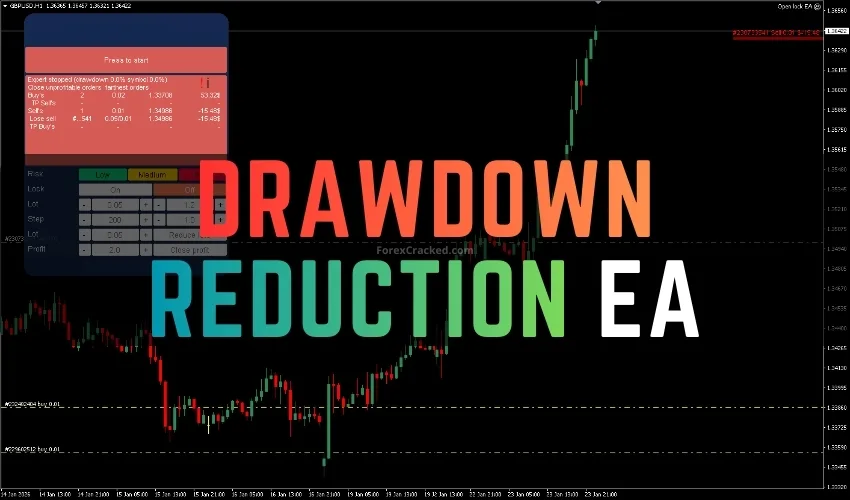

This article outlines the operational logic of the Drawdown reduction EA designed to manage account drawdown. The system utilises specific algorithms, including locking, averaging, and partial closing, to interact with existing market orders. The Drawdown Recovery EA is capable of disabling other active experts to manage their orders once a specific drawdown threshold is reached.
Core Mechanisms of the Drawdown Reduction EA
The primary function of this utility is to mitigate account drawdown through a sequence of automated actions. The Drawdown Reduction EA employs three distinct methods to handle loss making positions:
- Locking – This method is used to prevent the expansion of current drawdown.
- Averaging Orders – These are executed to generate profit intended to cover existing losses.
- Partial Closure – This technique splits larger losing positions into smaller segments to reduce the burden on the deposit.
The Locking Algorithm
Upon initialization, the EA assesses the account for unprofitable orders. If a drawdown is detected, the advisor executes a “locking” strategy. This involves opening additional transactions to ensure the total volume of Buy lots equals the total volume of Sell lots. Consequently, regardless of price direction, the floating loss remains fixed and does not increase. These specific transactions are tagged with a unique “locking” comment.
Segmentation of Positions
Once the drawdown is stabilized via locking, the algorithm identifies long-term unprofitable transactions. It divides these larger positions into smaller, manageable parts.
- Example – A single transaction of 1.0 lot may be conditionally divided into 10 separate transactions of 0.1 lot each.
The system is designed to close these smaller segments individually over time, rather than attempting to recover the entire position simultaneously. This approach aims to lower the risk profile compared to recovering a full position at once.
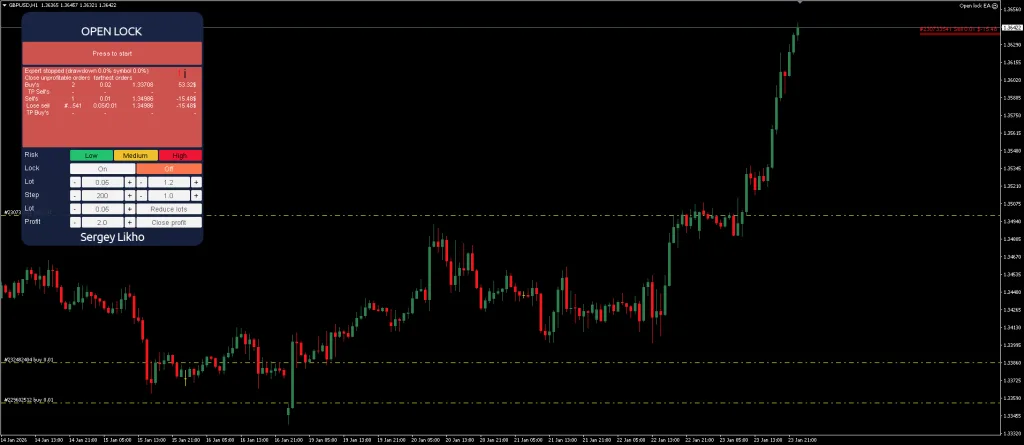
Order Management Logic
Opening New Orders
The Expert Advisor opens recovery orders based on a grid system defined by point distance in the settings. A new order is triggered if the preceding order is currently in a loss.
- Identification – These positions are marked with an “average” comment and assigned a specific Magic Number.
- Volume Calculation – New orders are opened with a small lot size, calculated by multiplying a base lot by a specified coefficient.
Closing Logic and Calculation
The closing process relies on the profit generated by the new “averaging” orders. When the profit from these new, smaller orders exceeds the loss of a specific segment of the original unprofitable position, a partial close is executed.
Calculation Example:
- Existing Position – A losing order of 1.0 lot with a floating loss of -$1000.
- Target Segment – The settings are configured to close 0.1 lot (1/10th of the main order).
- Profit Target – The user sets a required profit of $15.
For the transaction to execute, the equity on the account must reach a profit capable of covering the proportional loss plus the target profit.
- Formula: ($1000 Loss × 0.1) + $15 Target = $115 Total Profit needed.
Once the averaging orders generate $115, the EA closes those specific orders and 0.1 lot of the losing position. The result is a net profit of +$15 and a remaining losing order reduced to 0.9 lots. The advisor recalculates this logic dynamically as the market price changes.





Download a Collection of Indicators, Courses, and EA for FREE
Drawdown Recovery EA Usage Guidelines
The operational parameters of this Drawdown Recovery Expert Advisor suggest specific conditions for deployment and avoidance.
Recommended Deployment Conditions
The logic of this EA is designed for the following scenarios:
- Significant Drawdown – When the account drawdown reaches or exceeds 5%.
- Multiple Positions – When there are numerous buy and sell transactions of varying volumes active.
- Splittable Lots – When the volume of open transactions is large enough to be divided into smaller segments.
- Available Margin – When there are sufficient free funds in the account to allow the EA to open the necessary averaging and locking positions.
Conditions to Avoid
Usage of this specific algorithm is not recommended under the following circumstances:
- Single Small Positions – For example, on a $3,000 deposit, if there is a single 0.01 lot transaction with a $15 loss, the complexity of the locking and averaging mechanism is unnecessary.ca
- Negligible Drawdown – If the drawdown is extremely small relative to the balance.
Conclusion
The Drawdown Reduction EA offers a systematic approach to account drawdown recovery through locking, averaging, and position segmentation. While effective for accounts facing significant drawdown with available margin, it requires careful application and is not suitable for minor floating losses. Traders must evaluate their specific account conditions, specifically liquidity and drawdown percentage, before deploying this automated hedging tool.


The Recovery Manager EA (also published on this website) is better than this Open Lock EA. Both are average systems, but Recovery Manager works with the trend, which is safer. A model I’ve been looking for for some time is one that works on account recovery via hedge tunnel. For me, account recovery systems based on hedge tunnel are much safer than averaging. Averaging is good for sideways markets. Hedge tunnels are good for trending markets. Something that doesn’t already exist in the EA market is an expert advisor that works with both recovery strategies at the same time (averaging + hedging tunnel). So far, it seems that none have been released with both mechanisms embedded. In my opinion, it would be the perfect system: effective and safe.
all ea’s linked with the website wont work. i tested at least 5 of them and every single one doesnt have a valid license key.. Admin please fix this