

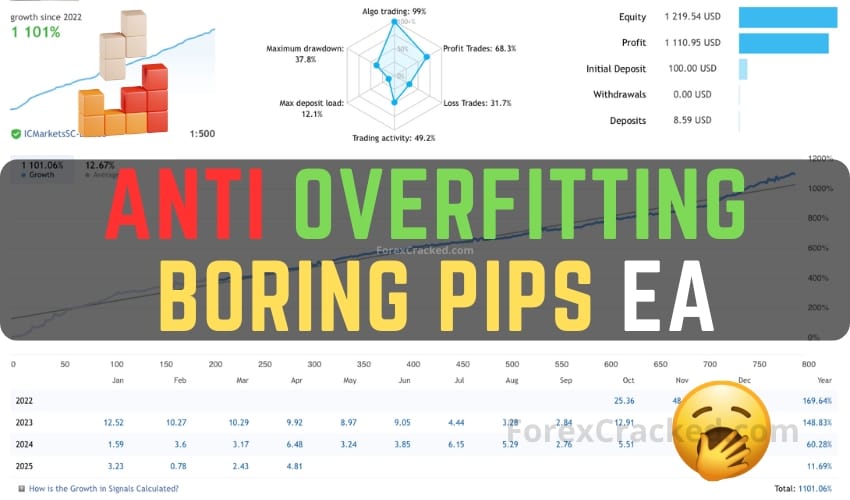
Boring Pips EA is designed to avoid overfitting a common issue in many automated strategies. Using a three stage optimization process, it aims for more stable live performance. Despite marketing claims of “AI” and “deep learning” in Anti OverFitting EA, its core strategy appears to rely on classic methods such as momentum, supply and demand zones, and Fibonacci levels.
In the world of automated trading, it’s common to come across EA that boast near perfect backtest results. Yet, when it comes to live trading, many of them underperform or completely fail. This discrepancy often points to a common issue: overfitting.
The developer of the Boring Pips EA highlights this:
“Have you ever wondered why most expert advisors are not effective in live trading, despite their perfect backtest performance? The most likely answer is Over-fitting.”
According to the developer, many EAs are programmed to fit historical data too closely. This tight alignment can make the strategy look brilliant in the past but renders it ineffective in real-time, unpredictable environments. Some developers might not even recognize this flaw; others may knowingly use overfitting as a way to make their EA look better than it actually is in order to impress buyers.
Unfortunately, this is quite accurate in many popular EA today.
Core Strategy and Logic
Anti OverFitting EA combines several classic trading concepts to identify entry opportunities across correlated currency pairs. Its approach is multi-layered, scanning for conditions across 4 timeframes before executing:
- Momentum Analysis – The EA monitors momentum slowing down in potential reversal zones. Traders familiar with momentum-based entries will find similarities to systems like the GerFX Momentum Capture EA, though the Boring Pips EA applies this concept specifically to correlated currency pairs rather than event-driven trading.
- Supply and Demand Zones – The system scans for potential zones where prices may reverse, identifying areas of institutional buying or selling pressure. This is the same foundational concept used by dedicated tools like the Supply Demand EA, but integrated here as one component of a broader multi-factor entry system.
- Fibonacci Retracement – Fibonacci levels are used to gauge potential reversal points within the broader trend structure. Traders who rely heavily on this approach may also want to explore the Fibot Fibonacci EA for a comparison of Fibonacci-centric strategies. You can also calculate key Fibonacci levels manually with our Fibonacci Calculator.
- Multi-Timeframe Confirmation – Entries are confirmed across 4 timeframes, filtering out noise and reducing false signals.
Based on observation, the system focuses on correlated currencies like AUD, CAD, and NZD, which often move in similar ways and can present unique trading setups. This correlation-based approach shares DNA with systems like the Smart Correlation Hedge EA, which also exploits currency pair relationships, though that EA focuses more on hedging, while Boring Pips targets directional momentum entries.
Key Features Summary
- Strategies used – Momentum, supply/demand zones, Fibonacci retracement, and AI-based momentum detection
- Currency pairs – Multi-currency (likely focusing on AUD, CAD, NZD correlations)
- Risk Controls – Includes take profit (with trailing option), fixed stop loss, optional grid and martingale
- Manual options – Traders can manually stop entries or close all positions
- Single Chart Setup – Can trade multiple instruments from one chart
Please test in a demo account first for at least a week. Also, please familiarize yourself and understand how this Anti OverFitting Robot works, then only use it in a real account.
Recommendations for Boring Pips EA
- Minimum account balance of 100$.
- It is made to work on AUDCAD, AUDNZD, and NZDCAD.
- It works on M5. (Work on any TimeFrame)
- This Boring Pips EA should work on VPS continuously to reach stable results. So we recommend running this Anti OverFitting EA on a reliable VPS (Reliable and Trusted FOREX VPS – FXVM)
- Low Spread, Slippage, and quick execution accounts are also recommended (Find the Perfect Broker For You Here)
- Use our Drawdown Calculator to assess your risk tolerance before going live with this EA.
Real AI or Just Marketing?
While the description mentions AI and deep learning, it’s important to approach those claims with caution. Terms like “artificial intelligence,” “cutting-edge,” and “deep learning” are increasingly used in marketing EAs, sometimes without any real machine learning happening in the background. In most cases, unless specified and demonstrated clearly, these claims can be more about sales than substance.
The EA behaves more like a rule-based system using traditional technical analysis principles. It’s likely that any “AI” aspect is minimal or symbolic rather than a core feature. This pattern is common across the EA market, for a comparison of another system that markets itself with AI terminology, see our review of the Adaptive Forex Trading EA, which similarly combines correlation and supply/demand logic under the banner of adaptive intelligence.
The Anti-Overfitting Optimization in Boring Pips EA
To address this issue, the Boring Pips developer claims to implement a unique “Anti-overfitting” process designed to make the EA more robust and generalizable outside the test data. This process is broken down into three phases:
- Initial Optimization (2010 – 2019) – The strategy is tuned using nearly a decade of historical data to find stable parameter values.
- Walk-Forward Testing (2019 – 2022) – These parameters are then tested on entirely unseen data, checking how they hold up without being tailored to it.
- Stress Testing – Finally, the system is put under simulated pressure with factors like entry lag and noise added to verify how it holds up under less-than-ideal conditions.
The idea is that if the Anti OverFitting EA performs well through all three phases, it’s less likely that its performance is simply due to overfitting.


Anti OverFitting EA
A multi-currency EA combining momentum analysis, supply/demand zones, and Fibonacci retracement with a structured 3 phase anti-overfitting optimization methodology.
Pros
- 3 phase anti-overfitting validation (optimization, walk forward, stress testing)
- Multi-currency correlation strategy on AUD, CAD, and NZD pairs
- Low minimum deposit requirement ($100)
- Single chart setup for multiple instruments
- Manual override to stop entries or close all positions
Cons
- AI/deep learning claims appear overstated, behaves as a rule-based system
- Optional grid and martingale modules introduce high drawdown risk
- No publicly verified live trading signal for independent validation
Summary
The Boring Pips EA takes a commendable approach to EA validation with its structured 3-phase optimization process, a genuine effort to address the industry-wide problem of overfitting. However, the AI and deep learning claims appear largely cosmetic, and the inclusion of optional grid and martingale features introduces significant risk that contradicts the otherwise conservative philosophy.

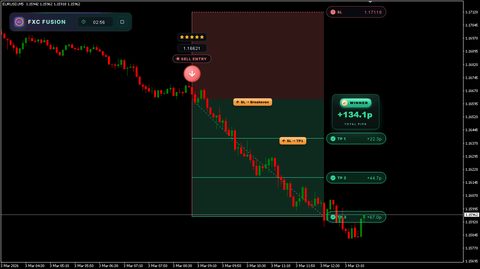
 Built by ForexCrackedWe tested 1,200+ indicators. Then we built our own.Six years of reviewing EAs and indicators went into FXC Fusion: two engines, the seven-panel cockpit, MT4 and MT5, from the team behind this site.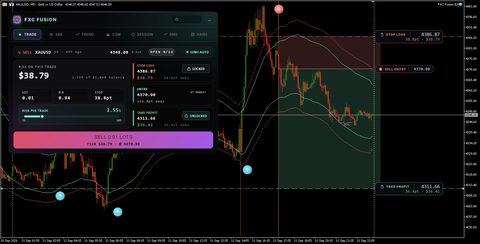
Conclusion
Boring Pips EA appears to be a EA with a strong emphasis on avoiding overfitting, which is a real concern in automated trading. It follows a structured 3-phase optimization method aiming to create more reliable, generalizable strategies. While the Anti OverFitting EA use of “deep learning” and “AI” may just be buzzwords, the general strategy seems grounded in tried and true trading concepts, aiming at slow momentum shifts and supply demand reversals.
As with any EA despite claims, sophisticated language, or perfect historical performance the real test always lies in longterm live results.


Discussion 4 comments
Is this still working?
Earlier checks 1
it doesn’t attach on my chart
Have you tried it in the strategy tester? How was the result?
Looking at the graph above, one pair only had an average of 8-9 transactions per month.
same here, nothing for a week, i guess thats why its called boring pips ea
This Ea , never opening