


BTC Trend EA is an automated trading system built for MetaTrader 5 that trades BTCUSD (Bitcoin) on the H1 timeframe. It pairs trend-direction entries with a recovery grid that adds positions and waits for the whole basket to close in profit. This review covers how the strategy actually works, what its public live signal shows, and a backtest we ran ourselves on the recommended settings, plus a free MT5 download link.
BTC Trend EA is based on the Quantum Bitcoin EA, so the public live signal and backtest charts below appear under that original name. The marketing for the underlying system calls it a “win-sealed grid” that ensures “every trading cycle concludes with a win.” That phrasing is worth unpacking, because a grid that always closes green on balance can still float deep losses on equity before it gets there. The numbers below show exactly where that line sits.
TL;DR – Free MT5 BTCUSD trend robot with grid recovery and no hard stop loss on the basket. Real profit factor (3.34 live, 3.72 in our matched-window backtest) and a ~77% win rate, but a 68% peak drawdown on the live account makes blow-up risk real. At a fixed minimum lot our backtest held drawdown far lower, so the risk you take is mostly the risk you size.
What Is BTC Trend EA?
BTC Trend EA is a free MT5 expert advisor that trades BTCUSD on the H1 chart. It opens a trade in the trend direction, then adds further orders at set distances if price moves against the first entry, holding the group until their combined target is hit. It does not place a hard stop loss on the basket, so risk is managed by position count and lot caps rather than a fixed per-trade loss.
That definition matters because the strategy type drives everything else in this review. A grid (a system that adds positions at intervals and closes them together) trades small, frequent wins against the risk of a rare large loss when price runs one way without retracing. Bitcoin’s volatility is what the EA feeds on, and also what can break a grid if a move is large enough.
Core Strategy and Logic
BTC Trend EA combines a directional entry with grid-based trade management. Reading the trade log from our own backtest makes the mechanics clear: each cycle opens with a comment like QB (Step: 1), and when price moves against it the EA adds Step: 2, Step: 3, and so on, then closes the whole set at once.
- Trend-direction entry – The first order of each cycle is placed in the direction the EA reads as the prevailing trend on H1. In a falling market it shorts; in a rising one it goes long.
- Grid recovery – If price moves against the open position, the EA adds orders at a set distance (90% grid distance in the recommended settings, widening by a 1.4 multiplier each step) up to a cap of 10 trades per cycle.
- Lot progression – Lots start at 0.01 and scale by a 1.2 multiplier, but the default also caps the lot at 1.2, so the progression is mild rather than an aggressive doubling martingale.
- Basket take profit and break-even – The cycle closes when the combined position reaches its target. After a minimum of 3 orders the EA manages the group toward a real break-even rather than holding indefinitely.
- No hard stop loss on the basket – There is no fixed stop protecting the whole grid. This is the core risk and the reason drawdown can run deep before a cycle resolves.
- Time and event filters – Trading is restricted to a daily window (08:00 to 22:30 in the recommended settings) with optional filters to skip Fridays, NFP, and holidays.
The “win-sealed” claim in the marketing is the grid doing its job: because the basket only closes when it is green, almost every closed cycle books a profit, which is why the win rate looks high. The risk does not disappear, it moves from the balance curve to the equity curve while a cycle is open. This is the same trade-off seen in the grid-based Bitcoin Robot Grid EA, which reported a near-100% closed-trade win rate alongside a 47% simulated drawdown.
For a contrast, the no-grid Bitcoin Wizard scalper takes the opposite design choice: a lower win rate (around 71%) and a lower profit factor in exchange for a much smaller 10% drawdown. Neither approach is wrong; they sit at different points on the risk curve.
Please test in a demo account first for at least a week. Also, please familiarize yourself and understand how this Bitcoin EA works, then only use it in a real account.
Recommendations for BTC Trend EA
- Minimum account balance of $1,000. (Work on any balance, but the grid needs room.)
- Works on BTCUSD. (Designed and tested for Bitcoin only.)
- It works best on the H1 timeframe.
- BTC Trend EA should run on a VPS continuously to reach stable results. So we recommend running this Bitcoin robot on a reliable VPS (Reliable and Trusted FOREX VPS – FXVM).
- A low-spread ECN account is recommended, since wide BTCUSD spreads eat into a grid that opens many orders (Find the Perfect Broker For You Here).
Because the EA holds positions for an average of about a day, swap costs matter. Budget for them when you pick a broker. Traders who want a directional grid on a different asset can compare the approach with the MT5 XAUUSD Trend Grid EA.
Key Features of BTC Trend EA
- Platform – MetaTrader 5 only (no MT4 build).
- Asset and timeframe – BTCUSD on H1.
- Strategy – Trend-direction entry with grid recovery.
- Lot control – Fixed starting lot with a capped multiplier, or an auto-risk mode.
- Event filters – Optional skip of Friday, NFP, and holiday sessions.
- On-chart panel – A status panel shows cycle step and break-even level.
Performance Review: Live Data and Our Backtest
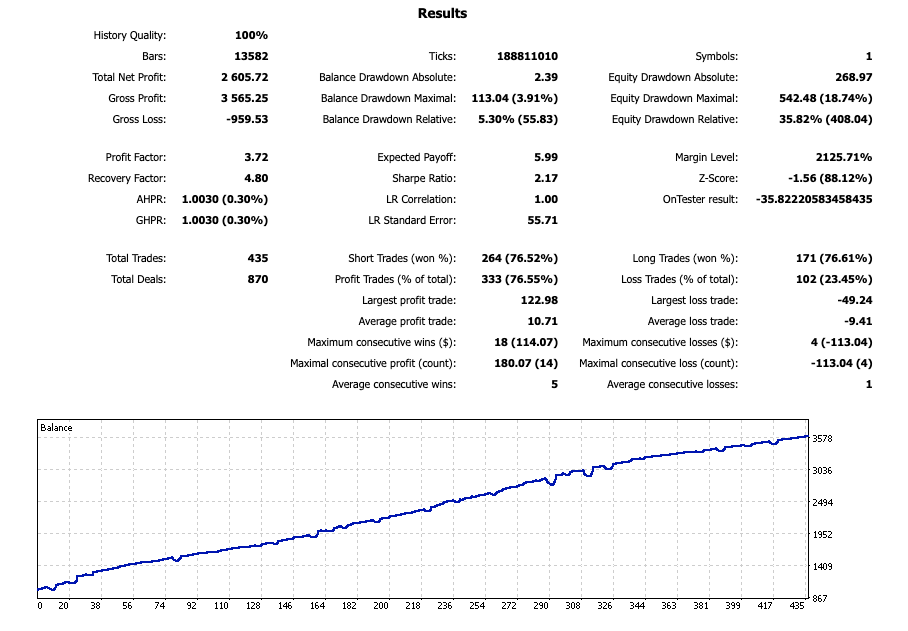
There are two data sources here: the vendor’s public Myfxbook signal, and a backtest we ran ourselves on a Tickmill demo with 100% real-tick history. To compare like with like, we ran the backtest over the same window as the live signal (2024-11-15 to 2026-06-09) on the same recommended v3.2 settings with auto-lot disabled, which is how the live account appears to have run.
A word of caution before the numbers: this is not a one-to-one replica. The live account took mid-period deposits and withdrawals and likely had setting changes along the way, and a real account also pays slippage, spread, and swap that a tester models imperfectly. Treat the backtest as a clean fixed-lot reference for the strategy’s behaviour, not a prediction of the live curve.
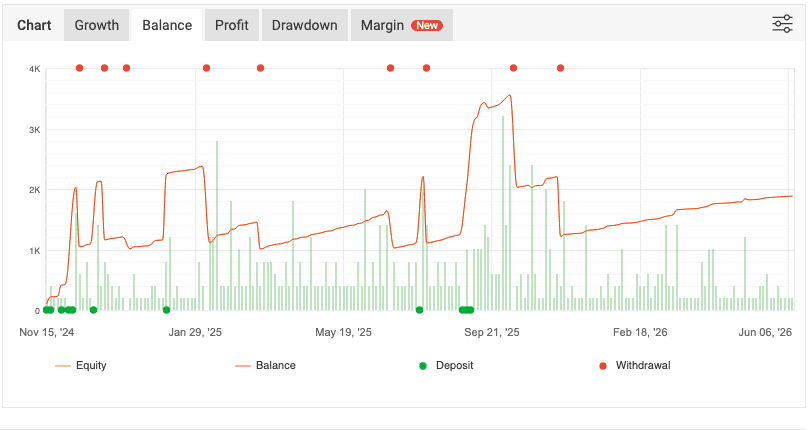
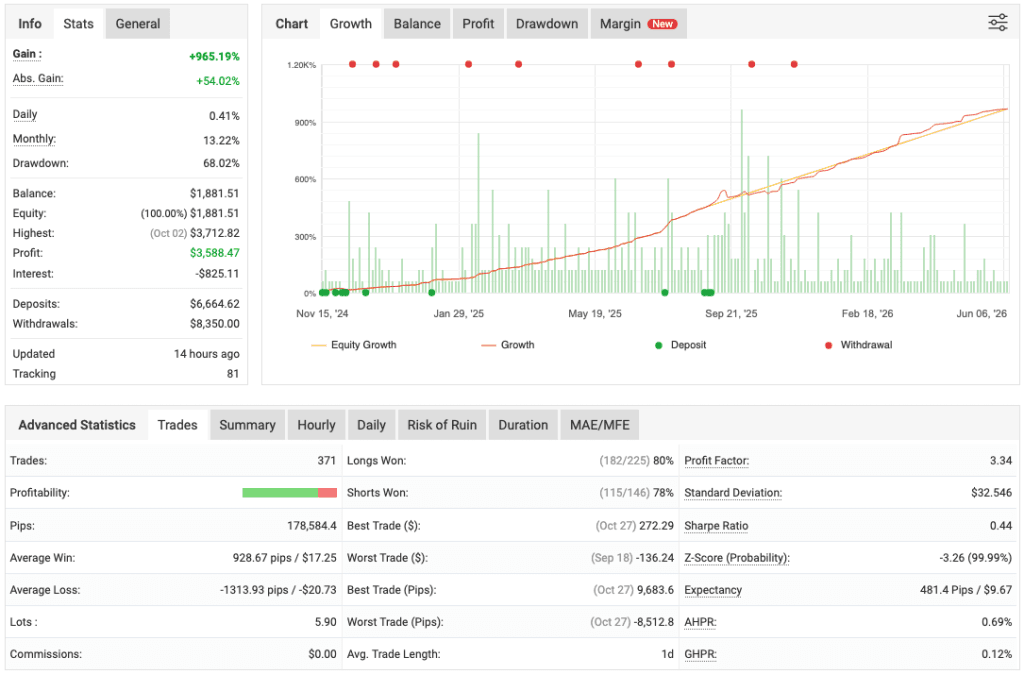
You can verify the live data yourself on the public Myfxbook signal page
(captured 2026-06-10 for the screenshots in this review).
| Metric | Live (Myfxbook) | Our Backtest (matched window) |
|---|---|---|
| Period | Nov 2024 – Jun 2026 (~19 mo) | Nov 2024 – Jun 2026 (~19 mo) |
| Net profit | $3,588 on $6,664 deposited | $2,606 on $1,000 (fixed 0.01 lot) |
| Profit factor | 3.34 | 3.72 |
| Win rate | ~79% (297 / 371) | 76.55% (333 / 435) |
| Max drawdown | 68.02% | 18.74% equity (3.91% balance) |
| Sharpe ratio | 0.44 | 2.17 |
| Avg win / avg loss | $17.25 / -$20.73 | $10.71 / -$9.41 |
| Trades | 371 | 435 |
1. Growth and Returns
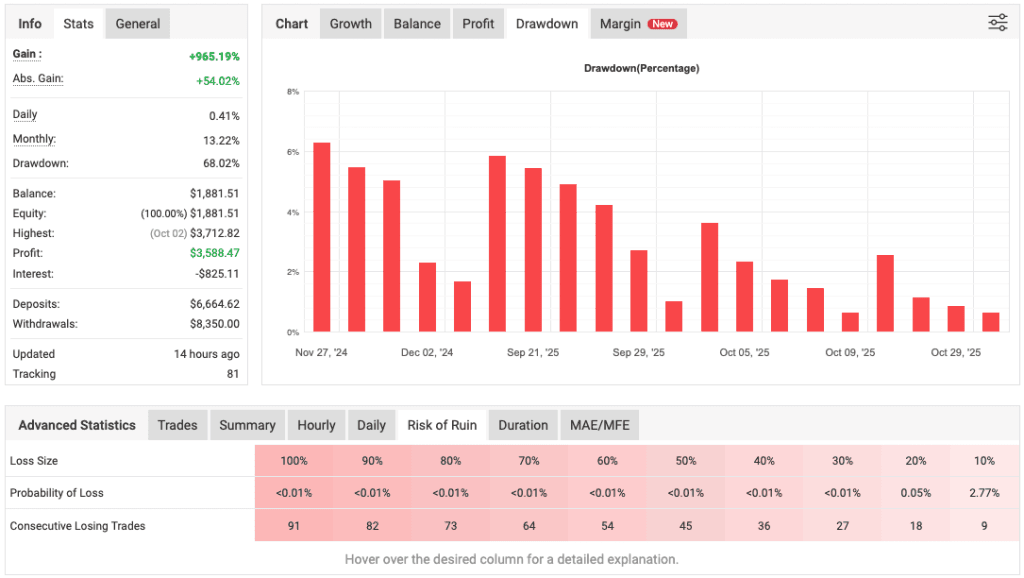
The live account’s headline “+965% gain” is a compounding figure distorted by deposits and withdrawals, so it overstates what the strategy returned. The honest live number is the absolute gain of 54%, which lines up with $3,588 of net profit against $6,664 in total deposits over 19 months. Our matched backtest, on a flat $1,000 with no top-ups, returned $2,606 (about 260%) over the same period at the smallest possible lot. The two are not directly comparable because of the live account’s cash flows, but both confirm a real, sustained edge across the full 19 months.
One more line from the stats panel deserves its own sentence. The signal deposited $6,664.62 across the tracking period and withdrew $8,350.00, with the red withdrawal markers visible along the top of the growth chart. Whoever runs this account has already taken out more money than they put in, which is rarer than any gain percentage in this niche. Read the two gain figures together too: +965% is the time-weighted number the chart headline shows, while the absolute gain on the money actually deposited is +54%. Both are real, they just answer different questions.
2. Win Rate vs. Risk Ratio
The win rate matches closely between the two: 76.55% in our backtest and about 79% live. The profit factors are also close (3.72 vs 3.34). That agreement is the useful part, because it suggests the live signal is doing roughly what the strategy does in a clean test, not relying on something the tester can’t see. The catch is the same in both: the average dollar loss is near or above the average win, so the high win rate is what carries the system. Expectancy stays positive (about $9.67 per trade live, $5.99 in the backtest).
3. Drawdown: The Risk You Take Is Mostly the Risk You Size
This is the most important section. In our fixed-lot backtest the balance drawdown was only 3.91%, while the equity drawdown reached 18.74% (max by money) and 35.82% on a relative basis. That gap is the grid’s signature: closed trades look almost flawless, but open baskets floated real losses before recovering. The live account ran much hotter, with a 68% maximum drawdown (the largest peak-to-trough equity drop on record).
The difference between an ~19-36% backtest drawdown and a 68% live drawdown is the headline lesson. At the minimum 0.01 lot the grid stays contained; the live operator clearly sized larger or changed risk settings, and the drawdown roughly doubled. The strategy’s risk scales with your lot settings, so size is the main dial you control.
4. Trade Behaviour and Direction
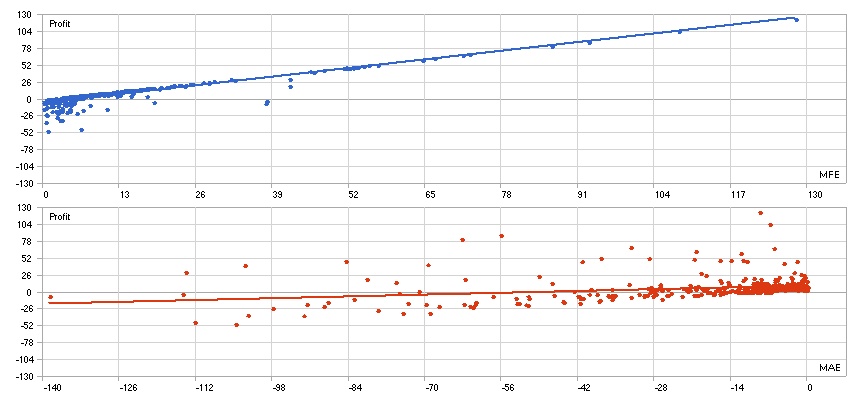
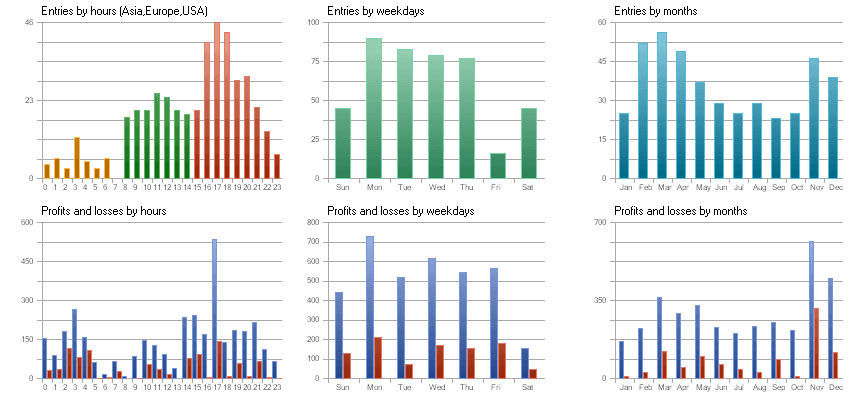
The matched backtest took both directions, 264 shorts and 171 longs, with near-identical win rates on each (76.5% short, 76.6% long). That mirrors the live account’s mix (225 longs, 146 shorts) and confirms the entry is genuinely directional rather than a fixed bias. It also means results depend on the market regime during your run; a one-way trend feeds the grid, while violent two-way chop is where a no-stop grid is most exposed.

Two more notes on the live account. The Z-Score of -3.26 (99.99% significance) shows trades are not independent; they cluster into streaks, exactly what a grid does when it opens and closes several orders together. And the -$825 of swap interest is a real cost of holding positions for an average of roughly a day.
BTC Trend EA

A free MT5 trend robot for BTCUSD that enters with the trend on H1 and stacks positions until a basket closes in profit. Strong profit factor, high win rate, high drawdown.
Pros
- Real live signal with 19 months of history, not just a backtest
- High profit factor on both live (3.34) and our own test (3.70)
- Win rate near 80% across 371 live trades
Cons
- 68% maximum drawdown on the live account
- Grid with no protective stop on the basket; a strong adverse trend can stack losers
- Built only for BTCUSD, so no diversification across pairs
- Swap costs add up because positions are held for days
Summary
BTC Trend EA has a genuine edge on BTCUSD, confirmed by both a 19-month live signal and our own real-tick backtest over the same window. The grid recovery keeps the balance curve smooth, and at a fixed minimum lot the drawdown stayed contained. The 68% peak drawdown on the live account came from running it harder, so this suits traders who accept grid risk and size conservatively, not anyone looking for a safe set-and-forget robot.
EA-vs-EA Comparison
| BTC Trend EA | Bitcoin Robot Grid EA | Bitcoin Wizard | |
|---|---|---|---|
| Strategy | Trend grid | Grid | Scalper |
| Max drawdown | 68% (live) | ~47% (sim) | ~10% |
| Profit factor | 3.34 (live) | high | 1.61 |
| Win rate | ~79% | ~100% (closed) | ~71% |
| Grid / Martingale | Grid (capped lot) | Grid | No |
| Pair | BTCUSD | BTCUSD | BTCUSD |
| Platform | MT5 | MT4 | MT4 |
Sources: each competitor’s published review on this site. The pattern is clear: the two grid systems post high win rates and high profit factors with large drawdowns, while the Bitcoin Wizard scalper trades a lower edge for far better drawdown control. The same Quantum family logic appears on forex pairs in the Quantum AUDCAD Grid Bot if you want to see how the approach behaves outside crypto.
Frequently Asked Questions (FAQ)
Quantum Bitcoin EA Verdict: Should You Run BTC Trend EA?
BTC Trend EA is a competent BTCUSD trend robot with a real edge, confirmed across both a public 19-month live signal and our own real-tick backtest over the same window, where the win rate (77%) and profit factor (3.72) lined up closely with live. However, its smooth balance curve hides the actual risk; the gap between a 3.91% balance drawdown and an 18.74% equity drawdown at fixed lot, against a 68% peak drawdown on the live account, shows how fast the risk grows when you size up. It is a reasonable free download for experienced traders who respect grid mechanics and keep lots small, but it is not a safe set-and-forget system for a small or untouchable account.


Discussion no comments yet
Is this still working?
Nothing here yet
No one has asked anything about BTC Trend EA Free Download: Quantum Bitcoin EA Strategy Revi yet. First question gets answered.