

Session Range Breakout EA is an automated MetaTrader 5 (MT5) robot that trades five markets from one chart: XAUUSD (gold), USDJPY, BTCUSD, US30 and DE40. It is a range breakout system. Each market gets its own range drawn over a quiet stretch of the day, the EA buys or sells when price leaves it, and anything still open is closed that evening. For this 2026 review we ran a 23-month backtest on the default settings over the same dates as the live account and read all 1,976 trades. Free download at the bottom.
TL;DR – Free MT5 range breakout robot for five markets. One trade per market per day, a stop on every trade, no grid or martingale. The live account and our test agree on a thin edge that leans on a few big gold days, and on $1,000 gold carries most of the risk.
What is the Session Range Breakout EA?
Session Range Breakout EA is a MetaTrader 5 expert advisor that draws a price range for five markets during fixed quiet hours and opens a market order when price breaks out of it. The stop sits at the far side of the range, there is no take profit, and the trade closes at a set time the same day. No grid, no martingale, no indicators.
Core Strategy and Logic
We ran it with the default One Chart Setup, which trades all five markets from a single chart, and read all 3,952 orders. The sales page gives the idea: quiet Asian hours, then a volatile London open. The log gives the rules.
- One range per market, one trade per day – Each market has its own range window, and the EA takes at most one breakout per market per day. USDJPY is the exception. When its first breakout is stopped out, it takes the break in the other direction, which happened on 62 days.
- Market order on the break, stop at the far side – Entries are market orders, not pending stops. The first stop sits at the opposite edge of the range, so a wide morning range means a wide stop.
- No take profit – Not one of the 1,976 trades had a target. Winners come from the scheduled close, which made +$7,589 across 713 trades, and from a trailing stop that locked in +$1,670 on 266 trades. Stops that closed at a loss took back $6,805.
- Trailing on the indices only – DE40 and US30 pull the stop along minute by minute once a trade moves. Gold, USDJPY and BTCUSD never touch their stop and hold until it is hit or the close arrives.
- The randomizer is a clock shift – At 01:00 each day the EA rolls a number from 0 to 10 for every market and shifts its timing by up to 10 minutes. Two of our runs with identical inputs finished $225 apart ($2,453.90 and $2,228.66).
| Market | First breakouts | Scheduled close | Trailing stop | Days with a trade | Closed on schedule |
|---|---|---|---|---|---|
| XAUUSD | from 07:12 | 20:00-20:11 | No | 57% | 81% |
| USDJPY | from 06:41 | 18:21-18:30 | No | 58% | 72% |
| BTCUSD | from 04:41 | 20:51-21:00 | No | 83% | 33% |
| DE40 | from 09:22 | about 22:30 | Yes | 95% | 4% |
| US30 | from 13:51 | about 23:25 | Yes | 98% | 16% |
Times are server time on a UTC+2/UTC+3 broker, which is what the EA is built for. The “range filter” in the product name shows up as skipped days: gold and USDJPY sit out about 4 days in 10, while the indices trade almost every session. The London story fits loosely. Gold and USDJPY start taking breakouts 2 to 3 hours before London opens at 10:00 server time, and each index runs a window of its own. Our forex market hours guide converts these to your own clock.
The idea is the classic Asian breakout strategy run on five markets at once. It is a simpler relative of the five-strategy Gold Pivot Breakout EA, and the opposite of the Asian Session Scalper EA, which trades inside the quiet hours this EA only measures. We have also covered a single-pair USDJPY range breakout day trader.
Please test in a demo account first for at least a week. Also, please familiarize yourself and understand how this Zerqon EA works, then only use it in a real account.
Recommendations for the Session Range Breakout EA
- Broker time – The windows assume a UTC+2/UTC+3 server, which most large MT5 brokers use. On any other clock the ranges land in the wrong hours.
- Minimum deposit – $1,000 runs, and it is what we tested. But gold cannot go below 0.01 lots, so each gold trade risks about 1.9% at that size. For gold to match the 0.3-0.4% the other markets risk, the account needs about $10,000.
- Symbols – Your broker needs all five. Change the symbol names in the One Chart Setup inputs if yours uses GER40 or DJ30.
- Switch the guards on – The spread filter and the equity drawdown cut-off (preset to 4%) both ship off.
- Account and VPS – A raw-spread ECN account and a VPS, since the EA trails index stops every minute and closes trades on a schedule until about 23:30 server time (FXVM).
- Work gold’s median $39 stop per 0.01 lot and the 24% drawdown against your own balance with the lot size optimizer and the drawdown calculator (Find the Perfect Broker For You Here).
Performance Review: Live Signal and Our Own Backtest
1. The live account, read in dollars
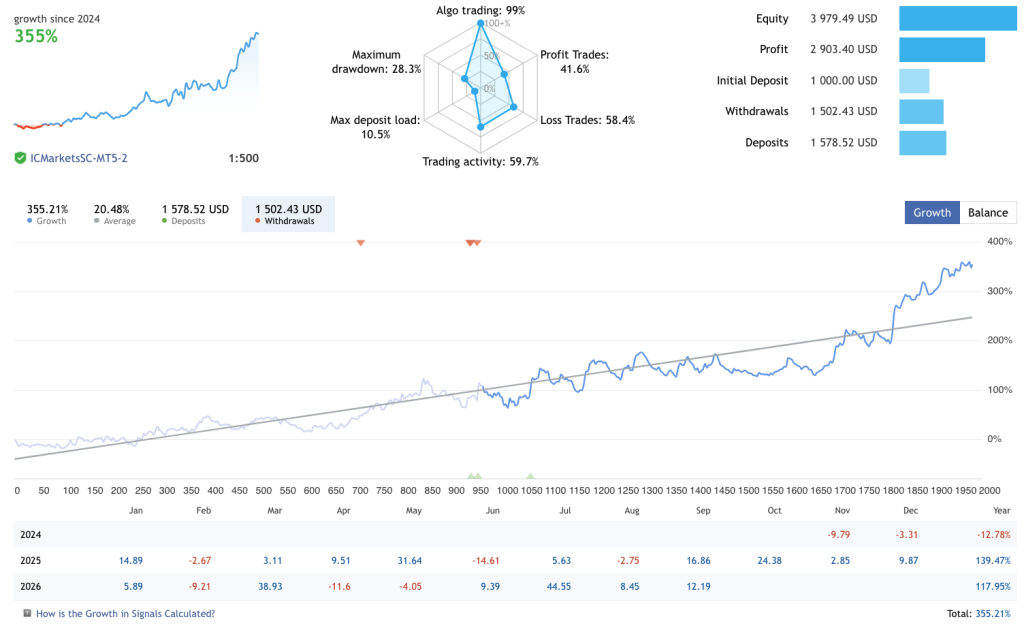
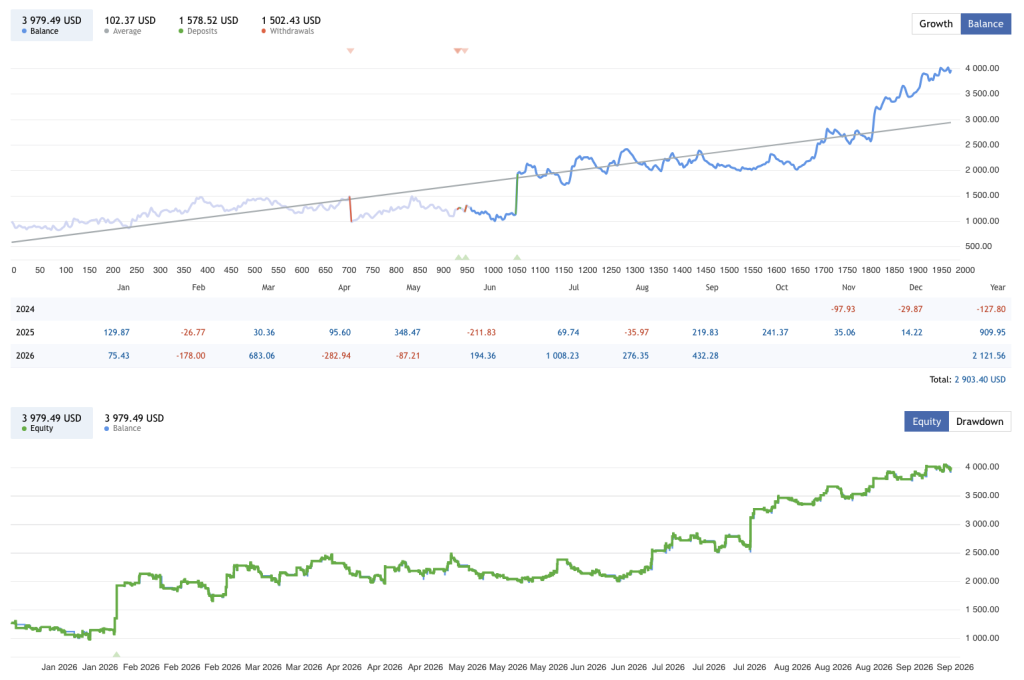
MQL5’s growth figure is chain-linked around every deposit and withdrawal, and this account has had both, so read it in dollars. The account made $2,903 of profit on $2,579 deposited in total, and $1,502 has already come back out. It has 0 subscribers at $49 a month.
MQL5 lists the signal as started on 1 January 2026, and its equity and drawdown charts begin there, so the equity drawdown figure covers about nine months. The 28.29% balance drawdown is the number that spans the whole record.
2. Our matched backtest
| Metric | Live signal | Our backtest |
|---|---|---|
| Period | Nov 2024 to 26 Sep 2026 | 1 Nov 2024 to 26 Sep 2026 |
| Money in / out | $2,578.52 in, $1,502.43 out | $1,000 in, nothing out |
| Closed trades | 1,978 | 1,976 |
| Long / short | 1,043 / 935 | 1,050 / 926 |
| Net profit | +$2,903.40 | +$2,453.90 |
| Profit factor | 1.17 | 1.30 |
| Max balance drawdown | 28.29% | 24.14% |
| Worst trade | -$141.93 | -$52.73 |
| Longest losing run | 17 trades | 19 trades |
| Losing months | 8 of 23 | 4 of 23 |
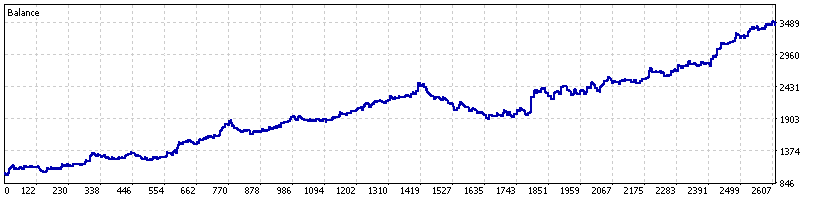
The totals line up closely, and so do the big months. May 2025, September and October 2025, March 2026 and July to September 2026 were strong in both records, and 14 of 23 months point the same way. The biggest miss is at the start, where our first two months ran on generated ticks and made money while the live account lost in both.
Underneath the totals the mix differs. The live account took 573 USDJPY trades to our 347 and about 90 fewer on each index, and its worst trade is almost three times ours. The listing doesn’t say which risk level or settings the account runs, so we won’t guess at the cause.
3. Which markets carry it
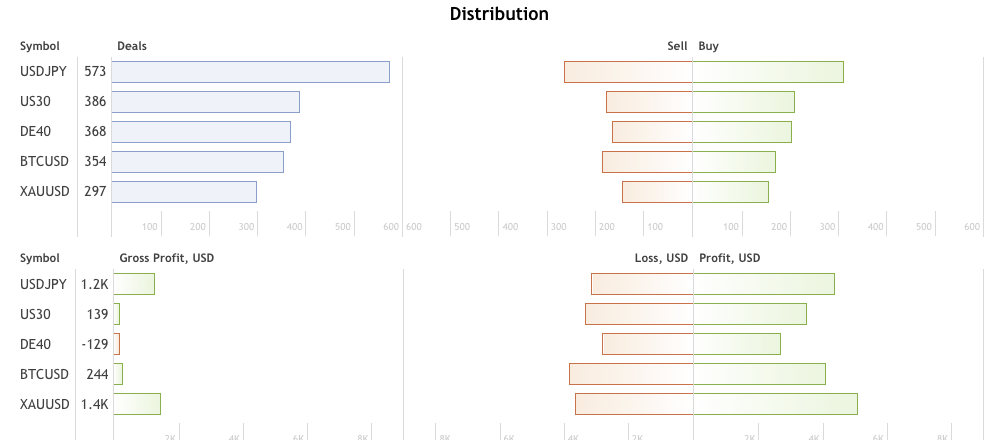
| Market | Trades | Net profit | Profit factor | Share of our profit |
|---|---|---|---|---|
| XAUUSD | 281 | +$1,399.09 | 1.45 | 57% |
| BTCUSD | 407 | +$451.15 | 1.26 | 18% |
| USDJPY | 347 | +$298.92 | 1.31 | 12% |
| DE40 | 463 | +$228.42 | 1.22 | 9% |
| US30 | 478 | +$76.32 | 1.06 | 3% |
Gold made more than half of our test’s profit on the fewest trades, and on the live account gold and USDJPY made about nine dollars in every ten. The two indices took 941 of our 1,976 trades and returned $305, and live, DE40 is net negative. Most of the trading happens on the markets that make the least money. We found a version of this in the five-pair FX Portfolio EA, where three of the pairs moved as one currency bloc.
4. The minimum-lot problem on small accounts
This is the finding that matters most on a $1,000 account. The EA sizes each market from the balance and the risk level, but it cannot go below the broker’s 0.01 minimum. In our test gold never left 0.01 lots for 23 months and BTCUSD almost never did, while the DE40, US30 and USDJPY lots moved from trade to trade.
Measured from the stop at entry, gold risked a median 1.92% of the balance per trade. The other four markets risked 0.29% to 0.43%. Each gold trade carried about five times the risk of anything else in the portfolio, which is why gold made 57% of the profit and why its own worst run cost $493 against a $603 worst drawdown for the whole account.
A gold stop at 0.01 lots cost a median $39 in our test. For that to be around 0.4% of the balance, the account has to hold about $10,000. Below that, the five-market portfolio on the sales page is mostly a gold robot with four smaller markets alongside. Nothing in the code is wrong here. The minimum lot does it, and it changes what you are buying on a small account.
5. A handful of gold days make the year
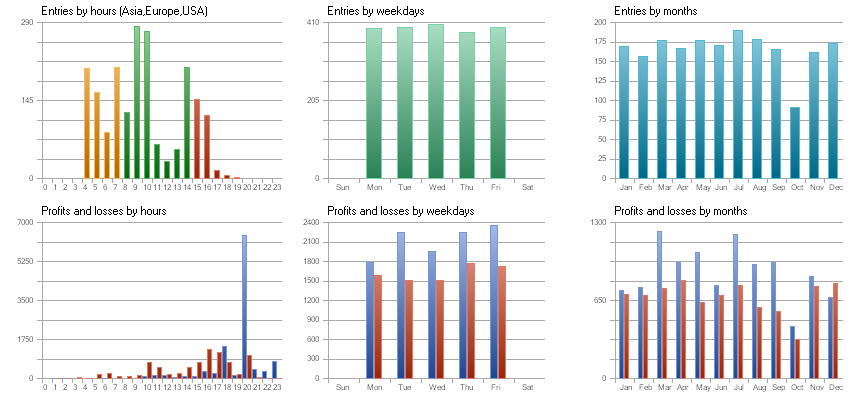
The best 10 of our test’s 489 trading days made $1,332, or 54% of the net profit, and 9 of the 10 biggest trades were gold. Take out the 20 best trades and $2,454 of profit becomes $674. MQL5 reports the same shape on the live account, noting that 80% of its growth came in 10 days out of 675.
That is how a breakout system with no target is meant to work: many small stops, and a few days where gold trends from the morning break into the evening close. What it asks of you is patience. From 14 November 2025 to 22 April 2026 our test went 158 days without a new balance high, with the 24% maximum drawdown landing on 20 January 2026. Anyone who started at that November high waited five months to get back to it.
Can you use the Session Range Breakout EA on a prop firm account?
The listing calls it prop firm ready, and some pieces are there: a stop on every trade, no hedging, a daily equity cut-off and a randomizer it sells as prop firm friendly. At the defaults we tested, it would still have broken the overall loss limit. The worst closed day on real ticks was -3.2% and the worst week -6.9%, which a 5% daily rule survives. The 24% maximum drawdown is more than twice the 10% overall limit at FTMO and most firms, and the cut-off ships switched off.
A challenge account is larger, so gold would no longer be stuck at the minimum lot, but the drawdown still has to come down by more than half. Run the lowest risk level, switch the 4% cut-off on, and read our prop firm trading strategies guide first.
Session Range Breakout EA
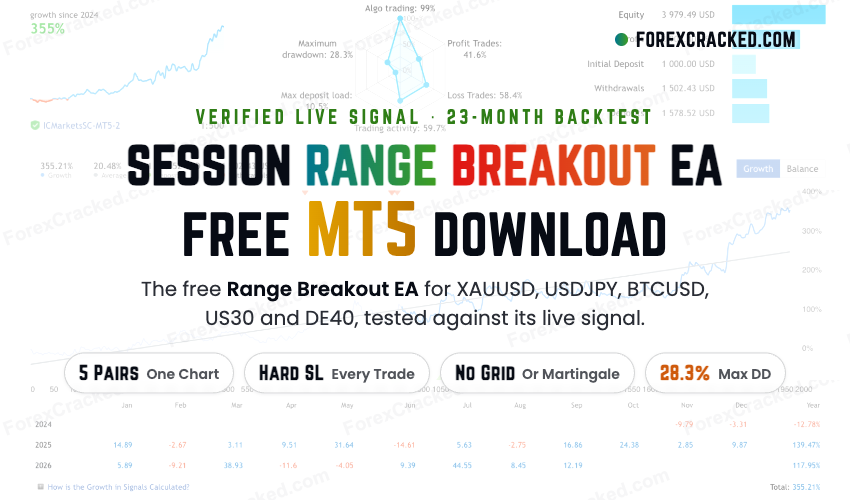
An MT5 range breakout robot that trades XAUUSD, USDJPY, BTCUSD, US30 and DE40 from one chart, one trade per market per day, closed the same day. Its 23-month live account and our matched backtest both land on a profit factor between 1.17 and 1.30.
Pros
- All 1,976 trades in our test had a stop loss at entry, with one position per market and no averaging or recovery
- The logic can be checked against a clock: fixed session windows, same-day closes and no indicator calls anywhere in the tester log
- The live account and our test agree on total trades, the long/short split, which markets pay and the biggest months
- Nearly two years of live account history across five markets, losing months included
Cons
- Profit factor of 1.17 live and 1.30 in our test, with 8 losing months out of 23 on the live account
- On $1,000, gold sits at the 0.01 minimum lot and risks about 1.9% per trade against 0.3-0.4% on the other markets
- The best 10 days made 54% of our test's profit, and the balance went 158 days without a new high
- The spread filter and the equity drawdown cut-off both ship switched off, and US30 and DE40 add trades more than profit
Summary
The mechanics are honest and easy to check: a box per market, a market order on the break, a stop at the far side and a same-day close. The developer's account and our test reached similar results over the same months. What they share is a thin edge. Most of the profit comes from a handful of gold trend days, and on a small account gold is the only market sized big enough to matter.
 Built by ForexCrackedWe tested 1,200+ indicators. Then we built our own.Six years of reviewing EAs and indicators went into FXC Fusion: two engines, the seven-panel cockpit, MT4 and MT5, from the team behind this site.
How it compares to other session and multi-market robots we have tested
| Session Range Breakout EA | FX Portfolio EA | Asian Session Scalper EA | Gold Pivot Breakout EA | |
|---|---|---|---|---|
| Markets | Gold, USDJPY, BTCUSD, US30, DE40 | 5 forex pairs | 10 forex pairs | XAUUSD only |
| Entry | Session range breakout | Indicator rule sets, H1 | Night-time mean reversion | Five pending-stop breakouts |
| Live profit factor | 1.17 | 1.35 | 3.13 | 1.56 |
| Live max drawdown | 28.29% balance | 23.9% balance | 24.61% equity | 10.52% balance |
| Live sample | 1,978 trades, ~23 months | 225 trades, ~5 months | 457 trades, ~3 years | 488 trades, ~6 months |
Session Range Breakout EA has the thinnest live profit factor of the four and the most trades behind it.
Frequently Asked Questions (FAQ)
Conclusion
Session Range Breakout EA does what its timetable says. Every trade has a stop, it never averages into a loser, and our test over the same 23 months landed close to the developer’s live account on trade count, direction and the months that mattered. However, the edge is thin, it comes mostly from a few gold trend days, and on a $1,000 account each gold trade carries about five times the risk of any other market. It suits a patient trader with a UTC+2/UTC+3 broker and a balance near $10,000 who switches the spread and drawdown guards on and judges it by the year.


Discussion no comments yet
Is this still working?
Nothing here yet
No one has asked anything about Session Range Breakout EA MT5 yet. First question gets answered.