


Mavrik Scalper EA is a MetaTrader 5 (MT5) expert advisor that scalps XAUUSD (gold) on the M5 chart and was sold on the MQL5 Market as an “AI-driven” system built on a “Hybrid Attention neural network”. Its public MQL5 signal has turned a $500 account into $1,173.57 in 2026 with no deposits or withdrawals along the way. We ran a 100% real-tick backtest over the same window, on the same $500, and read all 1,021 trades it placed to see what the neural network does when it trades. The free download is at the bottom of this review.
TL;DR – MT5 gold scalper with a five-month live account that our real-tick test reproduces almost trade for trade. Fixed 0.01 lots, a $38 hard stop on every position, no grid, no martingale. But the “AI” fires on a fixed 15-minute timetable in the London morning, takes about $1 per win against that $38 stop, and stayed short through a $600 gold rally. One stop erases about 29 average wins.
What is the Mavrik Scalper EA?
Mavrik Scalper EA is a MetaTrader 5 expert advisor for XAUUSD that opens a market order at the start of every 15-minute bar between 10:00 and 13:45 server time, in one direction per day, up to four positions at a time. Each position carries a fixed $38 stop loss on 0.01 lots and is closed by a trailing stop that usually locks about $1 within two minutes. It has no grid, no martingale and no averaging.
Core Strategy and Logic: What the Log Says the Neural Network Does
The sales page describes a Hybrid Attention model that “dynamically focuses on the most relevant market information”. We cannot see inside the model. What we can see is every order it sent across 37,131,584 real ticks on a Tickmill demo, MT5 build 6182, from 1 April to 21 September 2026, and the pattern is not subtle.
- A fixed 15-minute timetable – All 1,021 entries opened at exactly :00, :15, :30 or :45, at second zero, between 10:00 and 13:45 server time. That is 16 possible slots a day. Tickmill’s server clock runs at UTC+3 in summer, so the window is 08:00 to 11:45 in London, and it closes before New York opens.
- One direction per day – The EA never mixed buys and sells inside a day. It was short on 80 of the 85 days it traded and long on 5 (23 April, 4 and 5 June, 30 June and 14 July). All 55 long trades won.
- Not every slot fires – 123 weekdays fell in the window, the EA traded on 85 of them, and on 36 it fired all 16 slots. Of the 947 slots it left unused, only 25 were blocked by the four-position cap. The other 922, including 38 entire days, were skipped by a filter the log cannot show.
- A $38 stop, and a trail that wants $1 – 16 of the 17 losses closed at exactly $38.00 from entry plus slippage. Not one of the 1,021 trades closed at a take profit. Every exit was a stop-loss line: 645 of the 1,004 wins locked between $0.95 and $1.35, only 67 made $2 or more, and the two largest made $10.79 and $10.24.
- Fast when it wins, slow when it loses – Median holding time was 110 seconds, and 372 trades closed inside a minute. The 17 losses were held for a little over three hours on average. A short that has not paid its dollar sits there until gold either comes back or reaches the stop.
- Up to four positions, all the same way – 578 entries opened with nothing else open. When gold moves against the day’s bias they pile up: 283 opened with one already open, 114 with two and 46 with three. Four positions on 0.01 lots is $152 of stop risk at once, and the three-stop streaks in both records were a stack of shorts hit by one move.
None of this says the model is fake. It says its output is a timetable and a daily bias, which is worth knowing when point 6 of our 12-point EA scam checklist is the “AI / neural network” marketing layer. In shape it is nothing like the one-position breakout scalper in Gold Tripwire and very like the news mean-reversion robot we covered in August, which also buys its hit rate with a stop many times its target.
Please test in a demo account first for at least a week. Also, please familiarize yourself and understand how this Zerqon EA works, then only use it in a real account.
Recommendations for the Mavrik Scalper EA
- Minimum deposit – The vendor says $500 and the live account runs $500 at an effective 0.01 lots. Four open positions is $152 of stop risk, 30% of that balance, and the worst day in our test cost $101.52. On $1,000 the same stack is 15%.
- Leverage – Gold near $4,400 needs about $44 of margin per 0.01 lot at 1:100 and about $147 at 1:30. Four positions at 1:30 is roughly $590, more than the $500 minimum, so the vendor’s own floor only works at 1:100 or higher. The live account’s 17.31% peak deposit load is consistent with four 0.01-lot positions margined near 1:100 on a balance around $1,000.
- Pair, timeframe and server time – XAUUSD on M5, as the vendor says. The window we measured is 10:00 to 13:45 on a UTC+3 server with
InpGMTOffsetHoursat 0. On a broker with a different clock, set the offset, then watch on demo which hours it actually trades. - Account type – Raw spread or ECN. The average win is $1.24, the round-trip commission was already $0.06 of it, and every extra $0.10 of gold spread is another 8% gone.
- VPS – The trail is modified from the terminal within seconds of entry, so it needs a machine that is always on (FXVM).
- Put the $38 stop and the $152 four-position stack against your own balance in the lot size optimizer and the drawdown calculator (Find the Perfect Broker For You Here).
Performance Review: Live Signal and Our Own Matched Backtest
1. The live account, and what 134.71% does and does not tell you
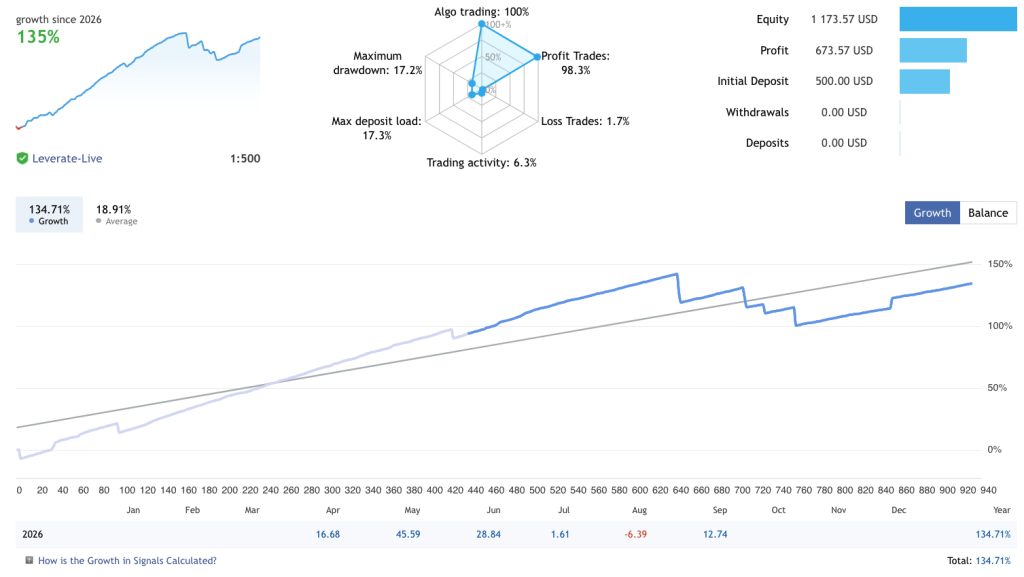
For once the growth figure is not distorted by cash flow: $500 went in on day one, nothing has been added or taken out, and the balance is $1,173.57. That is the honest headline, and a good one for five and a half months. What it hides is the shape of the return: the account has an open position 6.32% of the time, and it wins in ones and loses in thirty-eights.
Its two drawdown readings also measure different things. 17.22% by balance is the peak-to-trough fall from late July to late August. 8.58% by equity is the deepest floating loss on open positions at any one moment, about two and a half stops’ worth. The signal is listed at $999 a month and has no subscribers.
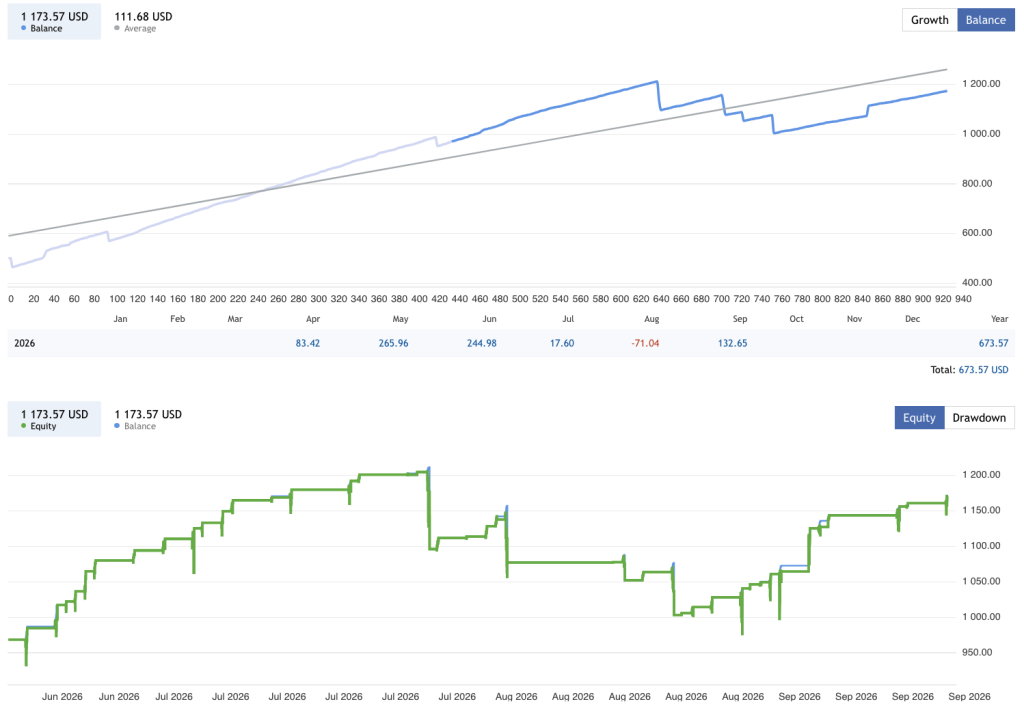
| Month, 2026 | Live account (0.01 lots effective) | Our test (fixed 0.01 lots, after commission) |
|---|---|---|
| April | +$83.42 (partial month) | +$55.86 |
| May | +$265.96 | +$250.48 |
| June | +$244.98 | +$263.15 |
| July | +$17.60 | +$38.58 |
| August | -$71.04 | -$118.23 |
| September, to the 21st / 18th | +$132.65 | +$110.03 |
| Total | +$673.57 | +$599.87 |
Five green months and one red on both sides, May and June within $20 of each other, and July thin on both. August is the month that matters, and both records lost there.
2. Our matched real-tick test
| Metric | Live signal ($500, Leverate-Live, 1:500) | Our backtest ($500, Tickmill demo, 1:100) |
|---|---|---|
| Period | April to 21 Sep 2026 | 1 Apr to 21 Sep 2026 (last trade 18 Sep) |
| Closed trades | 932 | 1,021 |
| Long / short | 54 / 878 | 55 / 966 |
| Net profit | +$673.57 | +$599.87 |
| Profit factor | 2.59 | 1.93 |
| Expected payoff per trade | $0.72 | $0.59 |
| Average win / loss | $1.20 / -$26.49 | $1.24 / -$36.34 |
| Best / worst trade | +$40.13 / -$42.85 | +$10.79 / -$41.64 |
| Longest winning / losing run | 325 wins / 3 losses (-$116.57) | 283 wins / 3 losses (-$115.01) |
| Max drawdown | 17.22% balance ($208.68) | 20.59% balance ($240.39), 22.39% equity |
| Average holding time | 23 minutes | 22 minutes 21 seconds |
| Recovery factor | 3.23 | 2.31 |
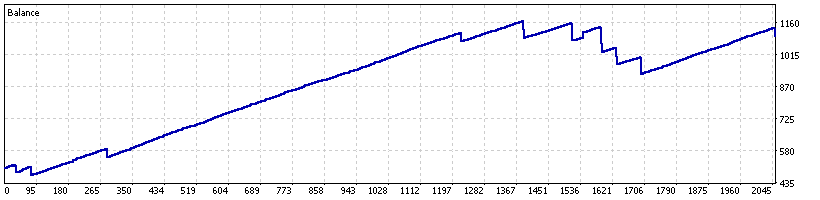
Four rows settle that the live account is running this file as shipped: 54 longs against our 55, a worst trade of -$42.85 against our -$41.64 (both the $38 stop plus slippage), a worst streak of three stops at -$116.57 against our -$115.01, and an average win of $1.20 against $1.24. Two brokers, two tick feeds, the same machine.
Where they part is the size of the losses. The live average loss is $26.49 against a fixed $38 stop, so a share of the live losses closed early, by a filter we cannot see or by the trail slipping through at a small loss, as one of ours did at -$0.50. That is most of the gap between a 2.59 and a 1.93 profit factor, and it makes our test the harsher record.
3. The payoff: one stop costs 29 wins
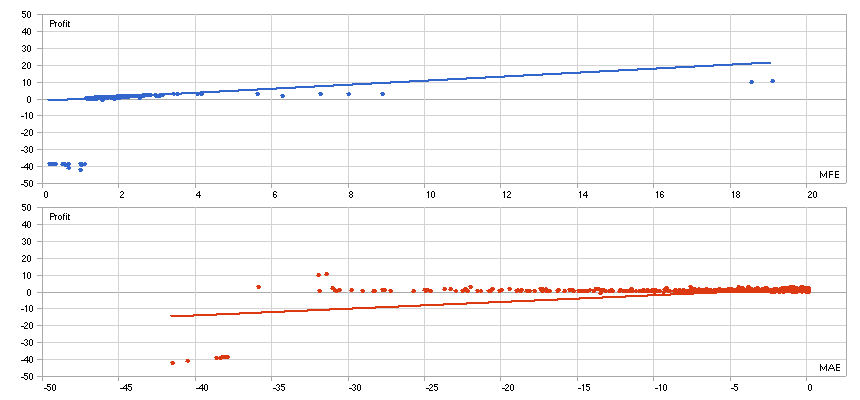
The average win in our test was $1.24 and the average loss $36.34. Divide one by the other and you have the number that runs this system: 29 to 1 against you on every trade. The break-even strike rate for that payoff is 96.70%, and the EA delivered 98.33%, which is 17 stops in 1,021 trades where 34 would have made it flat. Seventeen more stops, one every seven trading days, and the account is flat.
The news mean-reversion robot we reviewed runs the same trade at 10 to 1 and we called that thin. This is nearly three times as lopsided, and it makes the spread the second biggest risk here: the $0.06 commission is already 5% of the average win, and a broker quoting gold $0.20 wider takes another 16% off every winner without touching the losers.
4. Where the stops live: after the window, at 08:30 New York
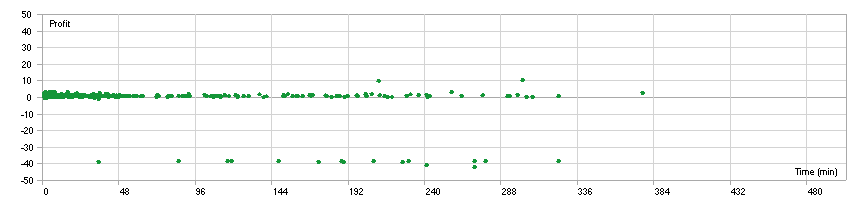
The window closes at 13:45, but the positions do not. 87 of the 1,021 trades were still open at 14:00 server time, and between them they lost $426.92; the other 934 made $1,088.05. A short that has not paid its dollar inside the window rides the New York open with a $38 stop, and 15 of the 17 stops were hit after 13:45.
Eight of them were hit between 15:00 and 15:40. That is 08:30 in New York, the minute US data lands. Both stops on 7 August, the first Friday of the month, closed at 15:30:02 with $3.61 and $2.61 of slippage on top of the stop. Three shorts on 14 August closed at 15:00, 15:22 and 15:30:00 for the test’s worst day, -$101.52.
The same minute cut the other way on 12 August, when two shorts rode the CPI drop to the test’s two biggest wins, $10.79 and $10.24, even after fills $5.06 worse than their trailed stops.
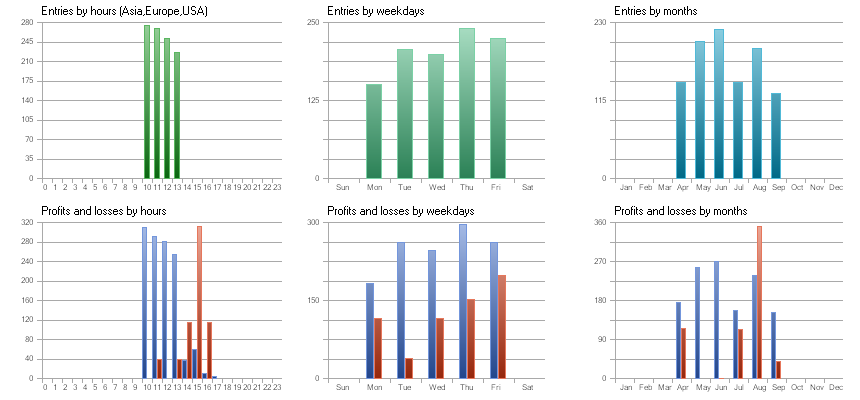
The news filter ships switched off, and the tester cannot run one in any case, so the live account may be avoiding some of this. Its August was still red. What the timing changes is how you size: the worst hour is one the EA does not trade in, holding up to four positions it opened three hours earlier.
The day-level result is almost mechanical. A clean 16-slot day paid between $17 and $24 in our test, 75 days finished green, 10 finished red, and every red day was a green day minus one, two or three stops.
5. Short through a $600 rally
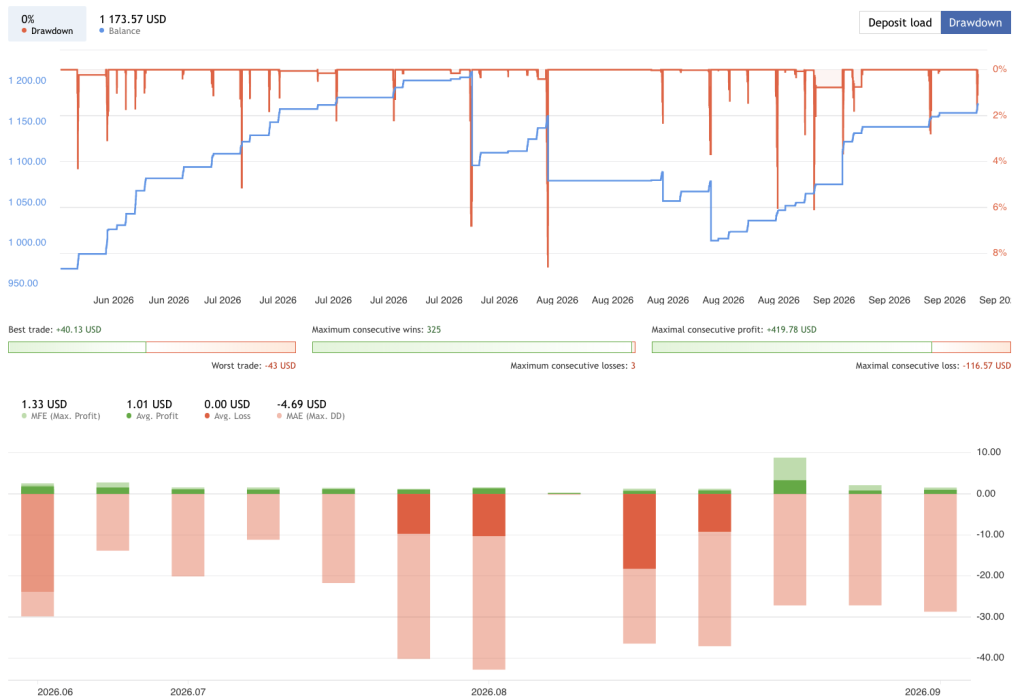
The direction bias is the part of the model we would most like to see and cannot. It chose short on 80 of 85 days, and it stayed short from 30 July, with gold at $4,045, to 24 August, with gold at $4,650. 11 of the 17 stops came in those four weeks.
Our balance peaked at $1,167.53 on 30 July, bottomed at $927.11 on 24 August, a $240.39 fall (20.59%), and had climbed back to $1,099.87 by 18 September without a new high. The live account peaked and troughed in the same weeks for 17.22%.
A system that is short 94% of the time is a bet that gold does not trend up during the London morning. From April to July 2026 that bet paid. Nothing in the log suggests the bias flips when it stops paying: it took the whole rally short, one 15-minute bar at a time.
Mavrik Scalper EA
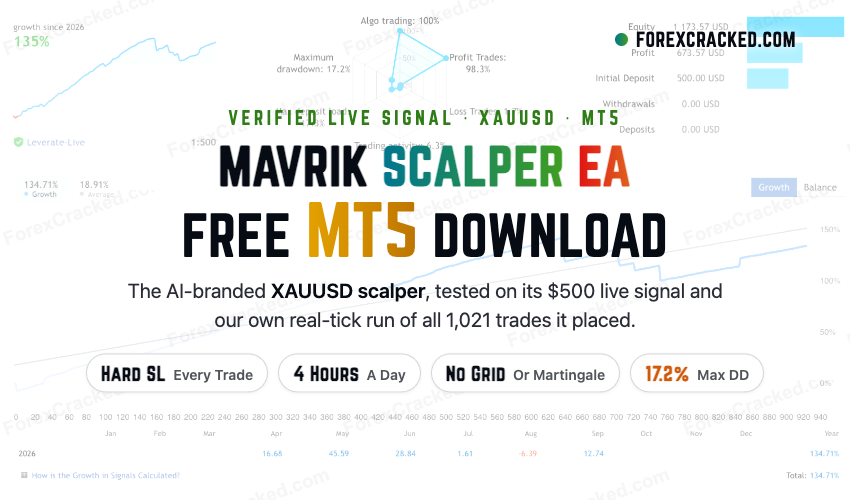
An MT5 XAUUSD scalper that opens a market order at every 15-minute bar between 10:00 and 13:45 server time, in one direction per day, trails each position out for about $1, and risks a fixed $38 per trade to do it.
Pros
- All 1,021 trades carried the same $38 stop and the same 0.01 lot. No position was ever added to after a loss and the EA was never long and short at once
- The live signal and our backtest agree on trade count, direction split, worst trade, worst streak and average win to within cents
- Five of six months were profitable on both records, and the account is in the market only about 6% of the time
- No deposits or withdrawals on the live account, so its 134.71% growth is, for once, the figure it looks like
Cons
- Average win of $1.24 against an average loss of $36.34 in our test. One stop undoes 29 wins and the whole edge is 1.6 points of strike rate
- Up to four positions in the same direction at once, so one bad hour can cost $152 on 0.01 lots, and 8 of our 17 stops were hit in the 08:30 New York data slot
- The direction bias was short on 80 of 85 trading days, including the whole 30 July to 24 August rally, which produced 11 of the 17 stops and a 20.59% drawdown
Summary
The live account is real and our matched test confirms it: the same trade count to within 9%, the same 94:6 short bias, the same $38 stop and the same three-stop worst streak. What the sales page calls a neural network behaves, in the log, like a scheduled London-morning gold short with a one-dollar trail. It pays while gold drifts and gives it back in stops when gold rallies, as August 2026 showed on both records.

 Built by ForexCrackedWe tested 1,200+ indicators. Then we built our own.Six years of reviewing EAs and indicators went into FXC Fusion: two engines, the seven-panel cockpit, MT4 and MT5, from the team behind this site.
How it compares to the fast gold and high-hit-rate robots we have tested
| Mavrik Scalper EA | Gold Tripwire EA | Auto News Trading Robot | Gold Sixfold EA | |
|---|---|---|---|---|
| Entry | Market order at 15-minute opens, one direction per day | Pending stop breakout | Mean reversion before scheduled news | Six pending stops per breakout |
| Average win / loss (live) | $1.20 / -$26.49 | $2.28 / -$4.01 | $1.64 / -$16.50 | $14.59 / -$12.12 |
| Profit factor (live) | 2.59 | 1.81 | 1.70 | 1.94 |
| Max drawdown (live) | 17.22% balance | 14.02% balance | 13.88% balance | 23.29% balance |
| Average holding time (live) | 23 minutes | 54 seconds | 3 days | 18 minutes |
| Positions at once | Up to 4 | 1 | 1 per pair | Up to 7 |
| Live sample | 932 trades, ~5.5 months | 172 trades, ~6 months | 400 trades, 3.5 years | 454 trades, ~7 months |
Mavrik has the highest live profit factor of the four and the most lopsided payoff by a wide margin. The Auto News robot is the closest in shape, and its three and a half years of history show what happens to that shape over time: the profit is real and thins every year.
Frequently Asked Questions (FAQ)
InpGMTOffsetHours input first, then give it a full week on demo before deciding it is broken.Conclusion
Mavrik Scalper EA does what its live signal shows, and our test proves the signal is the strategy: fixed lots, a real $38 stop on every trade, no grid, and five and a half months of profit on a $500 account. However, the neural network on the sales page behaves like a timetable in the log, the payoff is 29 wins per stop, and the stops arrive in stacks at 08:30 New York on the days gold rallies. It suits a trader who sizes from the $152 four-position stack rather than the strike rate, and who will switch on the filters the vendor left off.


Discussion no comments yet
Is this still working?
Nothing here yet
No one has asked anything about Mavrik Scalper EA yet. First question gets answered.