

We’ve reviewed over 1,500 EAs since we opened ForexCracked in 2019. Roughly 4 in 10 get flagged on our first read — sometimes within thirty seconds. The obvious ones are easy. A “recovery” EA that costs $2,000 and shows up on Telegram for $19, with a sales page that has six exclamation marks in the headline. You don’t need a checklist for that.
The dangerous ones are quieter. They show you a Myfxbook account that looks clean for three months. They quote real trader names you can find in industry forums. They post real-looking backtest reports with sensible drawdown numbers. By the time you spot the trick, your $5,000 demo-turned-funded account is sitting at $480 and the developer’s Telegram has gone dark.
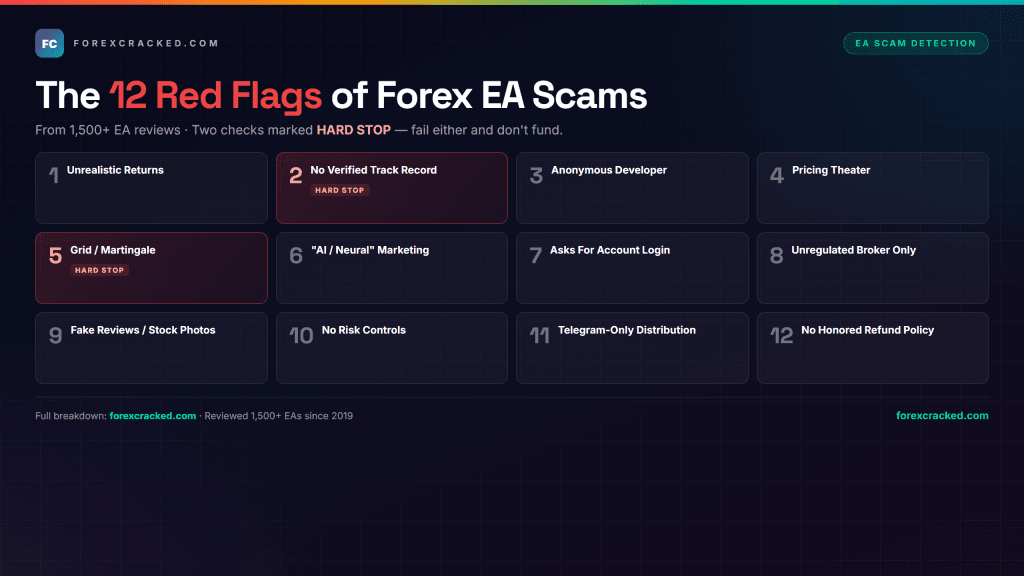
This is the list we use internally at the review desk. Twelve checks, every one of them earned from a robot that burned somebody who paid for it. Run through this checklist before you fall for one of the forex EA scams circulating today — paid or “free” — onto a real account.
1. Returns That Don’t Match Reality
I don’t care what timeframe it traded on. I don’t care what currency pair. If an EA claims 30% per month consistently — or worse, per week — close the tab.
A good rule of thumb from real prop firm performance: top funded traders pull 5%–15% per month after a strong year. That’s traders, not robots. EAs that survive long-term sit between 2%–8% monthly with drawdowns that occasionally swallow half of that. Anyone showing you a screenshot of 40% in 30 days has either curve-fit a doomed strategy or is showing you the only good month out of twelve.
We had a vendor email us last March pitching a “guaranteed 200% annual return” EA. The accompanying Myfxbook link was live for six weeks. By week ten the account was at -83%. By week twelve the page had been deleted. The Telegram channel still pretends those six weeks never happened.
2. No Verified Track Record
This is the single biggest tell. Real EAs come with a verified live performance link — Myfxbook, FX Blue, or both.. Anything else is somebody asking you to trust their screenshots.
Screenshots are useless. Anyone with an MT4 demo account, ten minutes, and Photoshop can produce screenshots showing $50K profit on $1K starting capital. We’ve seen it. We’ve seen the same screenshot resold under four different EA names.
What you want: a Myfxbook-verified live account. Not a demo. Not a “verified by the developer.” Demos don’t pay slippage. Verified-by-developer means nothing. The “Track Record Verified” and “Trading Privileges Verified” badges on Myfxbook are what matter — both green, both with at least six months of history, and the broker has to be one you’ve heard of.
If they can’t give you that, the EA is not ready. Either it’s too new (and you’re being asked to be the test capital) or it’s too broken to show real numbers.
3. No Author, No Backstory, No History
Real EA developers leave footprints. They have an MQL5 marketplace seller profile. They’ve spoken at a forex conference or two. They’ve shipped earlier EAs you can find references to in old forum threads from 2018.
When the only mention of a developer is their own sales page, that’s a red flag with a flashing siren. If their LinkedIn looks like it was created last Tuesday — same week the EA launched — that’s not a developer. That’s a sock puppet.
before:2024. If nothing predates the sales page, the developer didn’t exist before the sales page.4. Pricing Theater
The classic version: “Original Price $2,997 — Today Only $97.” That price never existed. Nobody ever paid $2,997. The vendor is anchoring you so the $97 feels like a steal.
The newer version is sneakier: a free EA with “premium” license features locked behind a $400 upsell, with the catch that the free version is purposefully crippled or routes through specific brokers the vendor has a kickback with.
Real EAs that cost money cost money openly. Real free EAs are free without an asterisk. Recognize the in-between as marketing manipulation.
5. Grid and Martingale Hiding as “Recovery”
This is my biggest pet peeve in the EA market, and I’m going to say it clearly: if an EA opens a second position when the first one moves against you, and a third when the second moves against you, and so on — that is martingale. Calling it “smart recovery” or “averaging strategy” or “anti-grid recovery system” doesn’t change the math.
The math: every grid or martingale strategy survives until it doesn’t. Five years of beautiful equity curves can vanish in a single 200-pip move that goes against you on a Sunday open. We have a folder of Myfxbook accounts that show this exact pattern. $20K turned into $80K over four years, then $80K turned into $400 on a single Brexit-style gap.
If you read the EA description and see the words “no stop loss” or “recovery on losing trades” or “averaging down” — that’s the math. It will work until it doesn’t, and when it doesn’t, you lose everything.
This isn’t always a scam, technically. Sometimes the developer genuinely doesn’t understand the risk. But the outcome for you is the same. Grid-disguised systems are the most common forex EA scam pattern we see.
6. The “AI / Neural Network” Marketing Layer
This is the scam that’s exploded since 2024. Every second EA pitch in my inbox claims to use “AI”, “neural networks”, “machine learning”, “GPT-powered analysis”, or some combination of the four. Almost none of them actually do.
What’s actually happening: vendors take a regular moving-average-crossover or grid EA from 2015, repaint the UI, slap “AI-Powered” on the sales page, and charge five times the price. The underlying logic is identical to the EA they were selling for $79 last year, now badged as a $399 “neural network.”
There’s a simple test. Ask the vendor — directly — three questions:
- What features does your model use as inputs? (open, high, low, close, volume, indicators — which ones?)
- How often does the model retrain, and on what data?
- Where is the inference happening — locally inside MT4, or on an external API?
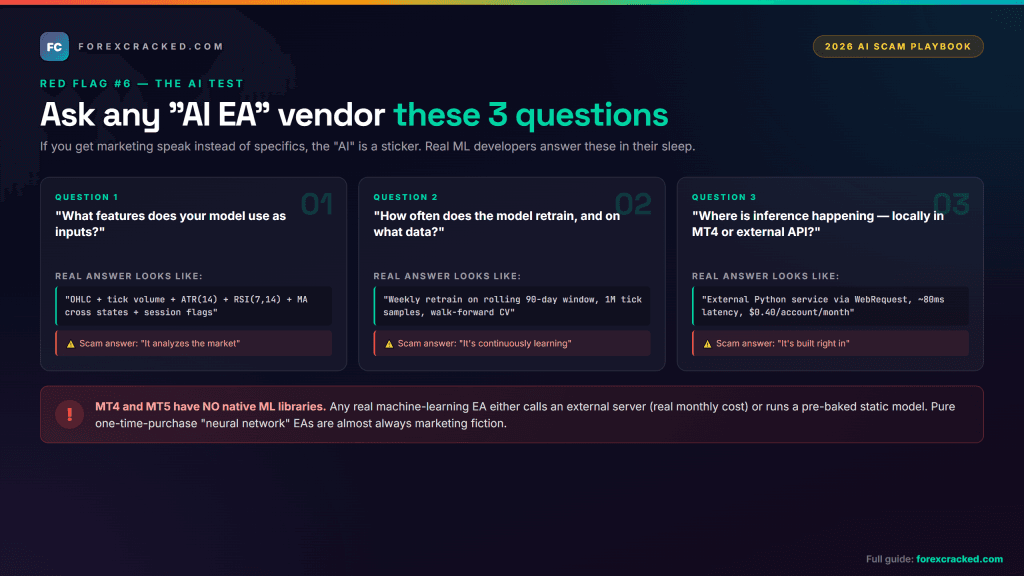
If you get marketing-speak back instead of specifics, the “AI” is a sticker. Real ML developers can answer these in their sleep.
The technical reality most buyers don’t know: MT4 and MT5 don’t have native machine learning libraries. There’s no import tensorflow inside the MQL editor. Any genuine ML inference has to either (a) call out to an external server via WebRequest — which requires real infrastructure the vendor has to pay for monthly — or (b) be a pre-trained model exported as a static lookup table, which is closer to a curve-fit indicator than a learning system.
In other words: a real AI EA has real costs behind it. The vendor either charges a subscription (because the external API costs them money every month) or the “AI” is fixed weights baked into the EA file. Pure one-time-purchase “neural network” EAs are almost always marketing fiction.
The grid is also still there underneath, by the way. The new dressing doesn’t change the math. If the EA opens a second position when the first goes against you, it’s still martingale — calling the entry logic “AI” doesn’t undo that risk.
7. They Ask For Your Account Number
Real EAs don’t need your live account number to function. They install on MT4/MT5 and run.
If a vendor or “support agent” asks for your live account number or — even worse — your investor password (“just so we can monitor performance and optimize”), close the conversation. The investor password is a read-only password. It can’t trade. But asking for it is the first move in a longer con where the next request is for your main login, supposedly to “fix” something.
If they ask for your broker login, you are the product. The EA is a delivery mechanism for stealing the account.
8. Broker Lock-In to an Unregulated Broker
Some EAs only work with one specific broker. Sometimes there’s a legitimate technical reason (the EA needs specific symbol naming or depth-of-market data the broker provides). More often, it’s because the developer is an IB (Introducing Broker) with that company and earns a commission on every trade you place.
That’s not automatically a problem. What is a problem: when the broker they steer you to is unregulated or regulated by a tier-3 jurisdiction nobody’s heard of. Real brokers are licensed by major regulators: the FCA in the UK, ASIC in Australia, CySEC in Cyprus, the NFA and CFTC in the US, or BaFin in Germany. Anything else and your money has no real protection.
Check the broker’s regulator before you fund. If you’ve been scammed and want to file a complaint, the FTC (for US-based vendors), the CFTC (for futures-related fraud), or the FCA (UK) are the actual agencies that take action. If the EA only works with a broker you’ve never heard of, that’s the bigger red flag, not the EA itself.
9. Fake Reviews, Stock-Photo Testimonials
The five-star reviews on sales pages are almost always fake. We assume this and you should too.
If you want to know what real users think, the place to look is not the vendor site. It’s:
- ForexPeaceArmy (filter for verified users)
- Reddit r/Forex (search the EA name)
- ForexFactory threads (sort by oldest, see how the EA performed over time)
- Trustpilot, but with skepticism — many EAs farm reviews
10. No Risk Management Controls
Every legitimate EA gives you control over risk. Fixed lot size, percentage-of-balance risk, max daily drawdown, max consecutive losses, news filter — these are non-negotiable features.
If the EA has no settings, no risk parameter inputs, and just trades whatever it wants — you’re not running an EA, you’re running someone else’s strategy with your money. There’s no margin of safety. When the strategy hits a bad patch (and it will), you can’t even reduce position size.
Check the inputs panel before you run anything. If there are fewer than five risk-related settings, walk away.
11. Telegram-Only Distribution
When the only way to get an EA is through a private Telegram group, and there’s no public review site, no GitHub, no MQL5 listing — that EA exists outside of accountability.
Public distribution channels (MQL5 marketplace, established forex sites with editorial review, GitHub for free EAs) all have some level of scrutiny. Telegram has none. The vendor can delete the channel and disappear with no record that they ever existed.
Some legitimate small developers do use Telegram for early-access distribution. The difference: they also have a public sales page, verified track record, and a footprint in other forex communities. Telegram-only = anonymous distribution = no accountability.
12. The Refund Policy
Real EA vendors offer 14–30 day money-back guarantees. Real ones also honor them — slowly, but they honor them.
Scam vendors do one of three things:
- No refund policy at all (just don’t mention it)
- 30-day refund policy with a clause buried in the terms saying “void if EA was loaded on a live account”
- 30-day refund policy that they simply ignore — they take your money, then your support tickets go unanswered
This is hard to check before buying. The best test: search “[EA name] refund” on Reddit and ForexFactory. If there’s a pattern of refund complaints, you have your answer.
Advanced Forex EA Scams: How Sophisticated Vendors Get Around the Basics
The 12 points above catch most fakes. But the scammers who’ve been at it for years have learned to clean up their sales pages enough to pass a quick scan. Sophisticated forex EA scams use a second layer of tricks — and here’s what we’ve documented over the years.
The Vendor Rotation
Same scammer, same EA, different brand name. They run a vendor for 8–14 months under a clean-looking domain. When complaints start piling up on ForexPeaceArmy and Reddit, they let the domain expire, register a new one, repaint the sales page, and relaunch the identical EA file under a new name.
How to check: take the EA’s actual .ex4 or .ex5 file properties (right-click → Properties → look at the compilation date and developer ID inside the file metadata). If the file metadata predates the website launch by a year or more, you’re looking at a re-skin.
Cross-search the EA’s distinctive feature names — “Smart Recovery Mode” or “Neural Grid Engine” type phrases — across older forum threads. If a different EA name shows up using identical feature naming from 2022, same product. New badge.
Review Manipulation Rings
Three sites all praising each other in a circle: Site A reviews EAs from Site B, Site B from Site C, Site C from Site A. None of them disclose the relationship. All three are run by the same operator.
Telltales:
- Same template design across the “different” sites
- Same writing style and oddly specific stat references
- WHOIS records (look them up on whois.com) often share the same registrar or contact email
- Sales urgency phrasing copy-pasted between sites
If the only positive reviews you can find live on websites that exclusively review EAs and never anything else, you’re in a manipulation ring. Real opinions live on community forums where users have other things to talk about.
Myfxbook Account Hijacking After Drawdowns
A scam EA shows a beautiful Myfxbook account for six months. You buy it. Two weeks later the Myfxbook page is set to “Privacy Mode: Account holder has hidden this account.” It’s still on the vendor’s site as “live verified track record” but you can’t see the recent months.
This is one of the dirtier moves. The account did exist. It even traded reasonably for the visible period. But Myfxbook accounts can be made private at any time, and many vendors hide accounts the moment a serious drawdown hits.
Defense: before purchase, screenshot the Myfxbook page yourself. Check back monthly. If the account goes private after a bad month, you’ve confirmed the developer hides bad data. Refund and move on — they’ll do the same thing again the next time they have a losing month.
Backtest Date-Range Cherry-Picking
Backtests that show 2017–2019 performance and nothing after. Or 2020–2021 only (the easy years). Or only the months when their strategy happened to fit.
A legitimate backtest covers 5+ years of continuous data including stressful periods: the August 2015 CNH devaluation, the 2020 March crash, the 2022 LDI gilt crisis. EAs that survive those weeks survive everything else. EAs that look great only when shown the smooth-trending periods will get rinsed in the next surprise.
Rule: any backtest range that conveniently excludes the years your specific strategy would have struggled is curve-fit marketing, not evidence.
Realistic Performance Benchmarks
For perspective, here’s what real returns look like in this industry:
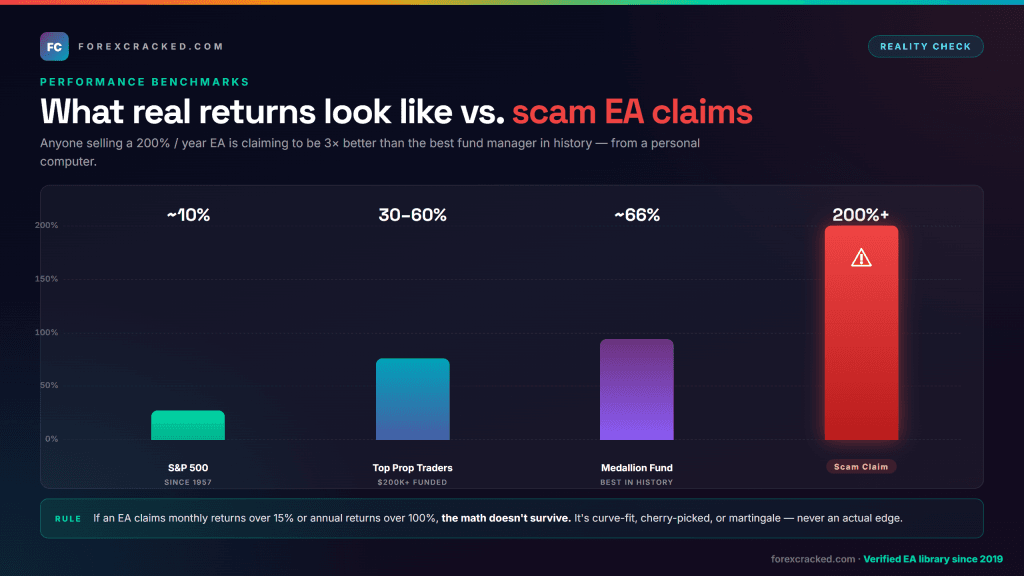
| Renaissance Technologies’ Medallion Fund | ~66% / yr |
| Top retail prop firm traders | 30–60% / yr |
| S&P 500 average since 1957 | ~10% / yr |
The Medallion Fund is widely considered the best-performing fund in history — run by Nobel-tier mathematicians with infrastructure budgets in the hundreds of millions. Anyone selling you an EA claiming 200% per year is claiming to be 3× better than the best fund manager in history, working from a personal computer. Use this for the smell test on every performance claim.
What to Do Before You Trust Any EA
Run this sequence on every EA — paid or free — before it touches a live account:
- Demo first, always. Minimum 30 days. Real demos with the same broker you’d use live, not a different demo account.
- Calculate the strategy’s risk of ruin. Plug in the win rate, average win/loss, and your risk per trade. If the number scares you, the EA isn’t ready for your money.
- Run a drawdown projection. What happens to your account after 10 consecutive losses at the EA’s default lot size?
- Cross-reference reviews. Don’t trust the vendor site. Look at independent communities.
- Check the broker. Make sure the EA isn’t designed to only work on a broker with weak regulation.
- Read the inputs panel. If risk controls are missing, the EA isn’t trying to keep you safe.
Treat any EA like a stranger asking to drive your car. Verify everything before handing over the keys.
How We Verify EAs at ForexCracked
For full transparency, here’s the editorial process every EA goes through before we publish it on the site:
If any of these stages flags concerns, the EA doesn’t ship. We’ve turned away roughly 600 EAs in the past 6 years for exactly the reasons in this checklist. Our full criteria are documented in our editorial standards.
This is also why we don’t take paid placements on broker reviews. The whole site is funded by optional affiliate links that are clearly disclosed on every page — and the editorial decision happens before any commercial conversation does.
Free EAs You Can Actually Trust
Five EAs from our library that have passed every check in this article. All free, editorially reviewed, with public testing documentation:
Each has its own review with backtest data, demo testing notes, and our risk assessment.
The Final Forex EA Scam Checklist
Save this. Print it. Stick it next to your monitor. Run any EA past it before you fund:
- Returns under 15% monthly
- [Hard stop] Verified Myfxbook or FX Blue live track record (6+ months)
- Developer has history before the EA’s launch
- Honest pricing (no fake “regular price” anchoring)
- [Hard stop] Not a martingale or grid in disguise
- “AI / neural network” claims backed by specific technical answers (not marketing words)
- Vendor never asks for account login details
- Works with regulated brokers (FCA, ASIC, CySEC, NFA)
- Real reviews on ForexPeaceArmy / Reddit / ForexFactory
- Risk management controls in the inputs panel
- Public distribution with accountability
- Honored refund policy (search “[EA name] refund” first)
FAQ
Are all paid EAs scams?
No. There are real paid EAs that deliver on their claims — usually quietly, with modest returns, sold by developers with five-year track records. The problem isn’t paid EAs as a category. The problem is the marketing playbook scam vendors use, which we covered above. Apply the checklist; price isn’t the indicator.
What if an EA shows a real Myfxbook account but I still don’t fully trust it?
That’s healthy skepticism. Two extra checks: (a) how long is the history — three months means very little, two years means a lot; (b) what’s the broker — a verified track record on a regulated broker carries far more weight than one on an offshore one. If both look reasonable, demo it for 30 days before you fund.
What about brand-new EAs with no track record yet?
Brand-new EAs are speculative by definition. If a developer has a public history of previous successful EAs, that’s reasonable cover for trying a new one. If the developer is also new, you’re paying to be the beta tester. Don’t fund anything on a brand-new EA from a brand-new developer.
How does ForexCracked actually verify EAs we publish?
Our editorial standards page covers this in full. Short version: code review, backtest verification, demo testing — all done before publication, all done internally.
Should I trust EA reviews on YouTube?
With extreme caution. Many YouTube EA reviews are affiliate-driven and rarely disclose it. If the reviewer is pushing you toward a specific affiliate link with urgency, treat it the same way you’d treat any other affiliate-disclosed sales page — interesting, possibly accurate, but verify everything independently before funding.
Are “AI EAs” or “Neural Network EAs” real, or just marketing?
Mostly marketing. MT4 and MT5 don’t have built-in ML libraries, so any real ML inference has to either run on an external server (which costs the vendor money continuously) or be a pre-baked static model (which isn’t really “learning” anymore). The honest test: ask the vendor what features the model uses, how often it retrains, and where inference happens. If you don’t get specific technical answers, the AI is a label, not a system.
Can I get my money back if I’ve already been scammed by a forex EA?
Sometimes, depending on how you paid. If you used a credit card, file a chargeback within 60–120 days (varies by issuer). If you paid via PayPal, open a dispute through their Resolution Center within 180 days. If you wire-transferred or paid via crypto, recovery is almost impossible. You can also report the vendor to the FTC (reportfraud.ftc.gov), the CFTC (cftc.gov/complaint), or the FCA in the UK. These rarely lead to refunds but they help build cases that eventually shut bad vendors down.
How fast do scam EAs typically blow accounts?
Grid and martingale EAs that look profitable usually take 3–18 months before a sufficient adverse move wipes them out. The smoothness of the equity curve in the visible period is what fools people. Outright pump-and-dump fakes can do it in days. Either way: if you find yourself thinking “this has been working for 6 months, time to scale up”, that’s the moment the math is closest to catching up. Real edges scale carefully; martingale edges scale until they implode.
we update this checklist every six months as forex EA scams evolve. If you’ve encountered a tactic that isn’t covered here, email us — we’ll add it to the next revision.


Discussion no comments yet
Is this still working?
Nothing here yet
No one has asked anything about How to Spot Forex EA Scams: A 12-Point Checklist yet. First question gets answered.