

Gold Sixfold EA is an automated MetaTrader 5 (MT5) robot that trades XAUUSD (gold) with a stack of pending stop orders rather than a single market entry. Every hour it lines up six buy stops above the market and six sell stops below it, each with its own stop loss and target, and lets a breakout trip as many as it can. Its public MQL5 signal has turned a $500 deposit into $1,977.71 of profit and $2,301.90 of withdrawals across 454 trades in 2026. We ran a 100% real-tick backtest over the same window and read all 36,388 orders it sent. Free download at the bottom of this review.
TL;DR – MT5 XAUUSD breakout robot with a seven-month live account behind it that has paid out more than twice its deposits in cash. Hard stop on every order, no grid, no martingale, never long and short at once. But the “six strategies” are six orders on one breakout, so a bad break costs up to six stops at once and pushed the live account to a 51% deposit load.
What is the Gold Sixfold EA?
Gold Sixfold EA is a MetaTrader 5 expert advisor for XAUUSD that places six buy-stop and six sell-stop orders at the open of every H1 bar, priced at recent range extremes, and cancels and replaces them an hour later. Each of the six carries a fixed dollar stop and target, from $6 to $25 of risk against $16 to $49 of reward. Whichever side breaks fills first, a trailing stop closes most trades within minutes, and it never holds buys and sells together.
Core Strategy and Logic
We ran version 1.30 on a Tickmill demo, MT5 build 6182, over 50,646,411 real ticks on XAUUSD H1 from 1 February to 10 September 2026, then read the order log rather than the summary page. The sales page says “6 integrated strategy layers.” The log says something more specific.
- Twelve pending orders an hour – At the open of each H1 bar the EA sends six buy stops above the market and six sell stops below it. They expire at the next bar and a fresh set goes out. Over 3,643 bars it placed 18,211 buy stops and 18,177 sell stops, and 455 of them filled.
- One or two levels, six exits – The six orders on a side sit at one or two prices a few dollars apart in more than 90% of hours, at recent range highs and lows that stay put for hours or days until price reaches them. The gap between the buy side and the sell side was a median $132 and never narrower than $43. What separates the layers is the exit: the stop and target pairs are $25/$19, $6/$49, $12/$16, $6/$17, $10/$19 and $12/$18, and every filled order in the log used one of those six.
- Fills arrive in bursts – When gold breaks a level, several stops trip within seconds. Our 455 fills came in 197 bursts: 99 single fills, 38 pairs, 13 triples and 47 bursts of four to six positions. The most it ever held at once was seven.
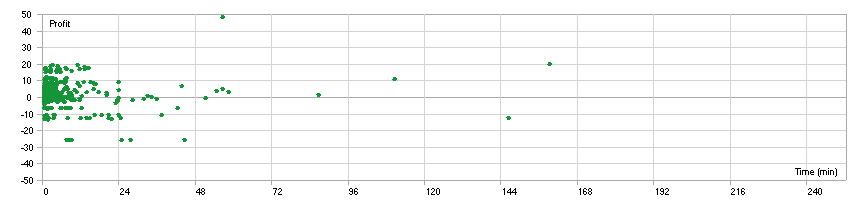
- The trail does the closing – Only 28 of 455 trades reached a take profit. 268 were closed by a stop that had been trailed into profit, averaging +$4.68, and 159 closed at a loss averaging $4.14. The targets are almost decorative.
- Fast in, fast out – Median holding time was 75 seconds, mean 5 minutes 30 seconds, longest 2 hours 38 minutes. It is in the market under 1% of the time.
The two-sided pending shape is the same family as the pending-order scalper in Gold Reflex, which arms one order per side, and the stacking is closer to the five-strategy Gold Pivot Breakout. It is the structural opposite of a gold grid like Quantum Queen, where exposure builds against you instead of with you.
Please test in a demo account first for at least a week. Also, please familiarize yourself and understand how this Zerqon EA works, then only use it in a real account.
Recommendations for the Gold Sixfold EA
- Minimum deposit – The live account runs 0.02 lots per layer on a $500 base, which is where its deposit-load and drawdown figures come from. On 0.01 per layer a full six-layer stop-out is $71, or 14% of $500. Call $500 the floor for 0.01 and $1,000 comfortable, which matches the vendor’s own recommendation.
- Leverage is not optional – At gold near $4,300, one 0.01 lot needs about $43 of margin at 1:100 and $215 at 1:20. Six layers at 1:20 is about $1,300 of margin, so a regulated 1:20 account cannot run this on a small balance at all. The live account is on 1:200.
- Pair and timeframe – XAUUSD only, on H1, because the pending orders are refreshed at the H1 bar open.
- Account type – Raw spread or ECN. Stop orders fill at the next available price, and with a median hold of 75 seconds the spread is a large share of every winner.
- VPS is required – The trail does the closing, and it has to be modified from a machine that is awake and close to the server (FXVM).
- Work the $71 six-layer stop-out and the $47.18 worst day against your own balance with the lot size optimizer and the drawdown calculator (Find the Perfect Broker For You Here).
Performance Review: Live Signal and Our Own Matched Backtest
1. The live account, and why the withdrawals matter more than the percentage
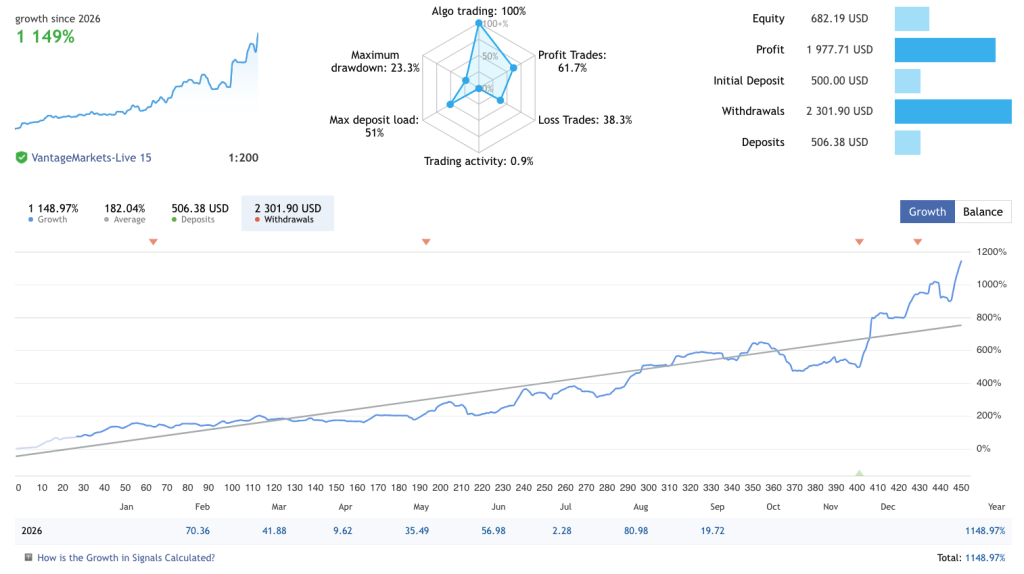
Read the sidebar in dollars, not the growth figure. The growth percentage is a chain-linked number that MQL5 rebuilds around every deposit and withdrawal, and this account has had four withdrawals and one top-up, so nobody received 1,149%. What the account has actually paid out is more than twice everything that was ever deposited into it, with a working balance still trading. That is the proof a percentage cannot fake.
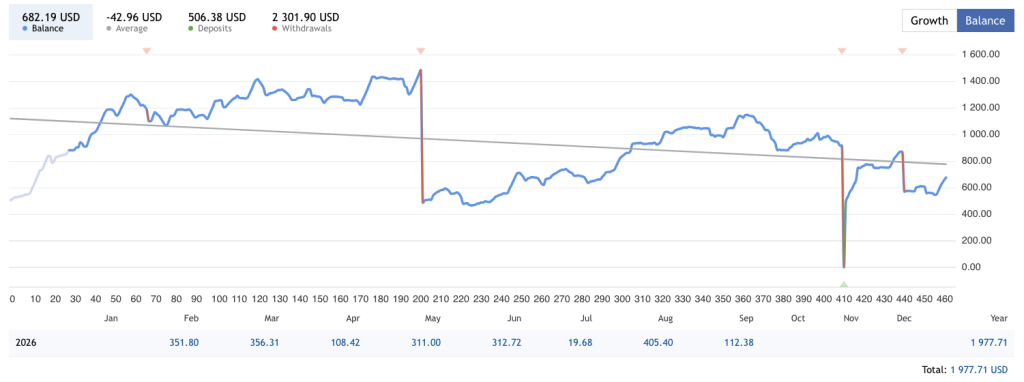
| Month, 2026 | Live, scaled to 0.01 lots | Our test, 0.01 lots |
|---|---|---|
| February | +$175.90 | +$247.28 |
| March | +$178.16 | +$58.63 |
| April | +$54.21 | +$203.42 |
| May | +$155.50 | +$178.70 |
| June | +$156.36 | +$181.58 |
| July | +$9.84 | +$81.70 |
| August | +$202.70 | +$75.73 |
| September, to the 12th / 10th | +$56.19 | +$55.35 |
| Total | +$988.86 | +$1,082.39 |
The live column is the monthly row from the chart above halved, so it sits on the same lot size as our test. Eight positive months on both sides and totals within 9% of each other, but the months themselves do not match: March, April and August swap places. That is what a stop order at an exact price does on a different broker’s feed with a different spread. These two records are the same strategy. They are not the same trades.
2. Our matched real-tick test
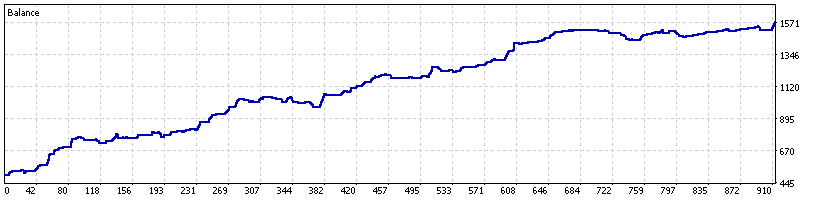
| Metric | Live signal ($500, 0.02 lots, 1:200) | Our backtest ($500, 0.01 lots, 1:100) |
|---|---|---|
| Period | Late Feb to 12 Sep 2026 | 1 Feb to 10 Sep 2026 |
| Closed trades | 454 | 455 |
| Long / short | 192 / 262 | 177 / 278 |
| Net profit | +$1,977.71 | +$1,082.39 |
| Profit factor | 1.94 | 2.60 |
| Expected payoff per trade | $4.36 | $2.38 |
| Average win / loss | $14.59 / -$12.12 | $5.98 / -$4.12 |
| Payoff ratio | 1.20 | 1.45 |
| Break-even win rate | 45.4% | 40.8% |
| Win rate | 61.67% | 64.62% |
| Best / worst trade | +$97.00 / -$51.56 | +$48.68 / -$25.51 |
| Longest losing run | 9 trades, -$209.14 | 9 trades, -$40.22 |
| Max drawdown | 23.29% balance, 10.34% equity | 7.16% balance, 6.10% equity |
| Average holding time | 18 minutes | 5 minutes 30 seconds |
| Recovery factor | 7.39 | 11.52 |
| Max deposit load / min margin level | 50.96% | 194.81% |
One row settles what the live account is running. Halve the live best and worst trades to put them on our lot size and they land within 30 cents of ours: the $25-stop layer and the $49-target layer showing up in both records at the same size. Add the near-identical trade count and the same short-heavy split, and the live account is running this file with the lot doubled, not a private variant.
Where they part is the hold. The live account keeps trades three times longer, so its wins and losses are both bigger per lot: $7.30 and $6.06 per 0.01 against our $5.98 and $4.12. Either the live set trails less aggressively or a real server modifies a stop more slowly than a tester. Either way the live account kept $2.18 of profit per 0.01 lot per trade against our $2.38, which is 92% of the tested edge.
3. Six orders, one breakout: what the Z-Score is telling you
Our run came out with a Z-Score of -6.42 at 99.74% confidence. On a grid EA that number is the signature of a basket where losers cluster. Here it means the six layers fire together, so their results are not independent. When the breakout is real, up to six trades win together. When it fails, up to six lose together.
The log shows how lopsided that is. 32 bursts of five or six positions produced $759.73 of the $1,082.39 net, and only seven of them lost. The 137 single and double fills netted just $84.58 between them, and 60 of them lost. When the stack fills, the breakout is usually real. The cost is that most of the profit rests on 32 moments in seven months.
The worst burst was a lesson in timing. Four positions opened at 15:30:00 server time on 12 August 2026 and lost $35.58 between them. That is the US CPI release minute, the news filter cannot run in a tester, and nothing else stood in the way. A six-position burst at 21:50 on 20 March lost $34.13 the same way.
4. The stops hold, mostly
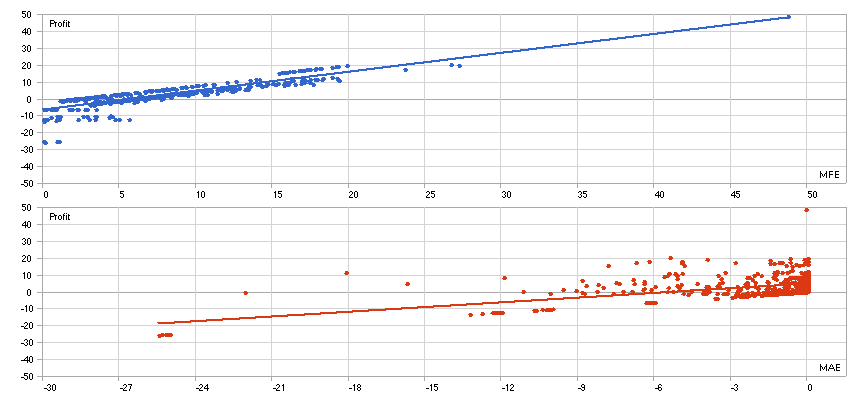
Every order is protected, and this time the protection mostly holds. The largest loss in 455 trades was $25.51, which is the $25 layer plus 51 cents of slippage. 30 of the 159 losses closed past their stated stop, but the worst overshoot was $6.79 on a $6 layer, and nothing came near the -$100 disasters that fast gold systems produce when a stop is virtual rather than server-side.
Entry slippage on the stop orders is the number to watch instead. Filled price against pending price averaged $0.57 across 455 entries, 79 were more than $1 worse, and the worst was $9.05, which on a $6 stop is a trade that never had a chance. Our 12-point EA scam checklist covers why a headline “stop loss on every trade” is only as good as the fill before it.
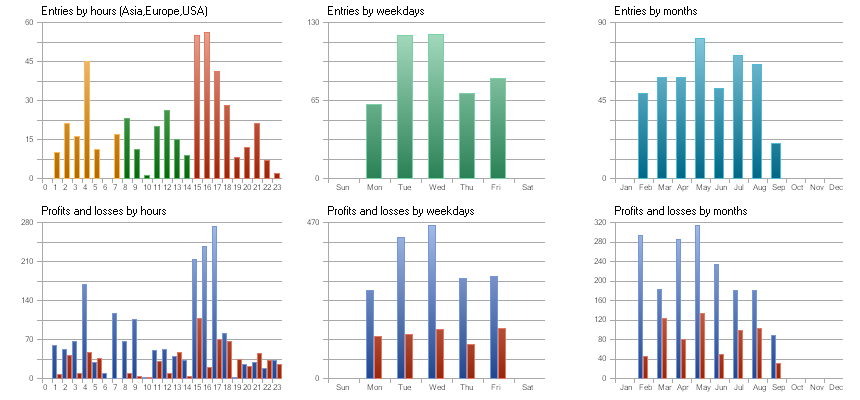
What holds up is the spread of the result. All three sessions pay: 154 trades in the Asian hours for +$516.37, 126 in London for +$190.48, 175 in New York for +$375.54. All six layers were net positive, from +$321.26 on the $25/$19 layer to +$108.72 on the $12/$18 one, the best ten trades made 20.3% of the net, and 100 separate days produced a trade.
Gold Sixfold EA
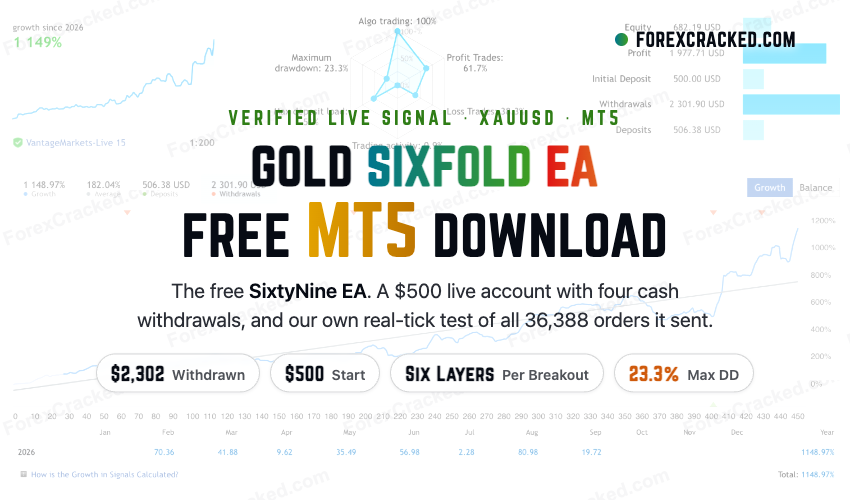
An MT5 XAUUSD breakout robot that arms six pending stops each side of the market every hour, trails each fill out in minutes, and has withdrawn $2,301.90 from a $500 live account in seven months.
Pros
- All 36,388 pending orders in our test carried a stop loss and take profit at placement, and the largest loss in 455 fills was $25.51 on the $25 layer
- Volume never left 0.01, the EA was never long and short at once, and no position was ever averaged or re-opened after a loss
- The live account has withdrawn $2,301.90 against $1,006.38 deposited, which a growth percentage cannot fake
- All six layers, all three sessions and all eight months were profitable in our test, and the live best and worst trades match ours to within 30 cents per 0.01 lot
Cons
- Up to seven positions open on one breakout, Z-Score -6.42, and a 51% maximum deposit load on the live account
- 46% of our test's trades closed inside 60 seconds, and stop-order entry slippage averaged $0.57 and peaked at $9.05
- The spread cap and the drawdown cap both ship at zero, and the worst burst in our test (-$35.58 across four positions) opened on the US CPI minute
Summary
The live record is real: $1,006.38 went in, $2,301.90 has come out, $682.19 is still trading, and no month has closed red. Our matched real-tick run made $1,082.39 on half the lot size with a 2.60 profit factor, and the best and worst trades in both records are the same two layers firing. The catch is that the six layers are six orders on the same level with different exits, so exposure arrives in bursts, and the live account runs that burst on 0.02 lots per layer against a $500 base.

 Built by ForexCrackedWe tested 1,200+ indicators. Then we built our own.Six years of reviewing EAs and indicators went into FXC Fusion: two engines, the seven-panel cockpit, MT4 and MT5, from the team behind this site.
How it compares to the gold breakout robots we have already tested
| Gold Sixfold EA | Gold Reflex EA | Gold Ambush EA | Gold Pivot Breakout EA | |
|---|---|---|---|---|
| Entry | Six pending stops per side | One pending stop per side | Breakout | Five breakout strategies |
| Profit factor (live) | 1.94 | 7.72 | 2.60 | 1.56 |
| Max drawdown (live) | 23.29% balance | 6.40% balance | 14.74% balance | 10.52% balance |
| Average holding time (live) | 18 minutes | 48 seconds | 16 minutes | 44 minutes |
| Live sample | 454 trades, ~7 months | 54 trades, ~4 months | 127 trades, ~3 months | 488 trades, ~6 months |
| Positions at once | Up to 7 | 1 | 1 | 2 live, 6 in our test |
| Cash withdrawn | $2,301.90 | None recorded | None recorded | None recorded |
Gold Sixfold has the deepest live drawdown of the four, the biggest live sample, and the only recorded cash withdrawals. Gold Reflex has the cleanest ratios on the thinnest sample.
Frequently Asked Questions (FAQ)
MaxDrawdown shipped at zero. Set a daily equity cut-off yourself and run 0.01 per layer on a balance where a $71 stop-out sits well under the daily limit.Conclusion
Gold Sixfold EA earns its live record. The stops are real, the lot never moves, the vendor has taken real cash out, and an independent real-tick run reproduced the same trades at the same size. However, the six layers are six orders on one level, so the risk is a stack that fails, and the two guards that would limit it ship switched off. It suits a trader on real leverage with tight gold pricing who sizes from the stack, not the growth figure.


Discussion 4 comments
Is this still working?
How to create your own Robert
What do you mean by creating your own Robot: building an EA from scratch, or getting the Robot named in the post? Tell me which one.
Hello, I’m an Arab trader. I found this robot by chance and tested it over the last two months and the last year, from January 1, 2026 to September 17, 2026. The results are great. I’ll run it on a cent account with standard lot size and 1.500 leverage and get back to you. It looks fantastic.
Hi, How about the perfomance for SixFold EA?