

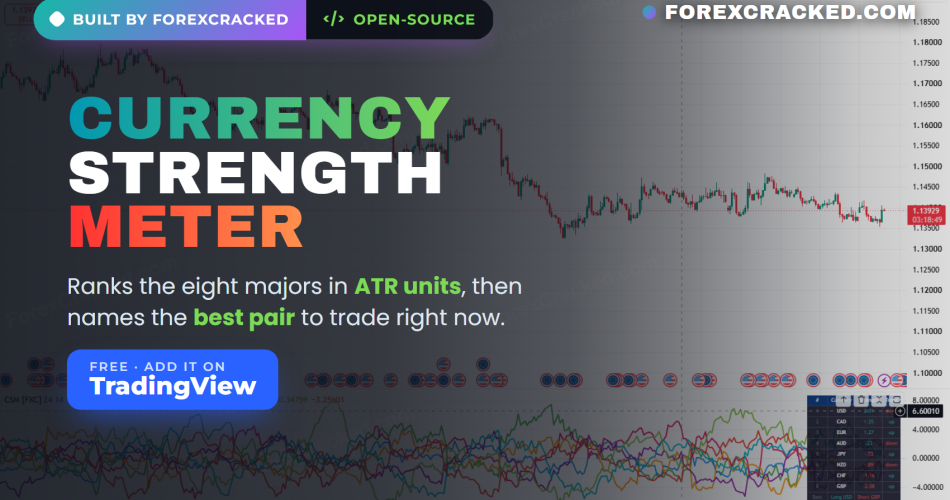
A currency strength meter for TradingView should answer one question before anything else: which pair is worth trading right now. Most of them dodge it. They average each pair’s percent change, hand you eight bars, and leave you to work out the rest. We got tired of that, so we built one that ranks the eight major currencies against each other, measures every move in ATR units instead of percent, and then names the strongest and the weakest as a single pair to watch. It is free and open-source on TradingView, and it reads all 28 major crosses, so every currency is judged against all seven of its counterparts and not just against the dollar.
Key Takeaways
- Free, open-source TradingView indicator that ranks USD, EUR, GBP, JPY, CHF, AUD, NZD and CAD from strongest to weakest in real time
- Strength is measured in ATR units, not percent change, so a quiet pair and a violent one are compared fairly instead of the loud one always winning
- It names the Best Pair to watch (long the strongest currency, short the weakest) and shows whether each currency is still strengthening or already fading
- A Spread reading tells you whether currencies are genuinely diverging or just drifting together, so you know when the ranking is worth acting on and when it is noise
What this currency strength meter shows on TradingView
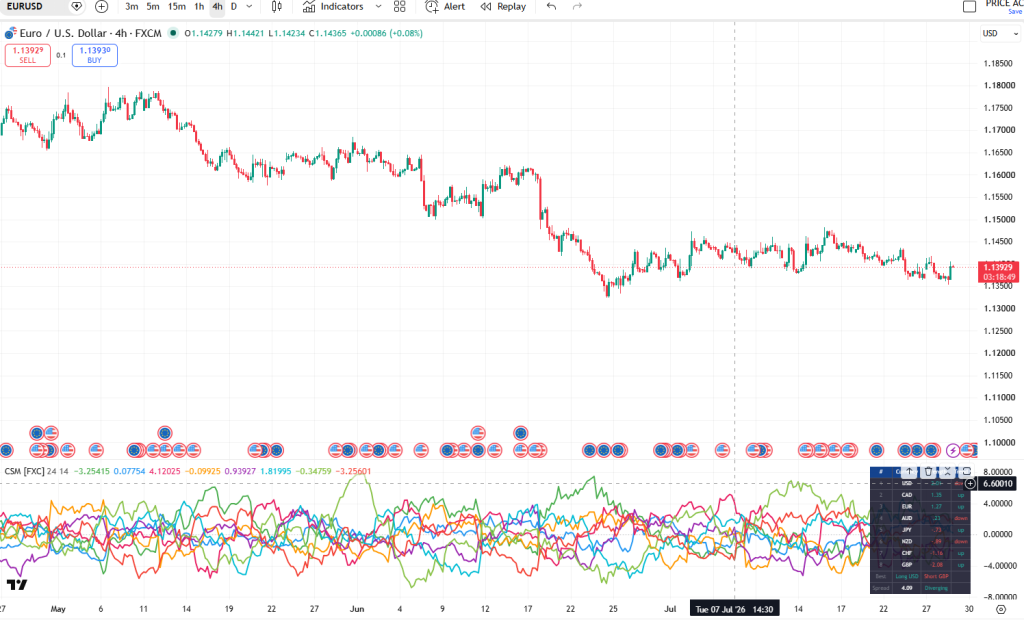
The indicator plots eight lines, one per major currency, and fills a compact table in the corner of the pane. The table ranks the currencies from strongest to weakest, shows each one’s strength score, and marks whether it is rising or falling against its own recent reading. Underneath the ranking it prints two things most meters never bother with. The first is the Best Pair: long the strongest currency, short the weakest. The second is the Spread, the distance between the top and bottom of the ranking, which tells you at a glance whether the market is actually diverging or everything is stuck in a huddle. You read the table, not eight separate lines, so the answer is there in a second.
The part that makes it different: ATR units, not percent
Here is the flaw in almost every strength meter, and it is the reason we built this one. They measure each pair’s percent change and average it. That treats a 40 pip move in a quiet pair and a 40 pip move in a violent pair as the same event, when they are nothing alike. The quiet pair just did something unusual. The violent pair does that before breakfast.
This meter divides every move by that pair’s own ATR before scoring it. A currency only ranks highly when it has moved far relative to how far it normally moves. Naturally calm pairs stop getting drowned out, and the ranking stops flattering whichever currency happens to be paired with the wildest counterpart that week. The numbers in the table are ATR units, so they mean something instead of being a mystery index between 0 and 100.
Best Pair and strength trend
The ranking on its own is useful. The Best Pair line turns it into a starting point for a trade. It takes the currency at the top and the currency at the bottom and pairs them, because that is where the divergence is widest and where a strength based trade has the most room to work.
The trend arrow next to each currency matters just as much. A currency that is top of the ranking and still strengthening is a different setup from one that is top of the ranking and already fading. The first still has momentum behind it. The second has usually made its move, and chasing it is how you buy the high. The table shows both, so you can favour the currency that is strong and still climbing.
The Spread: read this before you trust the ranking
The Spread is the gap between the strongest and weakest currency, and it is the honesty check. A wide spread means currencies are genuinely pulling apart and a strength trade has something to work with, so the table flips to Diverging. A narrow spread means everything is drifting together, the ranking is mostly noise, and the table reads Drifting. When it says Drifting, the best trade is usually no trade. We put the Spread in because a ranking always looks confident even when there is nothing behind it, and the Spread is what stops you acting on a ranking that does not mean anything.
Settings
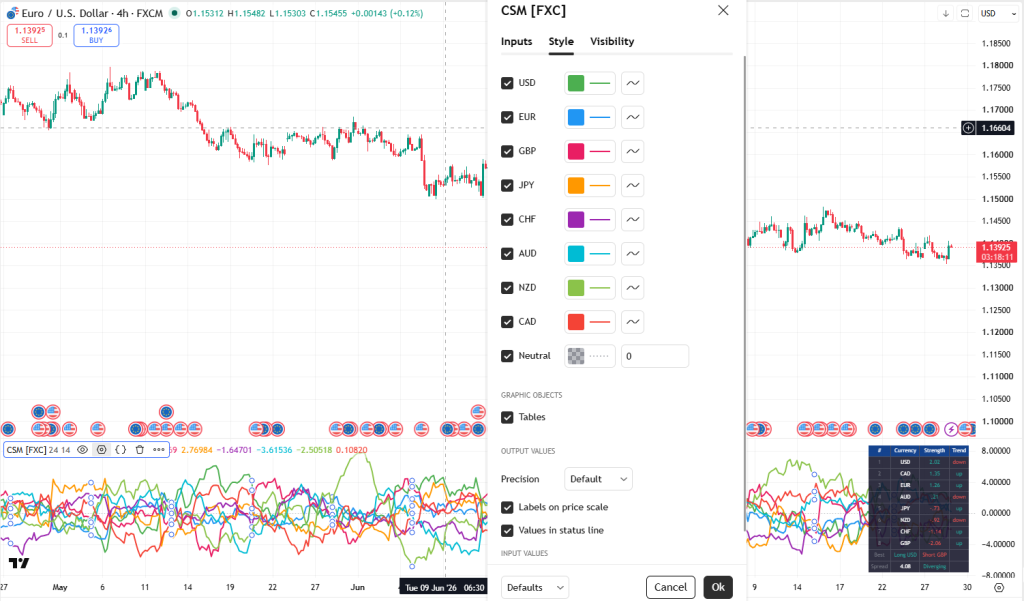
The defaults work on most charts, and there are only a few inputs to think about:
- Strength Lookback: how many bars back each move is measured over. Default 24. Lengthen it for swing trading, shorten it for intraday.
- ATR Length: the volatility yardstick every move is divided by. Default 14.
- Symbol Prefix: leave this blank on most charts. If the pairs do not load, set it to your data provider, for example OANDA: or FX:. This is the one input most likely to need a change.
- Show Ranking Table and Plot Strength Lines: toggles for the table and the eight lines, on by default.
How to add it on TradingView
- Open the script page: Currency Strength Meter [ForexCracked] (link below).
- Click the star to add it to your favourite indicators.
- On your chart, open the Indicators menu, go to Favourites, and click Currency Strength Meter [ForexCracked].
- If the pairs do not plot, open the settings and set the Symbol Prefix to your provider.
Currency Strength Meter [ForexCracked]
![Currency Strength Meter [ForexCracked]](https://www.forexcracked.com/wp-content/uploads/2026/07/currency-strength-meter-featured.png)
A free, open-source TradingView indicator that ranks the eight major currencies in ATR units and names the strongest and weakest as the pair to watch.
Pros
- Ranks all 8 majors across all 28 crosses
- ATR-normalized so quiet pairs are not drowned out
- Names the Best Pair and shows strength trend
- Spread reading flags divergence vs drift
- Free, open-source, works on any FX chart
Cons
- Frames the trade, does not time the entry
- A ranking is a shortlist, not a signal
- Needs the right Symbol Prefix on some data providers
- Strong currencies can still reverse
Summary
We built this because every strength meter we tried averaged percent change and let the loudest pair dominate the ranking. This one measures every move in ATR units, ranks the eight majors fairly, names the Best Pair, and reads the Spread so you know when the ranking is worth acting on. Free and open-source.
 Need a TradingView account?The free plan runs this indicator, with charts, alerts and watchlists.
Start free
Need a TradingView account?The free plan runs this indicator, with charts, alerts and watchlists.
Start free

 Built by ForexCrackedWe tested 1,200+ indicators. Then we built our own.Six years of reviewing EAs and indicators went into FXC Fusion: two engines, the seven-panel cockpit, MT4 and MT5, from the team behind this site.
How to trade with it
A strength meter frames a trade, it does not time one. The cleanest way to use this is in order. Read the Spread first. If it says Drifting, the ranking is not telling you much, so wait. If it says Diverging, take the Best Pair as a shortlist, not an entry, since it tells you where the divergence is and not when to get in. Prefer a currency that is both highly ranked and still strengthening over one that is highly ranked and fading. Then drop to your own entry method on that pair, confirm the setup on the chart, and manage the trade with a stop and a fixed account risk. The meter points you at the right pair. Your entry rules still do the rest.
The MetaTrader version and the strategy behind it
Prefer MetaTrader, want it live in your browser, or want the strategy behind a strength meter? We publish the same idea in a few forms. Grab the best currency strength meter indicator for MT4 and MT5, open the live currency heat map for the same strong against weak read with nothing to install, follow the currency strength meter strategy for trading strong against weak, browse every currency strength meter tool we have collected, or explore the full free forex indicators library.
Frequently Asked Questions
Add the Currency Strength Meter on TradingView
The Currency Strength Meter is free and open-source. Add it to your charts here: Currency Strength Meter on TradingView
Risk disclaimer: The Currency Strength Meter is an analytical tool that ranks relative currency strength from price action. It does not predict future price movement and it does not place trades. Strong currencies reverse, and results depend on market conditions, your settings, and your own execution and risk management. This is shared for educational purposes and is not financial advice.


Discussion no comments yet
Is this still working?
Nothing here yet
No one has asked anything about Currency Strength Meter for TradingView: Rank the 8 Majors i yet. First question gets answered.