Chapter 1 of 7 · Prop Firm Trading Course

Prop Trading Basics

What prop trading actually is, how a funded account works, and why the rules exist. Start here if the model itself is new. Each lesson takes about 9 minutes and ends with a short quiz.

You'll learn to Explain what a firm means when it says "funded" Separate the headline account size from the money you can actually lose Work out what a challenge fee is worth before you pay one
13 lessons out Reading time: 2 h 0 min Level: Beginner
Start with lesson 1 What Is Prop Trading? How Proprietary Trading Works · 9 min
Start lesson 1
Know this already? Take the chapter quiz 10 questions drawn from all 13 lessons. Pass at 70% and skip ahead.
Take the quiz
13 lessons out
Progress saves on this device, no sign-up

Moneta Funded is our featured prop firm and wrote the lessons in this course. We may earn a commission from links on this page. It does not change what we publish elsewhere.

Lesson 01 Start here

Prop trading isn't free money. It's access, and it comes with a rule set attached.

9min Reading
Reading 9 min
Sections 9
Quiz 5 questions
Beginner Quiz

In this lesson

  1. What does prop trading mean?
  2. How does retail prop trading work?
  3. Does a funded trader actually get the firm's money?
  4. Why do prop firms have so many rules?
  5. Prop trading vs trading your own account
  6. What you are really buying
  7. Who uses prop firms?
  8. What are the downsides?
  9. The main thing to understand

After this lesson you can

  • Explain what a firm means when it says "funded"
  • Separate the headline account size from the money you can actually lose
  • Say why the rules exist rather than resenting them
Lesson 02

A $100,000 account may sound enormous. The more important number might be $5,000.

10min Reading
Reading 10 min
Sections 11
Quiz 5 questions
Beginner Calculator

In this lesson

  1. What is a funded account?
  2. Step 1: choosing an account
  3. Step 2: the evaluation
  4. Step 3: passing the challenge
  5. Step 4: trading the funded account
  6. The account balance is not your risk budget
  7. Daily loss and maximum loss
  8. What happens when you make a profit?
  9. What is an account breach?
  10. The question worth starting from
  11. What comes next?

After this lesson you can

  • Walk the route from buying a challenge to receiving a payout
  • Tell a static drawdown from a trailing one, and say why it matters
  • Check a strategy against a rule set before paying for the account
Lesson 03

The better option isn't the one that gets funded fastest. It's the one whose rules fit how you already trade.

11min Reading
Reading 11 min
Sections 10
Quiz 5 questions
Intermediate Decision exercise

In this lesson

  1. What is a prop firm challenge?
  2. What is instant funding?
  3. Why choose a challenge?
  4. Why choose instant funding?
  5. The drawdown matters more than the account size
  6. Think about payouts before you think about passing
  7. Which type suits a conservative trader?
  8. What about aggressive traders?
  9. Questions to ask before choosing
  10. So, which is better?

After this lesson you can

  • Compare two programs on drawdown and payout terms rather than on the word instant
  • Say which route suits your own pace and temperament
  • Ask the five questions that matter before paying any account fee
Lesson 04

Instant funding removes the traditional challenge. It does not remove the challenge of trading well.

12min Reading
Reading 12 min
Sections 13
Quiz 5 questions
Beginner Worst stretch

In this lesson

  1. What is instant funding?
  2. The main difference is what you are not chasing
  3. That does not mean the account is easier
  4. A $100,000 account does not give you $100,000 of risk
  5. Static or trailing matters as much as the percentage
  6. Daily loss can catch traders by surprise
  7. A profit isn't a payout yet
  8. Who is instant funding best suited to?
  9. Be careful with the price of the account
  10. Instant funding still requires patience
  11. Is instant funding better than a challenge?
  12. Before you buy one
  13. The main thing to understand

After this lesson you can

  • Say what an instant account removes and what it keeps
  • Work out how daily limits, trailing drawdown and correlated trades shrink the room on an instant account
  • Test an instant program against your own worst stretch before paying for it
Lesson 05

The balance tells you the size of the account. The drawdown rules tell you how much room you have to trade.

6min Reading
Reading 6 min
Sections 7
Quiz 5 questions
Beginner Quiz

In this lesson

  1. What does simulated capital mean?
  2. How is live capital different?
  3. Why keep the trader's account separate from the firm's capital?
  4. Can you receive a real payout from simulated trading?
  5. A $100,000 simulated account is not $100,000 of risk
  6. Is a simulated funded account just a demo?
  7. What should traders take from this?

After this lesson you can

  • Tell simulated capital from live capital, and say which one a funded balance often is
  • Explain how a simulated account can still pay out real money
  • Separate what the firm does with your trades from the rules that govern your account
Lesson 06

Making money is easy to measure. The rules are there to show how you made it, and what you could have lost on the way.

7min Reading
Reading 7 min
Sections 9
Quiz 5 questions
Beginner Quiz

In this lesson

  1. Why the firm has to control risk
  2. Profit targets are only half the challenge
  3. Why daily loss limits exist
  4. Why rules make traders easier to compare
  5. Why some firms have minimum trading days
  6. Why some strategies are restricted
  7. Rules don't automatically make a firm good
  8. Why some traders end up fighting the rules
  9. The main takeaway

After this lesson you can

  • Say what each common prop rule protects against, from loss limits to minimum trading days
  • Read a challenge's profit target and loss limits as one package, not one at a time
  • Tell a rule you should trade within from an account that simply doesn't suit your strategy
Lesson 07

A profit target should indicate performance, not change it.

11min Reading
Reading 11 min
Sections 9
Quiz 5 questions
Beginner Decision exercise

In this lesson

  1. What is a profit target?
  2. Profit targets can be all over the place
  3. Profit targets are only half the equation
  4. Where traders get it wrong
  5. Your normal profit and loss matters
  6. What happens when you start off badly?
  7. You may not have passed just because you hit the profit target
  8. What happens when your profit target is close?
  9. A profit target should indicate performance, not change it

After this lesson you can

  • Turn a percentage target into the dollar figure you actually need, including after a bad start
  • Compare challenges on target against loss allowance, not on the target alone
  • Check the passing criteria that sit alongside the target before the first trade
Lesson 08

A daily loss limit is where the firm stops you, not how much you get to lose today.

9min Reading
Reading 9 min
Sections 9
Quiz 5 questions
Beginner Worked example Daily room

In this lesson

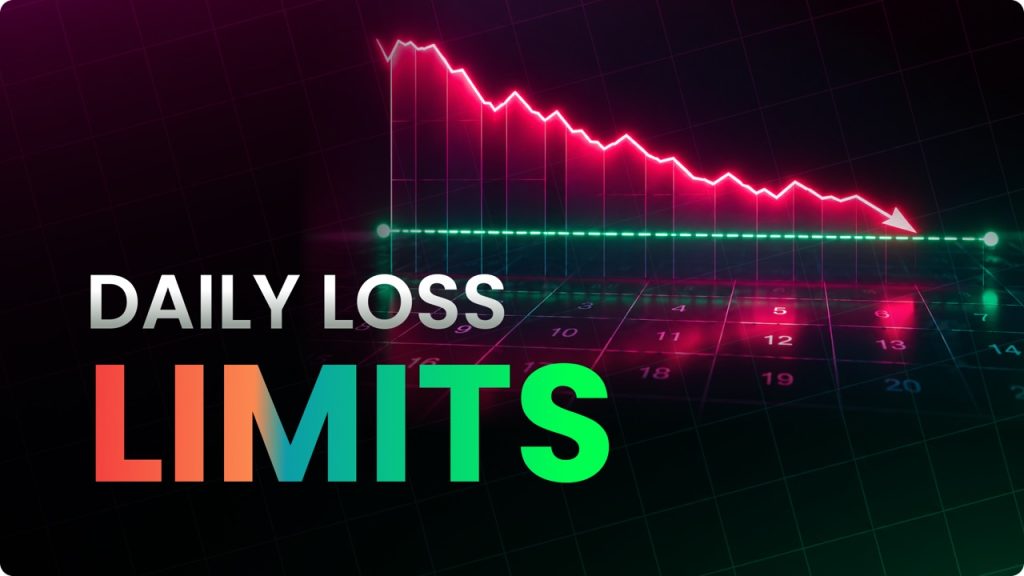
  1. What a daily loss limit means
  2. Balance or equity: check this first
  3. Morning profits can count too
  4. When does the daily loss reset?
  5. How traders end up near the limit
  6. Set your own daily stop
  7. Correlated trades use the limit faster
  8. News near the limit
  9. A risk control, not a daily allowance

After this lesson you can

  • Work out how much daily room you have left from your equity, not just your balance
  • Check how your firm measures the day: the reset time, open positions and morning profits
  • Set a personal daily stop that sits well inside the firm's breach level
Lesson 09

A maximum loss limit doesn't tell you how much you can lose. It tells you where the account stops.

12min Reading
Reading 12 min
Sections 9
Quiz 5 questions
Intermediate Drawdown playground Decision exercise

In this lesson

  1. What is a maximum loss limit?
  2. Static drawdown
  3. Trailing drawdown
  4. Why trailing drawdown trips up traders
  5. Maximum loss is your real boundary
  6. Payouts can change the room you have
  7. Don't trade at the edge of the limit
  8. Let the limit shape your risk before the first trade
  9. The account has to survive normal trading

After this lesson you can

  • Tell a static maximum loss from a trailing one, and work out the room each leaves
  • Size a position from the drawdown allowance rather than the account size
  • Spot when floating losses or a payout have quietly shrunk the room
Lesson 10

A good first payout feels good. A fifth or sixth tells you far more about how well you're managing the account.

11min Reading
Reading 11 min
Sections 11
Quiz 5 questions
Beginner Payout builder

In this lesson

  1. What is a prop firm payout?
  2. The profit split is only part of the payout
  3. When can you request a payout?
  4. Eligible profit
  5. What are consistency rules?
  6. What happens to the account after a payout?
  7. The first payout changes how you trade
  8. Should you withdraw as much as you can?
  9. A payout is not the finish line
  10. Most payout problems are rules nobody read
  11. The point of a funded account is repeatable payouts

After this lesson you can

  • Work out what a payout is worth from the split and the eligible profit
  • Read payout timing, consistency and minimum-day rules as one structure
  • Check what a withdrawal does to the account's room before requesting it
Lesson 11

A 90% split is 90% of eligible profit, and it's only worth something on an account you can keep.

6min Reading
Reading 6 min
Sections 6
Quiz 5 questions
Beginner Quiz

In this lesson

  1. What is a profit split?
  2. A higher split isn't always better
  3. How much difference does the split make?
  4. Some splits get better over time
  5. The split matters more when payouts repeat
  6. Do you want the highest split?

After this lesson you can

  • Work out what a split pays from the eligible profit, not the figure on your platform
  • Put a few points of split into dollars before you let it decide between two accounts
  • Check what it actually takes to reach an advertised split that improves over time
Lesson 12

A scaling plan rewards trading that stays boring. A bigger balance is no reason to change it.

7min Reading
Reading 7 min
Sections 8
Quiz 5 questions
Beginner Quiz

In this lesson

  1. How does scaling work?
  2. When scaling becomes a problem
  3. What actually scales?
  4. How do you qualify for scaling?
  5. Scaling rewards boring trading
  6. How a bigger account can change your head
  7. Is it worth choosing a firm for its scaling plan?
  8. Why scaling plans exist

After this lesson you can

  • Say what a scaling plan rewards and what it usually takes to qualify
  • Check whether the loss limits scale with the balance, not just the headline account size
  • Size from the room after a scale-up, so a bigger balance doesn't change how you trade
Lesson 13

Most challenges aren't lost to bad analysis. They're lost to trading differently because it's a challenge.

9min Reading
Reading 9 min
Sections 11
Quiz 5 questions
Beginner Challenge habits

In this lesson

  1. Risking too much
  2. Trying to pass too fast
  3. Revenge trading
  4. Moving stops
  5. Taking too many trades
  6. Ignoring correlation
  7. Rules that don't suit the strategy
  8. Not knowing the rules
  9. Passing, then turning reckless
  10. No daily stop of your own
  11. The challenge only tests what's already there

After this lesson you can

  • Spot the changes a challenge triggers in how you trade, before they cost you the account
  • Size risk from the distance to the breach level, not from the account size
  • Work out why a challenge failed before you buy the next one
CHAPTER 02 · COMING SOON
How Prop Firms Work

The programs, account sizes, drawdown rules and payout terms a prop firm sets, using our featured firm as the worked example.

9 lessons Beginner