

Gold Tripwire EA is an automated MetaTrader 5 (MT5) robot that trades XAUUSD (gold) with pending stop orders instead of market entries. It arms a buy stop above the market and a sell stop below it, waits for one of them to be tripped, then trails the position out in seconds. Its public MQL5 signal shows a $100 account at $233.55 across 172 trades in 2026, with nothing added or withdrawn. We ran a 100% real-tick backtest over the same window on the shipped defaults and read all 171 trades it placed. Free download at the bottom of this review.
TL;DR – Paid MT5 XAUUSD breakout scalper with a real, matched live account behind it. Hard stop on every trade, one position at a time, flat overnight and over weekends. But it wins small and loses big, every protective filter ships switched off, and the live account kept only 60% of the edge our test measured.
What is the Gold Tripwire EA?
Gold Tripwire EA is a MetaTrader 5 expert advisor for XAUUSD that places a buy stop above the market and a sell stop below it each session, roughly $39 apart. Whichever level is tripped becomes the trade. It carries a 300-point stop loss and a 1,500-point target from the moment it is sent, holds for a median of 15 seconds, and never opens a second position.
Core Strategy and Logic
We ran version 1.6 on a Tickmill demo, MT5 build 6140, over 39,293,862 real ticks on XAUUSD M15 from 1 March to 23 August 2026, then read the order and deal log instead of the summary page.
- A two-sided tripwire, not a signal – The EA armed 489 pending stop orders across 124 days, and on 123 of those days it armed both a buy stop and a sell stop. It has no view on direction. It waits for a level to break.
- Every order priced before it is live – All 489 pendings carried a stop exactly 300 points out and a target exactly 1,500 points out, attached at placement. Nothing depends on the EA still running to be protected.
- One position, one lotan class="fc-gloss-tip" data-slug="lot-size" tabindex="0">lot size – 171 of the 489 orders filled, 318 were cancelled, and no two positions were ever open at once. Volume never moved off 0.01. The no grid, no martingale and no averaging claims are all true and the log shows it.
- The target almost never pays – 170 of the 171 trades exited on a stop loss and exactly one reached the 1,500-point target. A tight trail moves the stop into profit within seconds, so the 300-point stop behind a 1,500-point target is not the risk-to-reward the account actually trades.
- Measured in seconds – Median holding time was 15 seconds, mean 55 seconds, longest 11 minutes 40 seconds. Total time in the market across nearly six months was 2 hours 39 minutes, or 0.064% of the period.
- Hard daily boundaries – Everything is cancelled and closed at 22:15 server time, new pendings go out at 01:15, and unfilled orders expire after 12 hours. Nothing is held overnight, into a Friday close, or over a weekend.
The shape is close to the pending-order gold scalper in Gold Reflex, which trails out on the same timescale, and it is the structural opposite of the Quantum Queen gold grid, where exposure builds instead of closing.
Please test in a demo account first for at least a week. Also, please familiarize yourself and understand how this MT5 Gold Robot works, then only use it in a real account.
Recommendations for the Gold Tripwire EA
- Minimum deposit – Both records ran $100 on 0.01 lots. That works, but one full stop is $3.00, or 3% of the balance, so it is only comfortable because the stop is small. Size from the drawdown, not the deposit.
- Pair and timeframe – XAUUSD only. The chart timeframe barely matters because entries are pending levels rather than bar signals, but M15 is what both records used.
- Account type – Raw spread or ECN, and nothing else. A median holding time of 15 seconds means the spread is a large share of every winner, and
inp_MaxSpreadis 0 by default so nothing stops a bad quote filling you. - VPS is required – A 15-second trade cannot survive a laggy home connection, and the trail is what closes almost every position (FXVM).
- Work a full stop and a bad day out against your own balance with the lot size optimizer and the drawdown calculator (Find the Perfect Broker For You Here).
Performance Review: Live Signal and Our Own Matched Backtest
1. The live account, read straight
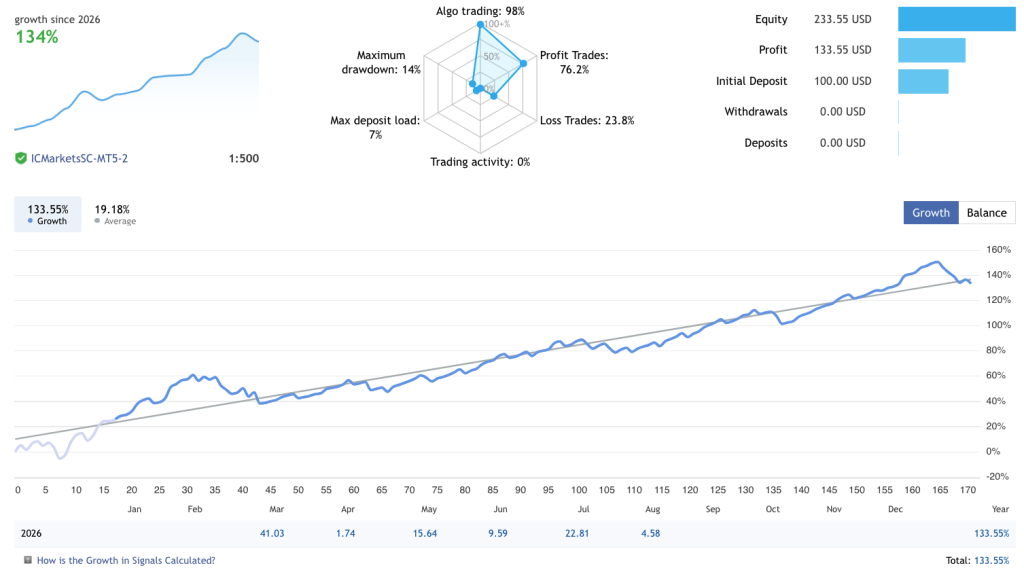
Deposits and withdrawals are both zero, so the headline growth figure needs none of the rebuilding a Myfxbook percentage usually does. The record runs from March to August 2026 on an IC Markets account at 1:500, 9 trades a week, algo trading 98%.
What makes this signal useful is that it is small and honest about size. Maximum deposit load never passed 7.02%, so there is no lot ladder hiding underneath the curve.
| Month, 2026 | Live net | Our test, same month |
|---|---|---|
| March | +$41.03 | +$67.53 |
| April | +$2.45 | +$63.82 |
| May | +$22.44 | +$13.33 |
| June | +$15.92 | +$34.62 |
| July | +$41.48 | +$41.84 |
| August, to the 23rd | +$10.23 | +$12.53 |
Six positive months on both sides. April is the outlier and it runs the wrong way for the vendor: our clean test made $63.82 in a month the real account made $2.45.
2. Our matched real-tick test agrees on almost everything
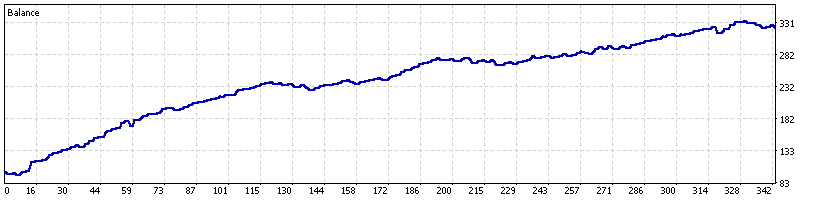
We matched the window deliberately so the two records could be laid on top of each other. They line up more closely than any pair we have compared this year:
- 171 trades against 172
- 55 seconds average holding time against 54
- 81 buys and 90 sells against 80 and 92
- a worst trade of -$8.74 against -$8.73
That level of agreement means two things. The live account really is running this logic rather than a hand-tuned variant, and the strategy in a clean tester behaves the way it behaves in the market. It also settles the vendor’s structural claims. Z-Score came out at 0.80 with 57.63% confidence, which is statistically indistinguishable from independent trades. A grid or recovery basket produces a strongly negative Z-Score because its trades cluster. This one does not.
3. Where the live account loses a third of the edge
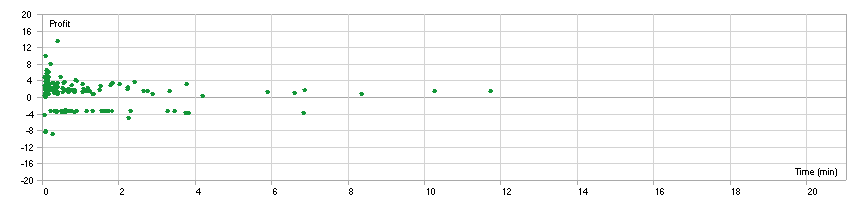
 Profit against holding time. The wall at the left edge is the whole strategy: 76 of 171 trades closed in under 10 seconds.
Our test netted $1.31 a trade. The live account netted $0.78. Same window, same logic, near-identical trade count, and the real money kept 59.5% of what the clean run measured. The rest went to spread, slippage and fill quality, which on a 15-second gold trade is not a rounding error.
| Metric | Live signal ($100, 1:500) | Our backtest ($100, 1:100) |
|---|---|---|
| Period | 1 Mar to 21 Aug 2026 | 1 Mar to 23 Aug 2026 |
| Closed trades | 172 | 171 |
| Net profit | +$133.55 | +$223.41 |
| Profit factor | 1.81 | 2.72 |
| Win rate | 76.16% | 80.70% |
| Average win / loss | $2.28 / -$4.01 | $2.53 / -$3.80 |
| Break-even win rate | 63.8% | 60.0% |
| Best / worst trade | +$10.00 / -$8.73 | +$13.61 / -$8.74 |
| Max drawdown | 14.02% balance | 5.10% balance, 5.70% equity |
| Longest losing run | 4 trades, -$16.28 | 2 trades, -$7.31 |
| Average holding time | 54 seconds | 55 seconds |
| Recovery factor | 5.91 | 16.36 |
The average loss is larger than the average win in both records, which is the single most important line in the table. Payoff ratio (average win divided by average loss) is 0.57 live and 0.67 in our test, so nothing here is carried by big winners. It is carried entirely by being right often. The live account breaks even at 63.8% and is running 76.16%, so it has about 12 points of cushion. Lose four of those points to a wider-spread broker and most of the profit goes with them.
The drawdown gap tells the same story from the other side. Our clean run gave back 5.10% at worst; the live account gave back 14.02%, which is 2.75 times deeper on the same strategy and the same lot size.
4. The 300-point stop does not always hold
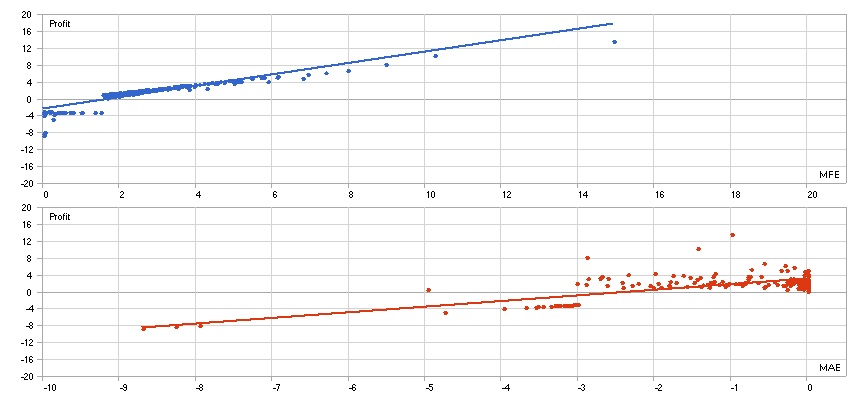
Every order is protected, but protection is a price, not a promise. 11 of the 33 losses in our test closed beyond the 300-point stop, and three of them roughly tripled it at -$8.77, -$8.33 and -$8.02. In a tester with clean liquidity assumptions.
The timing of two of those is the useful part. They opened at 15:30:02 on 2 July and 15:30:08 on 12 August, inside the minute US data releases land. Across the whole test, the four trades that opened in that minute lost $15.20 between them, against a total net of $223.41. The news filter that would have skipped them ships switched off.
An $8.77 loss on a $100 account is survivable, and switching the news filter on is one checkbox. But a system living on a 12-point cushion cannot afford many stops that come in at three times their stated size. Our 12-point EA scam checklist covers why a headline stop loss is worth less than the excursion chart behind it.
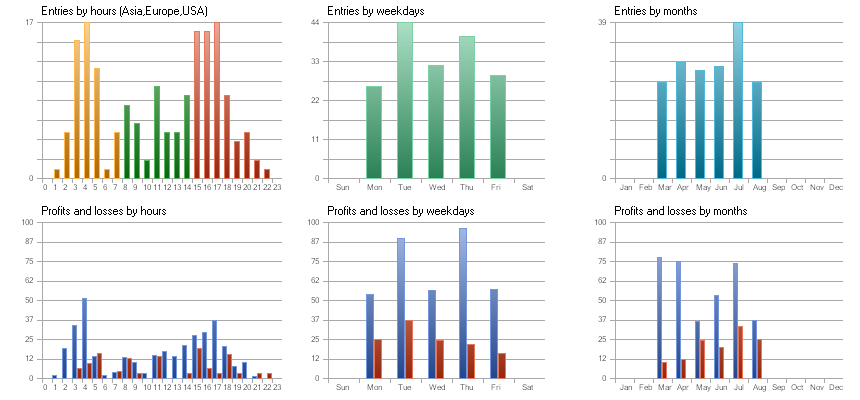
 Entries and results by hour, weekday and month. Nothing depends on one window.
One genuinely reassuring finding sits underneath all of this. Split our 171 trades by session and all three pay: 56 trades in the Asian hours for +$83.90, 45 in London for +$61.84, 70 in New York for +$77.67. The best 10 trades account for 31.8% of net profit, and 106 separate days produced a trade, 61 of them a single one. This is not a curve resting on one week in March.
Gold Tripwire EA

An MT5 XAUUSD breakout scalper that arms pending stops either side of the market, holds for a median of 15 seconds, and puts a real stop loss on all 489 orders it sent in our test.
Pros
- Every one of the 489 orders it sent in our test carried a server-side stop loss and take profit before it was live
- Only one position was ever open at a time, on fixed 0.01 lots, with a Z-Score of 0.80 that shows no basket-style trade dependency
- The live signal and our independent backtest agree to within one trade, one second of holding time, and one cent of worst trade
- It is out of the market 99.9% of the time and holds nothing overnight, on a Friday, or through a weekend
- Profit is spread across all six months and all three sessions rather than sitting on one lucky run
Cons
- Average win is $2.28 against an average loss of $4.01 on the live account, so it breaks even at a 63.8% strike rate
- The live account netted $0.78 a trade where our matched test netted $1.31, and its drawdown was 2.75 times deeper
- The news filter, the spread cap, the daily loss limit and the equity protection all ship switched off
- 11 of the 33 losses in our test ran past the 300-point stop, and the two worst opened inside the 15:30 data minute
Summary
The account is clean: $100 in, nothing added, 172 trades, now $233.55, and our matched real-tick run produced 171 trades with the same holding time and the same direction split. The catch is the shape of the edge. Average win is smaller than average loss in both records, so the whole result rests on how often it is right, and a third of the losses in our test broke through the 300-point stop.
How it compares to the gold scalpers we have already tested
| Gold Tripwire EA | Gold Reflex EA | Gold Ambush EA | |
|---|---|---|---|
| Entry | Two-sided pending stops | Pending stops, instant trail | Breakout |
| Profit factor (live) | 1.81 | 7.72 | 2.60 |
| Max drawdown (live) | 14.02% | 6.40% | 14.74% |
| Average holding time (live) | 54 seconds | 48 seconds | 16 minutes |
| Live sample | 172 trades, ~5.5 months | 54 trades, ~4 months | 127 trades, ~3 months |
| Stop on every trade | Yes | Yes | Yes |
Gold Reflex has the better ratios on a much thinner sample. Gold Tripwire has three times the trades, on a drawdown in the same band as Gold Ambush.
Frequently Asked Questions (FAQ)
inp_UsePropFirmMode is on by default, and the daily loss limit, equity protection and daily profit target inputs exist for exactly that use. All three ship switched off, so you have to set them yourself. In its favour, it holds one position at a time with a stop attached and closes flat before the daily and Friday boundaries, which is the behaviour most challenge rules want.Conclusion
Gold Tripwire EA does the boring things right. Every order carries a server-side stop, only one position is ever open, the lot never moves, it holds nothing overnight, and a live account and an independent real-tick test agree on it to within one trade. However, the edge is shaped so that a losing trade costs more than a winning one earns, which leaves the whole result standing on a 12-point win-rate cushion, and the real account kept only 60% of what the clean test measured. It suits a trader with genuinely tight gold pricing who will switch the shipped-off filters on. It does not suit anyone reading the backtest as a forecast.

