

Channel Breakout EA is a free gold trading bot for MetaTrader 5 (MT5) that trades XAUUSD breakouts: it waits with pending stop orders at recent highs and lows, with a stop loss on every order. For this 2026 review we read our tester logs leg by leg, matched our real-tick backtest against a live account that started with $60, and ran it back to 2020. Free download at the bottom.
The part worth reading is what happens on one breakout. Several orders sit at the same price and fill together, a lock about $1 into profit closes most of them, and a few far-target legs earn about half the money. That makes the deposit, not the strategy, the main risk.
TL;DR – Free MT5 gold breakout robot: pending stops at channel highs and lows, a stop on every leg, no grid or martingale. Up to six legs fill on one breakout, so below $1,000 the 0.01 minimum turns one stack into a large bet. Our test matched most of its live trades from August.
What is the Channel Breakout EA?
Channel Breakout EA is a gold trading bot for MT5 that trades XAUUSD. It places sell stop orders at a recent low and buy stop orders at a recent high, several at the same level, each with its own stop loss and take profit. When a breakout fills them, it moves every stop to about $1 in profit as soon as it can, then lets the targets work.
Core Strategy and Logic
Everything below comes from the logs of our own tests on the default preset: all of 2026 on Tickmill real ticks at a fixed 0.01 lot, 256 positions in all.
- Pending orders at the channel – Entries are pending orders: sell stops at a recent low and buy stops at a recent high, often placed days before price reaches them. Nothing trades until price breaks through, which makes it a breakout robot. In 2026 that came to 154 sells and 101 buys.
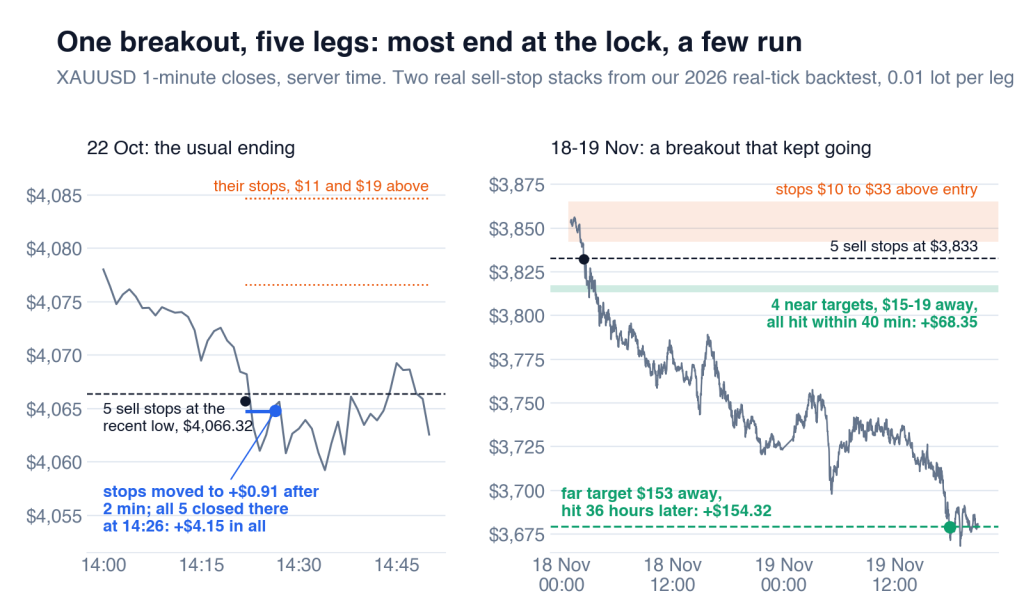
- Several legs at one price – The default preset combines several strategies, and their orders often share a level. When price breaks it, they all fill in the same second: 189 of the 256 positions filled together with others, up to six at once. We call each of these positions a leg.
- A stop and a target on every leg – Every order carries a stop loss and a take profit from the moment it is placed. Most legs have a near target about $18 away with a stop about $21 away. Some have a far target about $177 away behind a stop of about $39. All of these scale with the gold price: the near stop was $8.70 in 2020, when gold traded near $1,800.
- The $1 lock does most of the exiting – Once a leg is about $1 in profit, the EA moves its stop to roughly +$1 (median two minutes after the fill). 177 of the 256 legs closed there, 63 reached a target and 16 hit their original stop. It is a break-even stop with a dollar of profit on top.
- No grid, no martingale, no averaging – Lots are fixed per leg, and no leg ever filled at a worse price than a leg already open. Extra legs came either at the same price or further in the direction of the move. So there is no grid and no martingale, but six legs on one breakout are still six times the exposure of one.
- Any chart timeframe – It made the same trades to the cent on H1, M15 and M1 charts.
The stacking is the same pattern we found in Gold Ambush EA, where three strategies fired on one breakout in the same second. The exit is the opposite of Gold Trend Lock EA, which only locks a win at +$16.
Please test in a demo account first for at least a week. Also, please familiarize yourself and understand how this Channel Breakout EA works, then only use it in a real account.
Channel Breakout EA Settings
The EA ships with 20 presets in one dropdown. In the version we post, 18 of them start. Two (V3-A-Active and HiWR-V2tr+) stop at once with an “incorrect input parameters” message. This review covers the default, Combo Safe. These are the inputs that change how it trades:
| Input | Default | Notes |
|---|---|---|
| Mode | Combo Safe | The preset. Every working preset made money over May to November 2026 at 0.01 in our tests, which says more about gold this year than about the presets |
| InpUseFixedLot / InpFixedLot | false / 0.01 | true sets the same lot on every leg |
| Inp_Lot_Percent | 11.6 | The floating lot: about 0.01 per $550 to $850 of balance on each leg, never below 0.01 |
| InpMaxAtPrice | 0 (off) | Caps how many orders can wait at one price, which limits the stacking (see Recommendations) |
| InpMaxSpreadPoints | 300 | No new orders while the spread is wider |
| InpSmoothing | Auto | “Protection” overlays. In 2026 they moved the year’s result between +$1,657 and +$2,193 at 0.01 without changing how it trades |
| Prop guard (daily %, max %, drawdown limits) | 0 (off) | Closes trades and orders at a loss limit. Tested in the Performance Review |
| InpSimSelfCheck | false | true prints every preset’s simulated last 30 days to the journal |
Recommendations for the Channel Breakout EA
- Deposit – Start from about $1,000 per 0.01 lot of leg size. At the default floating lot from $1,000 up, the worst stack in 2026 had about 16% of the balance at risk if every stop had been hit. Below that the 0.01 minimum takes over and the share grows fast (section 4 below). The lot size optimizer helps when you size up.
- Lot setting – The default floating lot compounds every win into bigger legs. A fixed 0.01 per $1,000 is the calmer way to run it.
- Orders at one price – Setting InpMaxAtPrice to 2 is the trade-off we would test first. In 2026 at 0.01 it kept 71% of the profit (+$1,273.02, profit factor 5.23) with at most three legs open, and the worst stack fell from 10.9% to 6.6% of the balance. A cap of 1 cut the profit to +$632.25, but on a $300 account it brought the worst stack down from 35% to 15%.
- Pair and timeframe – XAUUSD only. Any chart timeframe works.
- Leverage – Margin is small next to the stop risk (about $9 per 0.01 leg at 1:500), so 1:100 is enough on a sized account.
- Backtesting – Use “every tick based on real ticks”. The $1 lock depends on the exact order of ticks, so 1-minute OHLC and generated ticks read high (section 5).
- VPS – Channel Breakout EA should run on a VPS continuously, since its orders wait for days and fill at any hour.
- Broker – A low-spread ECN account. A 250 ms delay changed nothing in our 2026 test. Compare forex brokers here.
Performance Review: Is This Gold Trading Bot Profitable?
1. The live account
The EA runs on one long live account under its original name, Gold Beaver: Weltrade, MT5, 1:500. It started on 28 May 2026 with $60, and $117.57 more was added on 5 June. On 20 November it showed +$864.86 over 148 trades and a 7.64 profit factor. Every trade was a 0.01 leg, and the lot never grew with the balance.
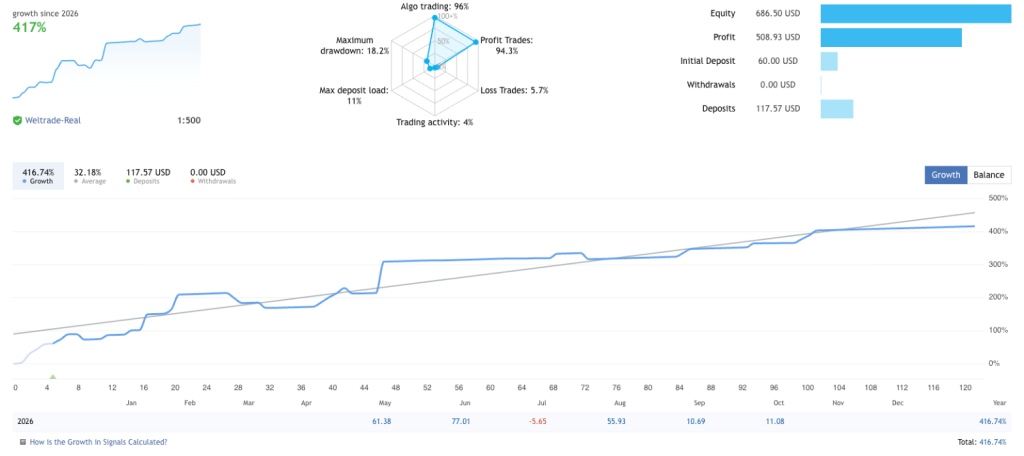
The 18.2% equity drawdown is not a loser held open. It is one open trade at -$17.62 on a $96.83 balance on 5 June, the day both deposits went in. Losing legs close at their stops: the worst live trade was -$24.47. The deeper dollar dips, -$57 in September and -$53 in August, are several legs open at once: at 0.01, no single leg can lose that much.
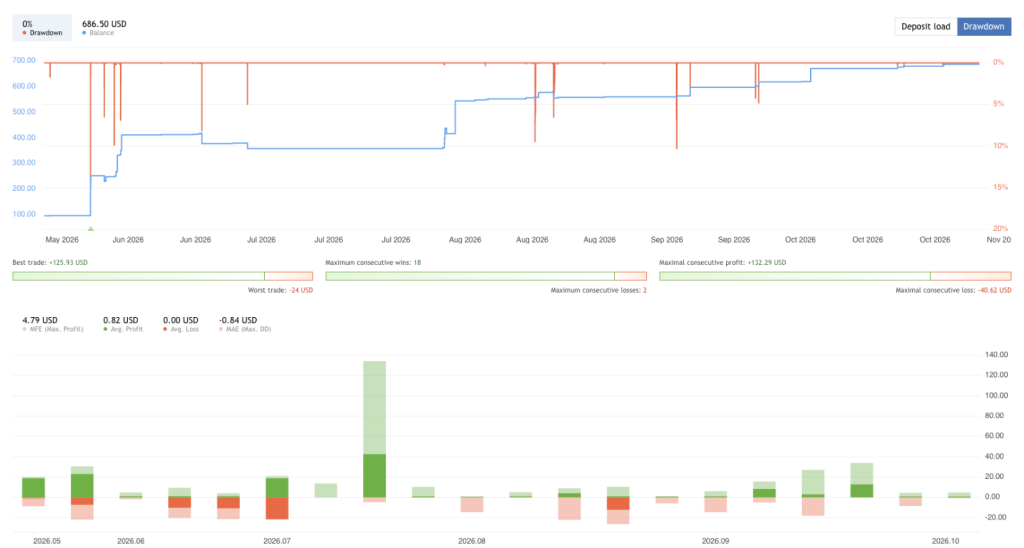
Four large legs (+$152.82, +$125.93, +$63.54 and +$60.92) made 47% of the account’s profit.
2. Does our backtest match the live account?
We ran the default preset at a fixed 0.01 over the live account’s window and compared each closed trade by its close time.
From August the two records are mostly the same trades. Our test closed a trade within five minutes of 82 of the 116 live trades from August to November. In October all 27 live trades had a match, +$68.45 live against +$67.49 in our test. September matched least (5 of 17), before the October updates, and the last live trades fall after the end of our data.
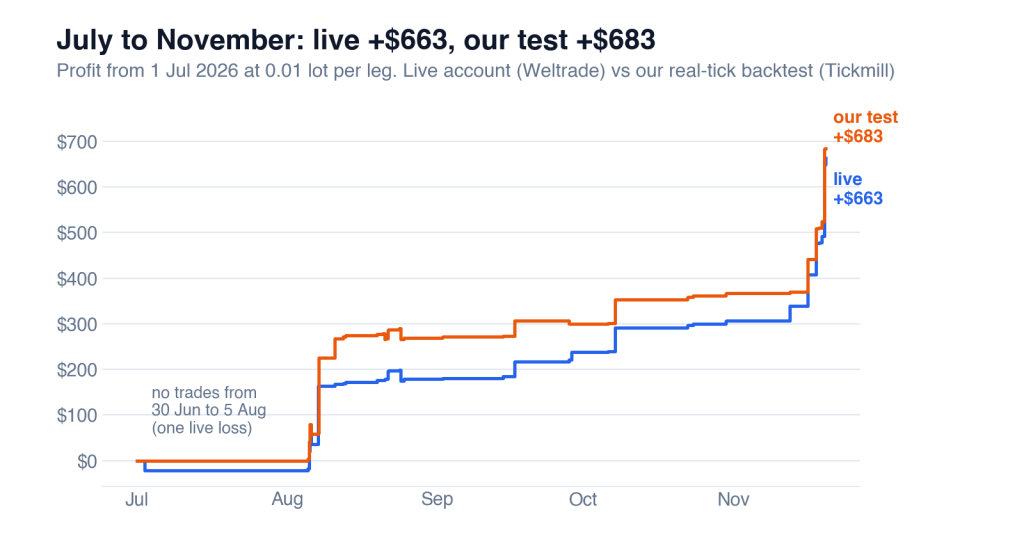
June doesn’t match any preset well: the default preset was only added in a late-June update, and the live account ran another one before it. The file we post is the late-October version, and it matches the live trades on both sides of that update.
3. Our 2026 real-tick test
From 2 January to 19 November 2026 at a fixed 0.01 lot on $1,000 (Tickmill real ticks, 1:500, default settings otherwise):
| Metric | Result |
|---|---|
| Net profit | +$1,790.89 |
| Positions (legs) | 256 |
| Profit factor | 6.52 |
| Max balance / equity drawdown | 6.41% / 13.52% ($163.72) |
| Worst day | -$47.31 (13 January) |
| Weeks with no new trade | 13 of 46 |
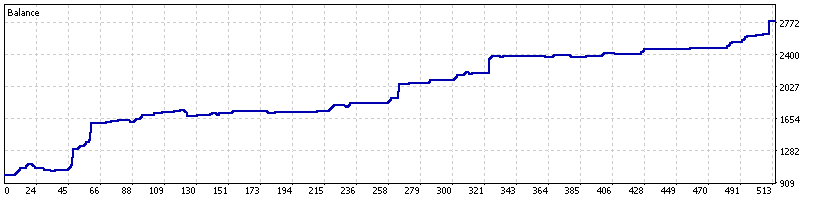
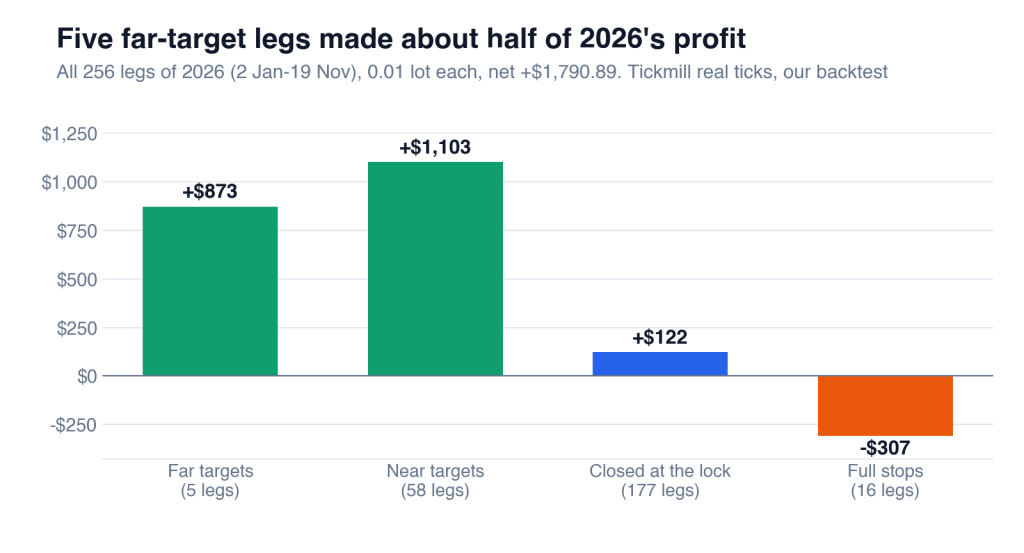
The profit sits in a handful of legs and a few months. January alone made $633, and July had no trades at all: the longest quiet spell was 36 days, from 30 June to 5 August. The live account went through the same gap with a single losing trade.
4. The deposit decides the risk
The stop on every leg limits what one leg can lose, but a stack of five or six legs can lose them all at once. We measured the worst moment of 2026 for each start: what every open leg would have lost if all its stops had been hit together.
| Start (2026, real ticks) | Net profit | Deepest equity drop | Worst stack at risk |
|---|---|---|---|
| $60, default lot | +$2,207.29 | 65.04% | 176% of the balance |
| $100, default lot | +$2,215.88 | 52.71% | 105% |
| $300, default lot | +$2,899.11 | 32.06% | 35% |
| $1,000, default lot | +$5,854.50 | 13.96% | 16% |
| $10,000, default lot | +$58,383.50 | 16.42% | 16% |
| $1,000, fixed 0.01 | +$1,790.89 | 13.52% | 11% |
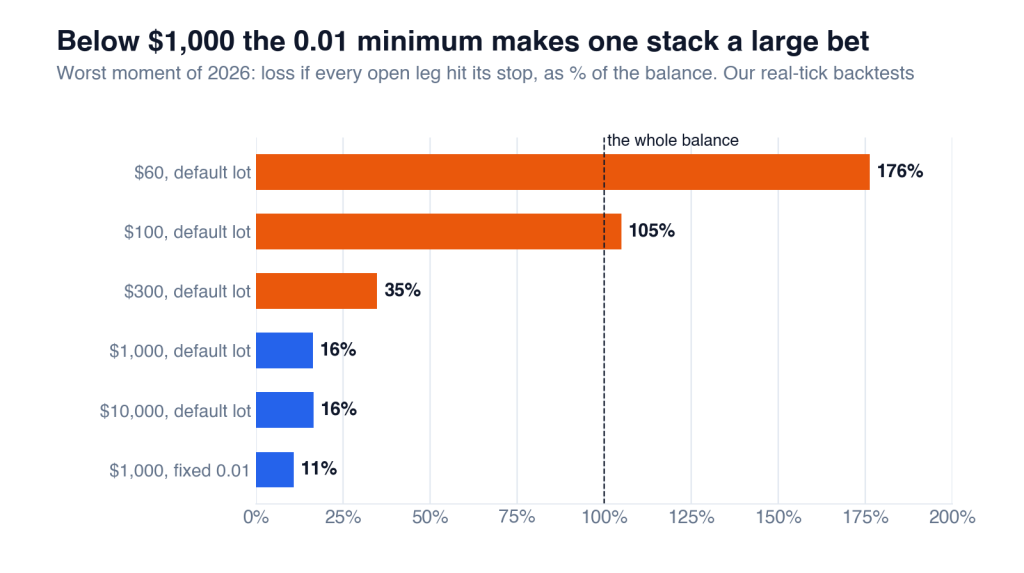
Below $1,000 the 0.01 floor turns one breakout into a bet on the whole account. No full stack was stopped out together in 2026, or in any year back to 2020: at most three legs hit their stops at once. That is the lock doing its job, and the small accounts above survived because of it. The live account’s $60 start is the same case: our test of it at 0.01 legs (no deposits) fell 67% below its peak equity at its worst moment.
The large net figures are compounding, not a forecast. The default lot grows with every win, so a good year like 2026 turns into big numbers on paper.
5. Earlier years
Real ticks on our test broker start in January 2026, so earlier years ran on 1-minute OHLC. On 2026 that model showed 24% more profit than real ticks (generated ticks 39% more), with the same trade count and drawdown, so read these rows as optimistic. Fixed 0.01 lot on $1,000:
| Year | Legs | Net profit | Profit factor | Full stops | Weeks with no new trade |
|---|---|---|---|---|---|
| 2020 | 217 | +$288.85 | 2.12 | 31 | 25 |
| 2021 | 235 | +$265.38 | 1.74 | 38 | 13 |
| 2022 | 234 | +$480.55 | 4.29 | 17 | 13 |
| 2023 | 224 | +$414.82 | 2.92 | 22 | 10 |
| 2024 | 189 | +$501.29 | 3.01 | 23 | 18 |
| 2025 | 281 | +$1,499.71 | 3.32 | 36 | 15 |
| 2026 (real ticks, to 19 Nov) | 256 | +$1,790.89 | 6.52 | 16 | 13 |
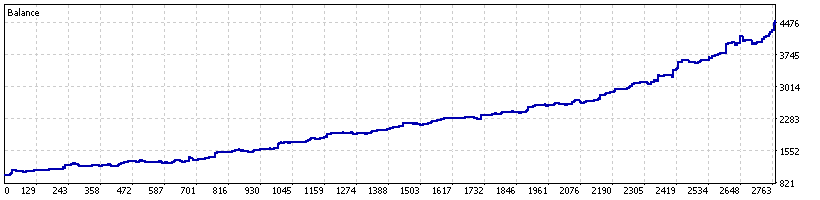
Every year made money at a fixed lot, and 2026 was by far its best. Compare years by profit factor, not dollars: the stops and targets grow with the gold price, so a 2026 leg risks about 2.5 times the dollars of a 2020 leg. Over 2025 and 2026 at the default floating lot (1-minute OHLC), our data gave a profit factor of 7.7 with a 22.7% equity drawdown.
6. Prop firm accounts
On $100,000 at 1:100 with the default lot, 2026 had two days that lost more than 4% of the day’s starting balance on closed trades (13 January and 19 March). We turned on the built-in prop guard at a 4% daily and 10% total loss limit:
| 2026, $100,000, 1:100 | No guard | Guard 4% / 10% |
|---|---|---|
| Net profit | +$589,976.97 | +$72,591.83 |
| Profit factor | 7.30 | 1.78 |
| Equity drawdown | 17.37% | 21.12% |
| Worst day (closed trades) | -5.51% | -3.21% |
| Legs closed early by the guard | 0 | 78 |
The guard keeps the daily limit but costs most of the edge. It fired 26 times, at losses of 2.2% to 3.2%, and closed stacked legs that the lock or the targets would have saved. For a challenge, a fixed small lot with InpMaxAtPrice at 1 or 2 is the safer route.
Channel Breakout EA

An MT5 XAUUSD breakout robot that stacks pending stop orders at channel highs and lows, puts a stop on every leg and locks each leg at about +$1. Our 2026 real-tick test made +$1,791 at 0.01 lot with a 6.52 profit factor and matched its live account.
Pros
- A stop loss on every leg from the moment the order is placed
- No grid, no martingale and no averaging in our logs
- Our real-tick test matched most live trades from August, all 27 in October
- Positive at a fixed lot in every year from 2020 to 2026
Cons
- Up to six legs fill on one breakout, so exposure multiplies
- Below $1,000 a single stack can risk more than the whole balance
- About half the profit comes from a few far-target legs
- Long quiet spells, up to 36 days without a trade in 2026
Summary
Our backtest matches most of its live account's trades, and every year we tested was positive at a fixed lot. However, one breakout can fill six legs at once, a few far-target legs carry half the profit, and below $1,000 the 0.01 minimum puts most of the balance on one stack. Size it at about $1,000 per 0.01 leg.

 Built by ForexCrackedWe tested 1,200+ indicators. Then we built our own.Six years of reviewing EAs and indicators went into FXC Fusion: two engines, the seven-panel cockpit, MT4 and MT5, from the team behind this site.
Your download will start automatically. If it doesn’t, click here.Right now a download can take up to a minute to start. Please wait a moment, or use click here.
How it compares to other gold breakout robots we have tested
| Channel Breakout EA | Gold Ambush EA | Gold Tripwire EA | |
|---|---|---|---|
| Entry | Pending stops at channel highs and lows | Pending stops beyond swing highs and lows | A buy stop and a sell stop each session |
| Positions on one breakout | Up to 6 | Up to 3 | 1 |
| Stop on every trade | Yes | Yes | Yes |
| Main exit | Lock at about +$1, targets | Trailing stop, no target | Tight trailing stop within seconds |
| Profit factor (live) | 7.64 | 2.60 | 1.81 |
| Max drawdown (live) | 18.2% equity, 14.33% balance | 18.31% equity, 14.74% balance | 14.02% balance |
| Live sample | 148 trades, 27 weeks | 127 trades, about 3 months | 172 trades, about 5.5 months |
The live records cover different windows, so read them as a rough guide. This one has the highest live profit factor and the longest record of the three, and also the most positions on a single breakout.
Frequently Asked Questions (FAQ)
Conclusion
Channel Breakout EA keeps a stop on every leg, never averages down, and its live account trades like our test. The catch is that one breakout is a stack. The money comes from the few legs that run, and the risk from how many legs one level fills, so the account size matters more than the preset. Start this gold trading bot on demo with a fixed 0.01 lot and at least $1,000, and judge the Channel Breakout EA free download over months, not weeks.


Discussion no comments yet
Is this still working?
Nothing here yet
No one has asked anything about Channel Breakout EA yet. First question gets answered.