
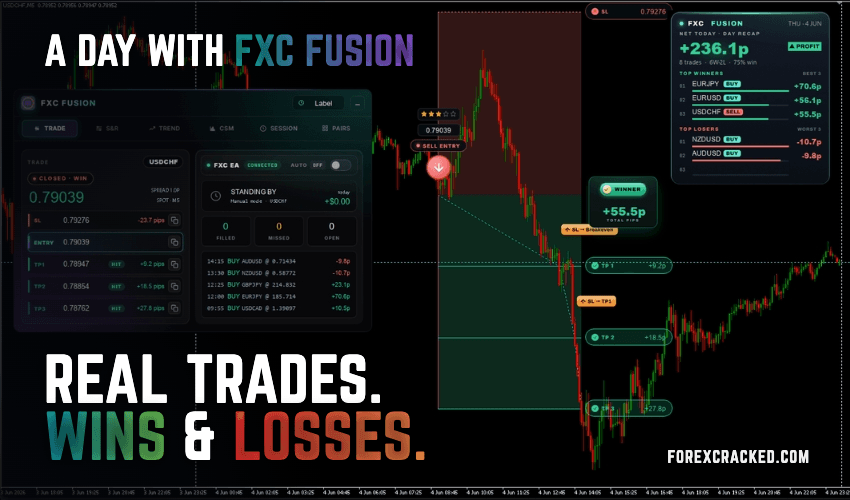
We have written about what FXC Fusion is and why we built it around one graded trade a day. This is the part that matters most: what that actually looks like in practice, with the wins and the losses both on the table.
The Founding 50 drop opens on Monday, June 22, and waitlisters get a 24-hour head start before it. So rather than describe a trading day, here is a real run you can watch, then a walk through how a single day fits together.
Twenty trading days with FXC Fusion on one chart: one graded setup a day, the full plan drawn each time, wins and losses
How a day actually runs
The honest version of a trading day with FXC Fusion is that, for long stretches, nothing happens. That is the point. The engine is not looking for something to do; it is waiting for one specific thing. Here is the shape of it.
- It waits. Instead of reacting to every move, the engine watches for a coil, a tight consolidation where price has gone quiet, and does nothing until one forms. Most of the chart is spent waiting, which is exactly what stops the overtrading.
- It scores. When price breaks out of that coil, the setup is graded from Q1 to Q5 before you ever see it as a trade. A weak break and a strong one do not look the same, so you are never guessing which signal to trust.
- It draws the plan. The moment a setup qualifies, the entry, the stop loss, and three take-profits are drawn on the chart. Nothing about your risk is improvised in the heat of the moment, because it was decided before the trade.
- You decide. You look at the grade and the plan and you take it or you skip it. That is the whole job. The cockpit around it shows the currency strength, the multi-timeframe trend, graded support and resistance, the session and a multi-pair view, so the one trade is taken in context, not blind.
- Then that pair is done. Once a setup fires for a pair, that pair is finished for the day. There is no second signal to talk you into a marginal re-entry. It resets, and you wait again.
It is closer to a disciplined breakout routine than to staring at arrows. Quieter, and a lot less tiring.
Real trades, the good and the bad
Numbers in a marketing image are easy to fake, so we would rather just show you setups the way they actually played out. Here are three from a recent run: a win that got tested, a clean one, and a loss. We show the loss on purpose.
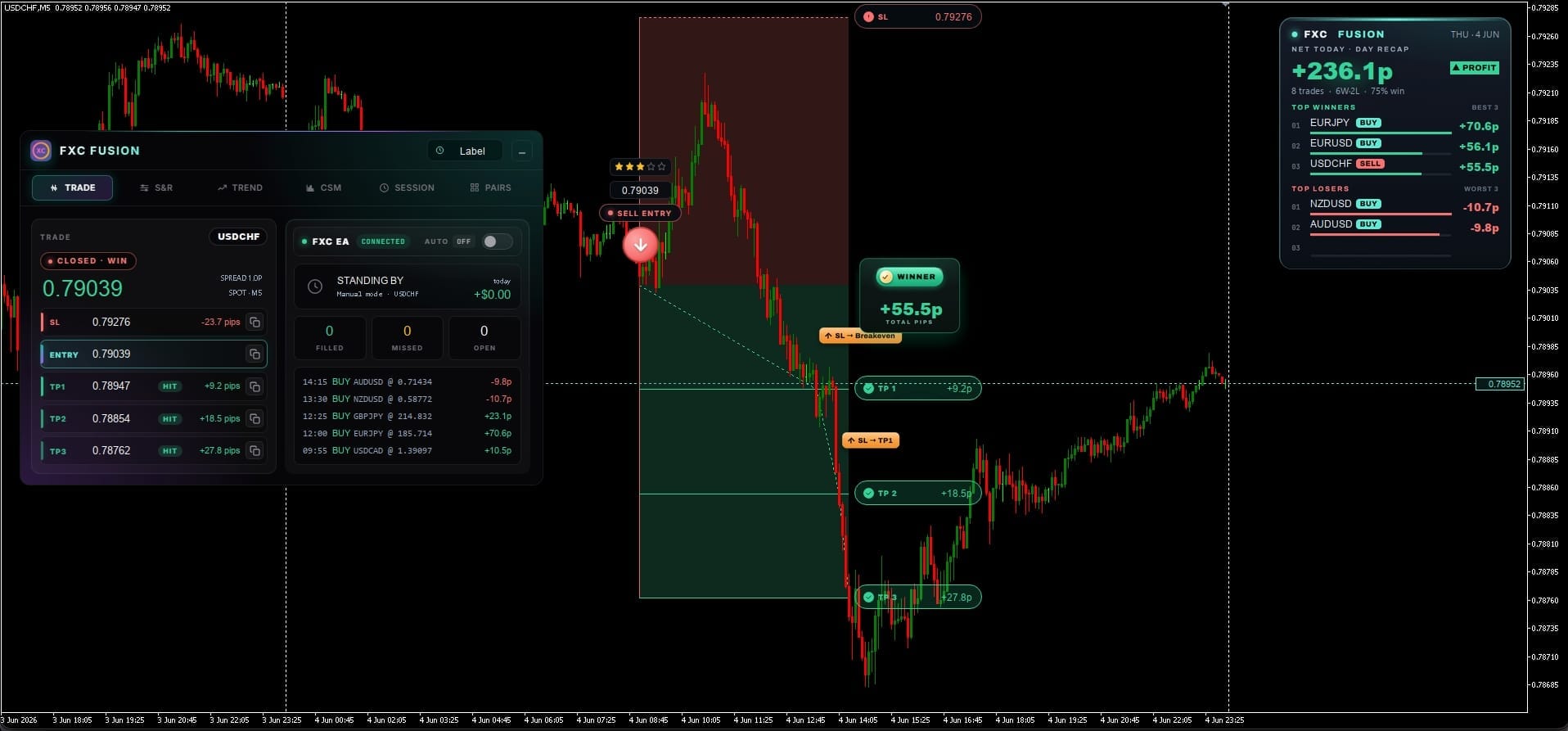
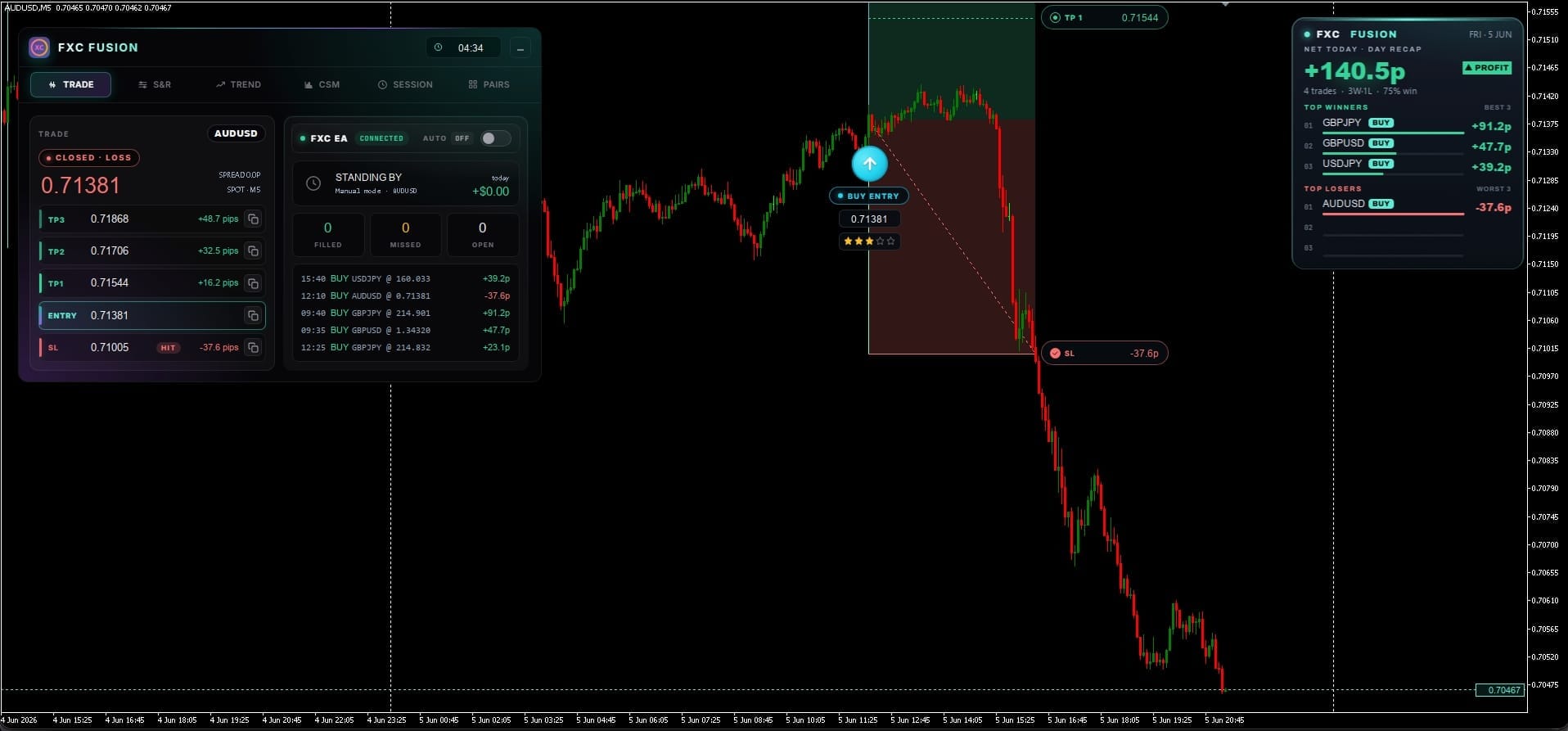
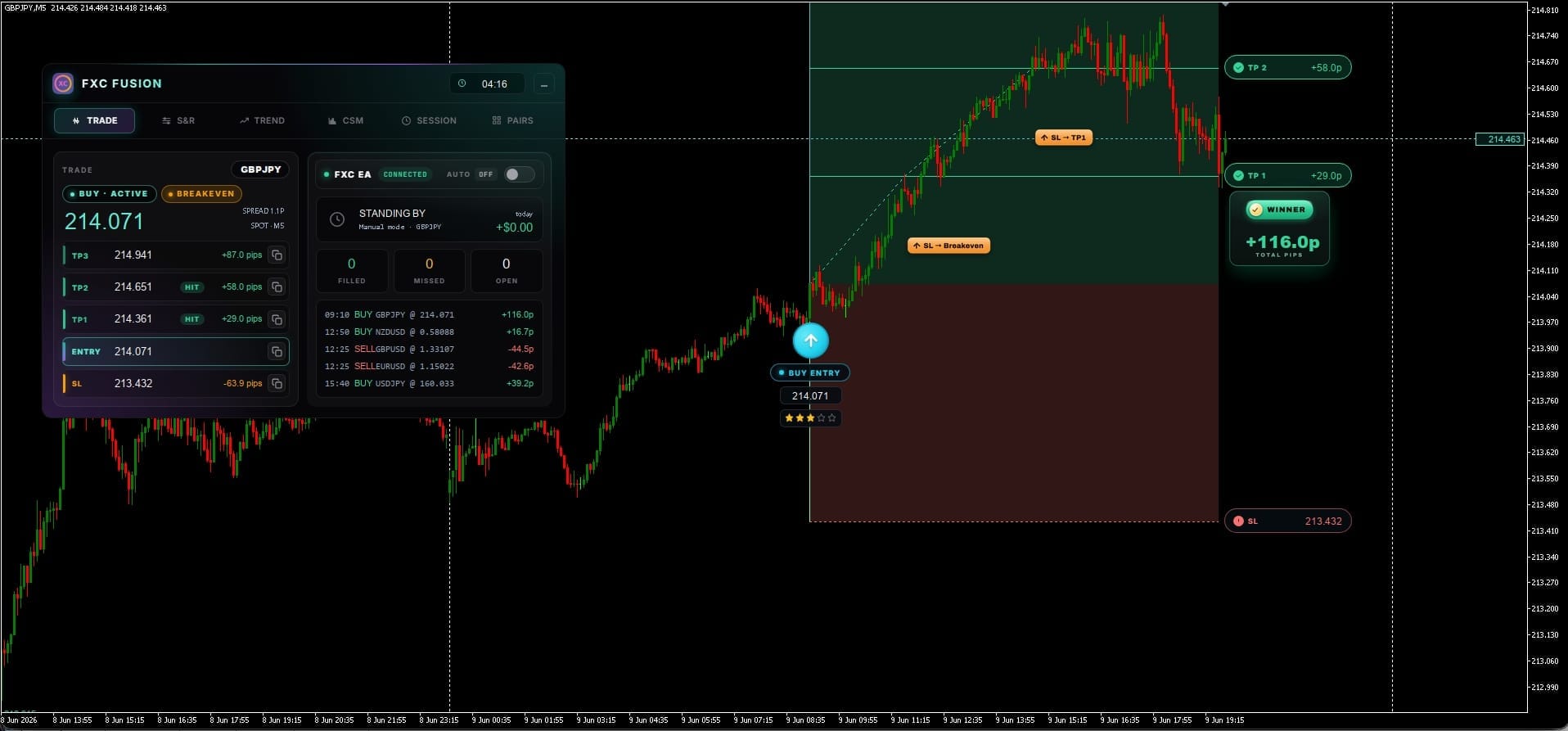
Notice what the loss did not do. It did not blow past a vague stop, and it did not turn into three revenge trades. The risk was fixed before the entry, so a losing trade is just a small, planned cost, not a hole in the account. That is the difference between a tested non-repaint signal with a plan and an arrow you have to manage by feel.
The plan manages itself
The trade screenshots above show the second half of the value: once you are in, the plan runs without you redrawing anything. The stop and the three take-profits are already on the chart. As price clears the first target, the stop moves to breakeven, then trails up behind the move, so a winner that turns around does not hand the profit back. You can watch it or walk away; the plan does not change because you looked away.
And it does not repaint. A signal fires when the setup qualifies and then locks. It does not move, redraw, or vanish afterward, so the trade you reviewed at the open is the trade you are holding at the close. That single property is what makes a screenshot like the ones above worth anything.
An indicator, not a robot
FXC Fusion scores the trade and draws the plan; you place the order. That is how most people will use it, and it is deliberate. For anyone who would rather not key in every entry, there is an optional Auto EA add-on. In semi-auto it pre-fills the trade with the exact levels Fusion drew and waits for your one-click confirm, so you stay in control. It can also run one-click or fully automatic inside filters you set, but it only ever executes the trades Fusion already graded. It is genuinely optional, and the indicator is complete without it. If you are weighing automation against manual execution, semi-auto is the middle ground.
The Founding 50 is opening
This is the moment to act on if you want it. FXC Fusion is not sold on tap; it goes out in limited monthly drops, and Drop 1 is just 50 Founding licences at $247, the lowest price it will ever sell at. The cap is on purpose: a breakout edge depends on a price level not being overcrowded, so fewer copies in circulation keeps those levels cleaner. When the drop sells out it closes until the next one, and each one opens higher, $347 for Drop 2 and $447 after that. Every licence is for life, with a 14-day money-back guarantee.
Drop 1 opens on Monday, June 22. If you are on the waitlist you get a 24-hour head start to buy before the public, which matters when there are only 50 licences. Joining is free, and the head start is the only thing it promises, not a discount or a locked price.
- Meet FXC Fusion, what it is and who built it.
- The Problem With Forex Arrow Indicators, why one graded trade a day beats arrow spam.
- A Day With FXC Fusion, what a real trading day looks like (you are reading this one).
Common questions
See the live cockpit & get in first →
Written by Silent and the ForexCracked team. After six years and 1,200+ tools tested, FXC Fusion is the one we built for ourselves, and this is what a day with it looks like.


Discussion 1 comment
Do you keep a journal of your trades with this indicator or better: do you got a myfxbook account?