
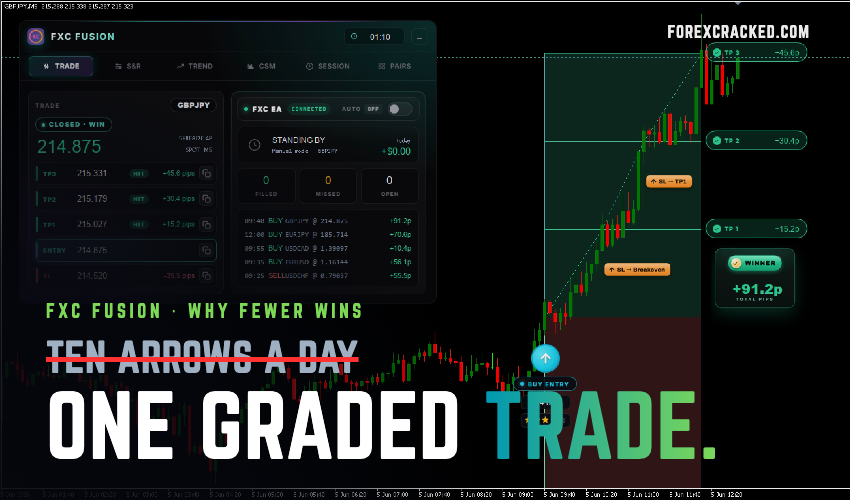
Most MetaTrader indicators are built to fire as often as possible. More arrows feel like more opportunity, so that is what gets sold. After six years and more than 1,200 indicators and expert advisors tested on this site, our honest conclusion is that the constant stream of signals is the problem, not the value.
This article makes the case for the opposite approach: fewer trades, each one scored and fully planned before you act. It is not where we started. It is where the testing led us, and it is the reason we eventually built our own indicator instead of recommending someone else’s.
The hidden cost of arrow-spam indicators
Across those 1,200-plus tools, the same failures kept turning up. Not in the marketing, which always looks clean, but in how the tools behaved once they were on a live chart. Four problems came up again and again.
- Overtrading. An indicator that paints ten arrows a day gives you ten reasons to click. Most of those setups are marginal, and every marginal trade still pays the spread and the commission. We have reviewed plenty of these, from the Super Arrow to the Stalker Arrow, and the pattern holds: the more often a tool signals, the harder it quietly works against the account.
- Repainting. The arrow that looked perfect in the screenshot was often printed after the move had already happened. In live use it moves, or it vanishes. It is the single biggest credibility killer in this category, which is why we tag every tool we test for it, and why a genuinely non-repaint indicator is rarer than the marketing suggests.
- No plan. An arrow says buy. It does not say where to put the stop, where to take profit, or how much to risk. So the plan gets improvised in the moment, which is exactly when judgement is worst. Good risk management needs the levels decided before the trade, not after it moves against you.
- Decision fatigue. Ten signals across eight pairs forces a second decision the indicator was supposed to remove: which of these do I actually take? A dashboard-only panel shows more information but rarely answers that question. The signal volume becomes its own source of stress.
None of this is the trader’s fault. It is what happens when a tool is designed to feel busy instead of being disciplined.
What one good trade a day actually means
The alternative to arrow-spam is not a different arrow tool. It is a tool that mostly waits. Instead of reacting to every wiggle, the engine looks for a coil, a tight consolidation where price has gone quiet, and trades the breakout out of it. One scored setup at a time.
“Scored” is the part that changes how you trade. Every qualifying setup is graded from Q1 to Q5, so a strong trade never looks the same as a weak one. You are not staring at ten identical arrows trying to guess which is best; you are looking at one setup with a confidence grade attached.
And because it commits to one trade per pair per day, it cannot overtrade by design. Once a setup fires for a pair, that pair is done until the next session. There is no tenth arrow to tempt you into a marginal trade, because there is no tenth arrow.
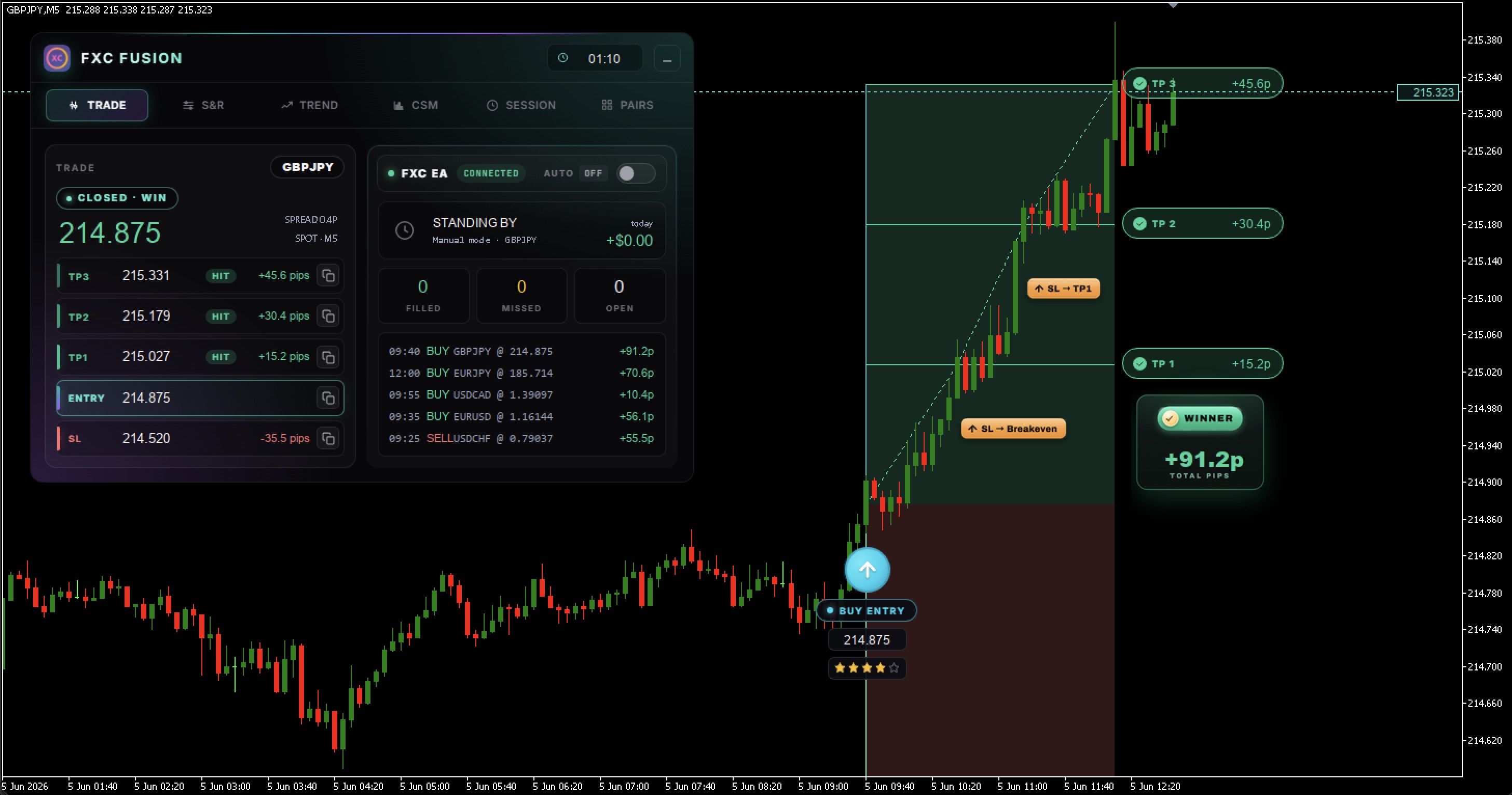
Why fewer, scored, and planned trades win
Discipline is hard to hold on your own. The case for one graded trade a day is that the structure does the holding for you. Three things make that work.
- The whole plan arrives with the signal. The moment a setup qualifies, the entry, the stop loss, and three take-profits are drawn on the chart. You are not deciding risk in the heat of the moment; the risk-to-reward is visible before you commit, and you simply decide whether to take the trade as planned.
- The grade keeps you honest. A Q5 setup and a Q2 setup are not treated the same. Seeing the score makes it natural to pass on the weak ones, which is the habit most arrow tools actively break.
- It does not repaint. A signal fires when the setup qualifies and then locks. It does not move, redraw, or disappear afterward, so the trade you reviewed is the trade you took.
The other half of the picture is context. The one trade is not taken blind. It sits inside a six-panel cockpit, so you can see the multi-timeframe trend, currency strength, graded support and resistance, the session, and a multi-pair scanner before you act. Fewer trades, taken with the full picture in front of you, are easier to manage and far easier to stay consistent with.
We are not going to ask you to take that on faith. As the drop gets closer we will keep posting real setups to the ForexCracked YouTube channel, the ones that hit the stop included, so you can judge the indicator on its process rather than on a marketing number.
This is the thinking behind FXC Fusion
This philosophy is what we built FXC Fusion around. If you have not seen it yet, we introduced it in an earlier article: it is a six-panel trading cockpit for MetaTrader 4 and MetaTrader 5 that watches for a coil and trades the breakout out of it, one scored setup at a time. Every qualifying trade carries a quality grade from Q1 to Q5 and arrives with the entry, stop loss, and three take-profits already drawn. It does not repaint, and an optional Auto EA can handle execution if you want it. The point of the cockpit is that the single trade you take is taken in full context, not on the strength of one arrow.
If you would rather not place every order by hand
FXC Fusion is complete as an indicator. It scores the trade, draws the plan, and you place the order, which is how most traders will use it. For anyone who would rather not sit and key in every entry, there is an optional Auto EA add-on, and the mode worth understanding is semi-auto.
In semi-auto, Fusion grades a setup and draws the entry, stop, and targets as usual. The EA then pre-fills the order with those exact levels, and nothing goes live until you confirm it with one click. You still decide whether the trade is taken; the EA only removes the manual step of re-typing the plan into the order ticket, which is also where mistakes creep in. It can also run one-click or fully automatic inside filters you set, such as which pairs, a daily trade cap, and a minimum quality grade. Either way the principle holds: it executes the trades Fusion already graded, it does not invent its own. The add-on is genuinely optional, and the indicator is complete without it. If you are still weighing automation against manual execution in general, that is a fair debate, and semi-auto is the middle ground built for it.
How to get it first: the Founding 50
FXC Fusion does not go on sale on tap. It is released in limited monthly drops, and Drop 1 is just 50 Founding licences at $247, the lowest price it will ever sell at. The reason for the cap is the same reason the approach works: a breakout edge depends on a price level not being overcrowded. If thousands of traders pile onto the identical level with the identical stop, that cluster of orders becomes the very thing the market hunts. Fewer copies in circulation keeps those levels cleaner. When a drop sells out it closes until the next one, and each drop opens higher, $347 for Drop 2 and $447 after that. Every licence is for life, with a 14-day money-back guarantee.
Drop 1 opens on Monday, June 22. Joining the waitlist is free, and it gives you a 24-hour head start to buy before the public, which matters a lot when there are only 50 licences. That head start is the only thing the waitlist promises. It is not a discount or a locked price.
- Meet FXC Fusion, what it is and who built it.
- The Problem With Forex Arrow Indicators, why one graded trade a day beats arrow spam (you are reading this one).
- A Day With FXC Fusion, what a real trading day looks like.
Common questions
See the live cockpit & join the waitlist →
Written by Silent and the ForexCracked team. After six years and 1,200+ tools tested, FXC Fusion is the one we built for ourselves.


Discussion no comments yet
Nothing here yet
No one has asked anything about The Problem With Forex Arrow Indicators yet. First question gets answered.