

The GBPUSD EA is an forex trading robot for MetaTrader 4 and MetaTrader 5 that trades only the GBPUSD pair on the H1 timeframe. It runs a recovery based strategy: rather than closing a losing batch at a stop, it splits each entry into several smaller orders and uses the profit from the winning trades to close the losing ones. As of 2026 it is a free download for both MT4 and MT5, where the earlier version shipped for MT4 only.
That design is the source of the GBPUSD EA’s headline trait, a very high win rate, and it is also where the risk hides. This review skips the sales copy and works from two things only we can show you: a public live MQL5 signal that has run since September 2025, and our own H1 backtest over the same window. Together they tell you what a 90% win rate on this robot is actually worth.
TL;DR – Free MT4 and MT5 robot trading GBPUSD on H1. It wins about 90% of trades, but a recovery basket holds the losers, so the rare loss is large and equity drawdown hit 31%. Two public live accounts back it (close to two years combined), though the first was deleted in 2025 and both leaned on deposits to ride out drawdowns. Needs a low-spread hedging account and a VPS.
What Is the GBPUSD EA?
The GBPUSD EA is a free MetaTrader 4 and MT5 robot that trades the GBPUSD pair on the H1 timeframe. It splits each trade into a basket of smaller orders and recovers losing positions using the profit from winning ones, with a 250-pip hard stop loss (a fixed worst-case exit) acting as the final backstop. It is built for one pair only and runs fully automated.
The reason that definition matters is that the risk sits in a different place than a simple stop-and-reverse robot. There is no single clean stop on every position. Instead, losers are held inside a basket and worked off over time, so the danger is a basket that keeps growing during a long adverse move, not one quick fixed loss.
Core Strategy and Logic
The GBPUSD EA is a recovery trader dressed up as a high win-rate scalper. Reading the live behaviour and the settings the EA actually exposes, the mechanics break down like this:
- Trade splitting – Each signal is opened as a batch of smaller orders rather than one position, which spreads the entry across several fills.
- Profit redistribution – When part of the batch is losing, the EA does not cut it. It uses the profit booked by the winning orders to close the losers one at a time until the batch is clear.
- Size-increasing recovery – The version we tested runs a “SmartRecovery” routine that increases the recovery size by 1.6x for up to 3 steps. This is martingale-flavoured: each recovery leg is larger than the last, which is how the robot drags losing baskets back to break-even.
- 250-pip hard stop loss – Every basket has a fixed 250-pip stop as a catastrophic backstop. It is wide on purpose, so it only fires when recovery has failed, not on normal trades.
- Trailing stop exit – Winning baskets are managed out with a trailing stop on the H1 chart, locking in gains as price moves the right way.
- Pending-order entries – Trades are placed with pending orders inside a daily session window rather than at market, aiming for better fills.
This is the opposite end of the risk curve from a true fixed-stop system. For an honest contrast, the no-grid FX Portfolio EA we reviewed with its own live signal takes a fixed loss on every trade and wins under half of them, while this robot wins 90% by holding losers instead. Both can work; they just put the risk in different places. If you want to see how far the recovery idea can be pushed, compare it with a dedicated recovery EA like WallStreet Recovery PRO.
Key Features of the GBPUSD EA
- Platform – MetaTrader 4 and MetaTrader 5, with a free build for each.
- Pair – GBPUSD only (it took a single stray XAUUSD trade on the live account, but GBPUSD is the whole job).
- Timeframe – H1, with an average holding time around 16 hours on the live signal.
- Strategy – Trade-splitting with a profit-redistribution and size-increasing recovery.
- Risk control – A 250-pip hard stop loss per basket and a trailing-stop exit.
- Account type – Needs a hedging account (one that allows opposite positions on the same pair at once), which on MT5 means the hedging account mode.
- Automation – Fully automated, with default settings tuned for brokers on GMT+2 server time with daylight saving.
The EA exposes a small set of inputs that actually change its behaviour. These are the values we ran in the backtest below.
Please test in a demo account first for at least a week. Also, please familiarize yourself with and understand how this GBPUSD Robot works, then only use it in a real account.
Recommendations for GBPUSD EA
- Minimum account balance of $1,000.
- Works best on GBPUSD (the default settings are built for it).
- It works best on H1. (Work on any TimeFrame)
- GBPUSD EA should work on VPS without interruption to reach stable results. So we recommend running this Forex Trading Robot on a reliable VPS (Reliable and Trusted FOREX VPS – FXVM)
- A low-spread ECN or Raw account is recommended, with a hedging account type. Leverage of at least 1:100 (1:500 recommended), and a server clock on GMT+2 with DST so the session window lines up. (Find the Perfect Broker For You Here)
Because this robot recovers losing baskets by adding size, your starting lot is the single dial that decides whether a bad run is survivable. Set it deliberately rather than leaving the default: plug your balance and the risk you can stomach into the Lot Size Optimizer before you go live, and size for the worst case, not the average trade. Traders who want a simpler single-pair option for the same market can compare it with the King Sniper GBPUSD scalper.
Performance Review: Two Live Accounts and Our Backtest
This robot has a longer paper trail than most free EAs, spread across two separate public accounts plus a backtest we ran ourselves. The order matters, because the first account is the one most traders never got to see.
The first live account (2024 to 2025), since deleted
The robot’s original public account ran on IC Markets from mid-2024 to mid-2025, then was taken down. We captured it in June 2025, before it disappeared, which is the only reason its record still exists. Over about a year it placed 1,217 trades, won 91.94% of them, and posted a 2.68 profit factor with $2,938 of net trading profit. Equity drawdown reached 24%.
That account already shows the pattern the current one repeats. The “384% growth” badge was an illusion of cash flow: on a $160 start, roughly $10,326 was deposited and $8,965 withdrawn across the year, so the honest figure is the $2,938 the strategy actually earned, not 384%. The worst single trade lost $101.62 and the longest losing run was 7 trades in a row.
One caveat we cannot resolve: we caught this account looking healthy in June 2025, but it was deleted within a few months. Public signals are usually pulled when an account turns bad, so it is reasonable to assume the stretch we never captured is the reason it is gone. We are showing the good half of a record that no longer exists, which is the opposite of a clean two-year proof.
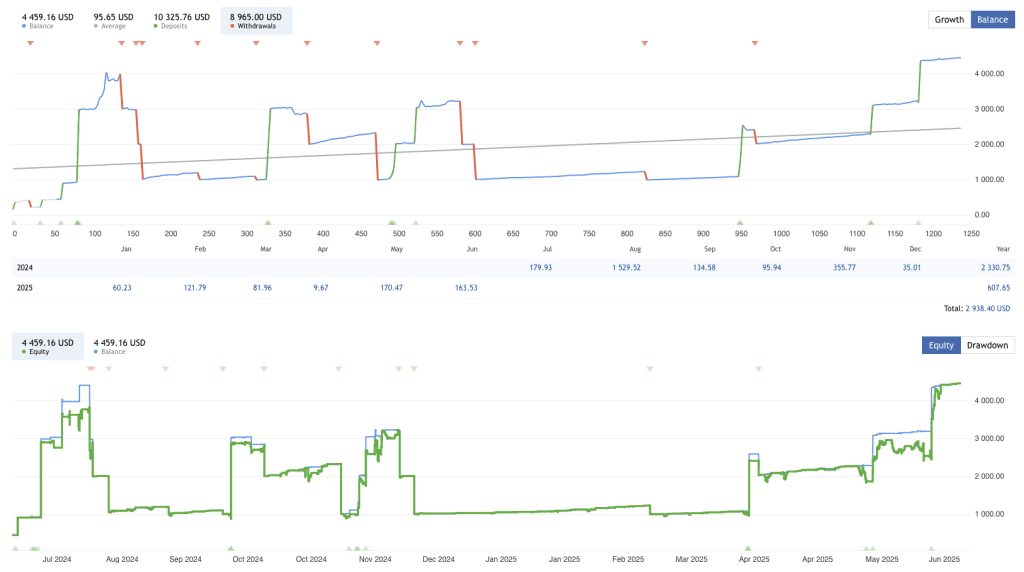
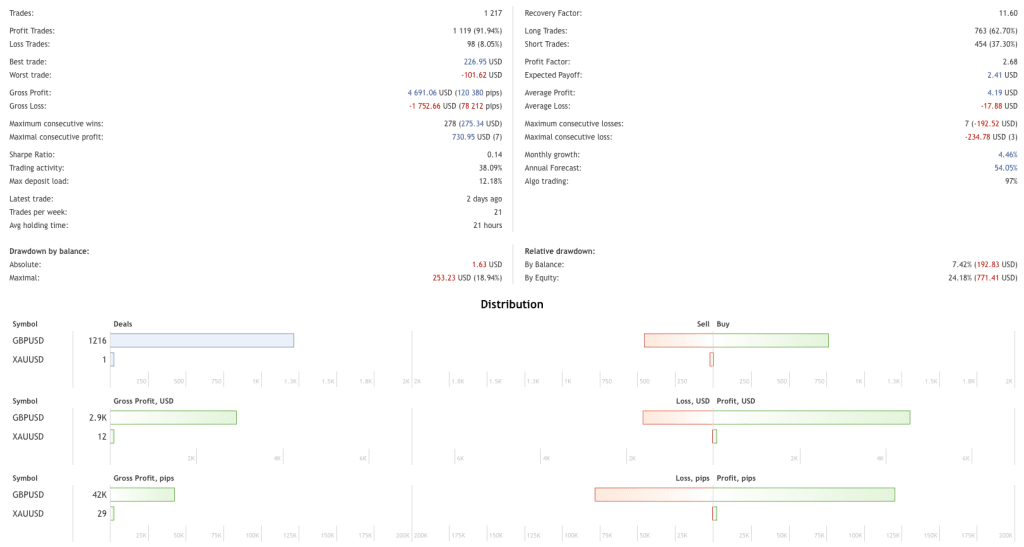
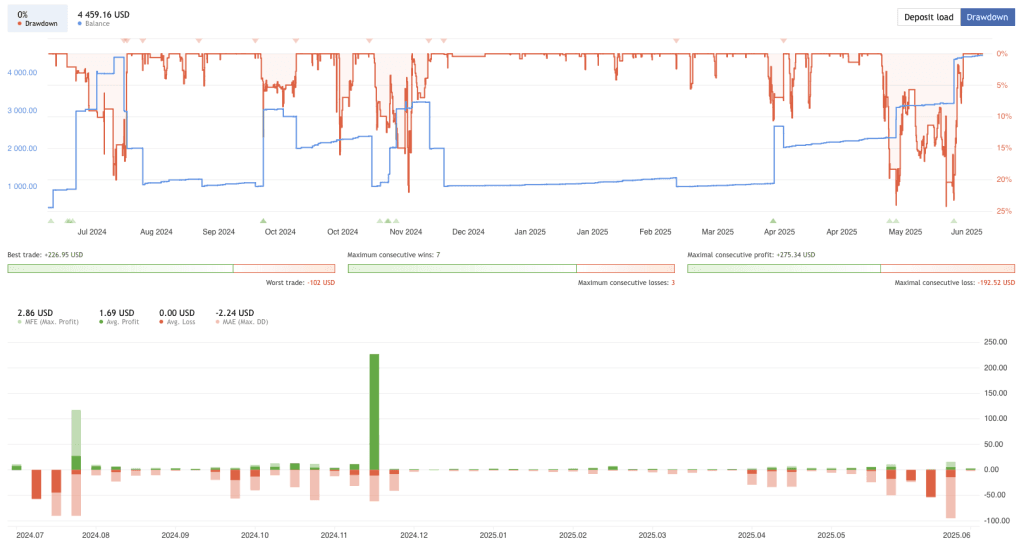
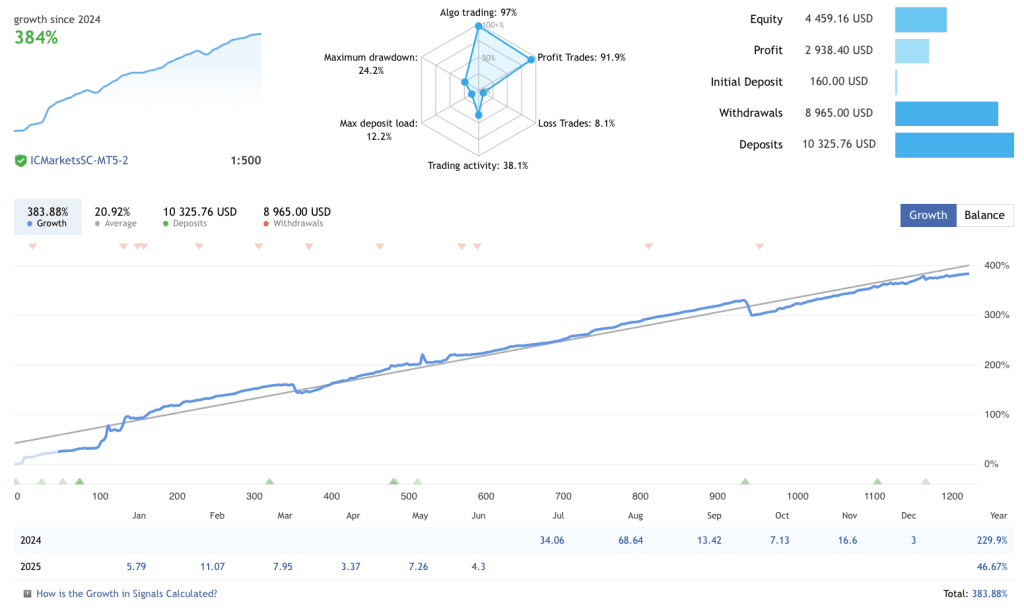
The original public signal, captured June 2025. The account was removed shortly after, so this dated screenshot is the only surviving record. This is exactly why we screenshot signals instead of embedding a live widget that would now be dead.
The current live account (2025 to now) and our backtest
After the first signal came down, a new public account was started in September 2025 on a CapitalPointTrading account with a $250 deposit, and it is the one still running. We pair it with a backtest we ran ourselves on GBPUSD H1 over the same window (17 September 2025 to 18 June 2026) on a clean $1,000 with a fixed 0.01 lot.
A word of caution before the numbers: this is not a one-to-one match. The live account did not simply compound; it was topped up and partly withdrawn as it ran (figures in the table below). Our backtest had only 29% real-tick history quality and took far fewer trades than the live account (156 versus 798). Treat it as a clean fixed-lot reference for how the strategy behaves, not a prediction of the live curve.
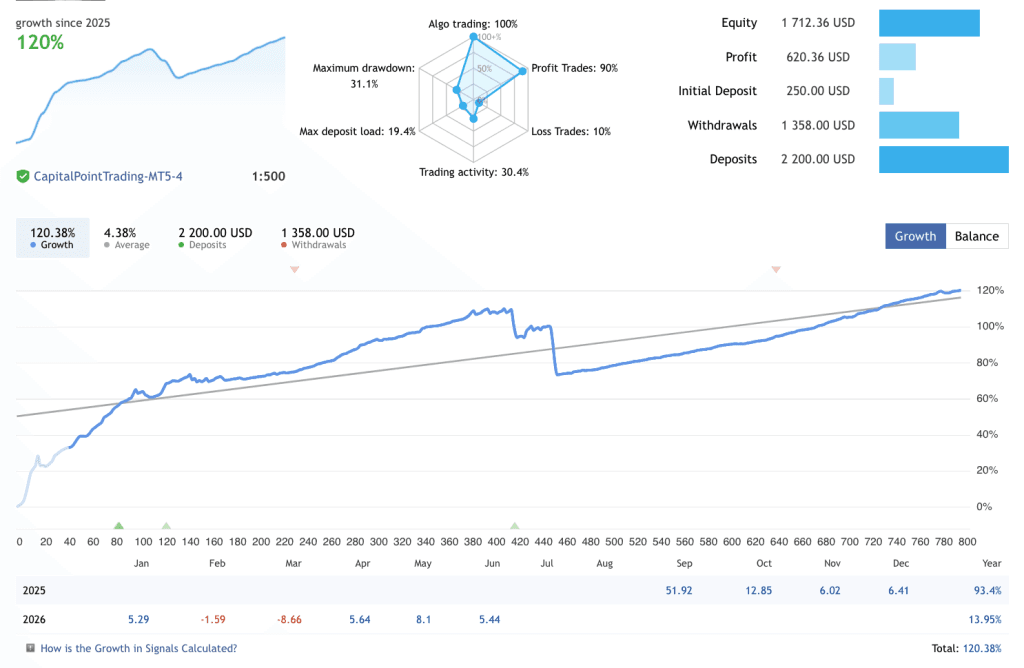
| Metric | Live signal (MQL5) | Our backtest (matched window) |
|---|---|---|
| Period | 17 Sep 2025 to 18 Jun 2026 | 17 Sep 2025 to 18 Jun 2026 |
| Structure | $250 start, ~$2,200 deposited, ~$1,358 withdrawn | $1,000 start, fixed 0.01 lot |
| Trades | 798 | 156 |
| Win rate | 89.97% (718 / 80) | 94.23% (147 / 9) |
| Profit factor | 1.77 | 1.42 |
| Avg win / avg loss | $1.99 / -$10.12 | $1.06 / -$11.81 |
| Max drawdown | 31.06% equity / 17.59% balance | 6.88% equity / 5.89% balance |
| Net trading profit | $620.36 | $46.26 (+4.6%) |
The two columns agree on what matters: the live account behaves the way the strategy does in a clean test. The tester wins 94% for a 1.42 profit factor (gross profit divided by gross loss), the live account 90% for 1.77, and nothing in the live result is hidden from the backtest. That agreement is the most trust-building line in this review.
What is the GBPUSD EA win rate, really?
The 90% win rate is genuine, but on its own it means little for a recovery robot, because a system that holds losers and works them off with winners posts a high win rate right up until the run it cannot recover. The honest reading is in the loss size, not the win count. On the live account the worst single trade lost $76.73, the average loss ($10.12) was about five times the average win ($1.99), and the longest losing streak ran to 5 trades. The 250-pip hard stop is the only thing standing between a stubborn basket and the account.
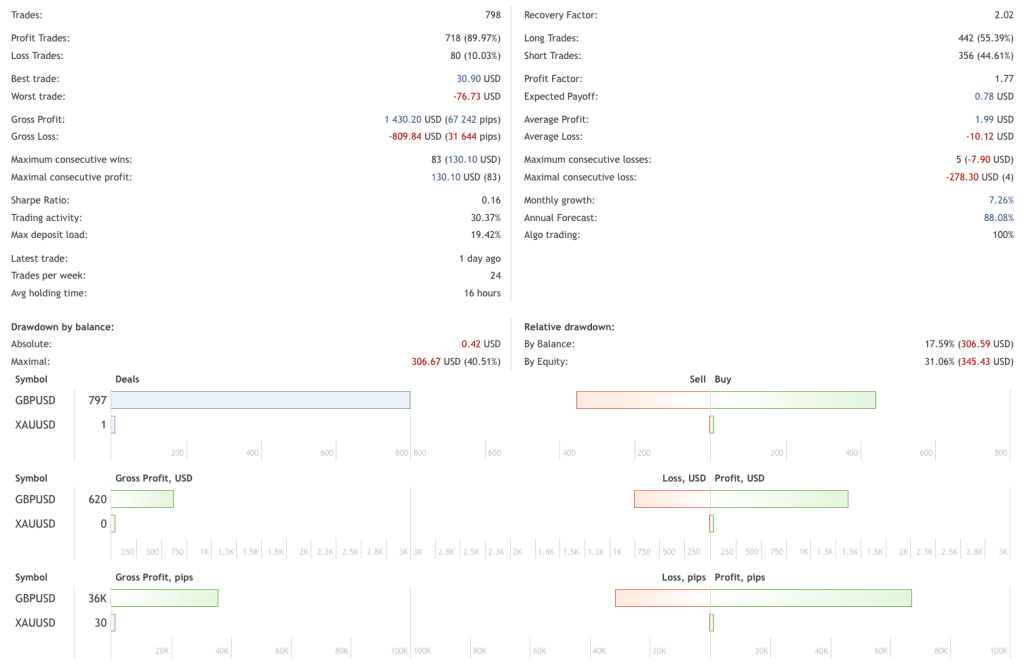
Growth, drawdown and the deposit problem
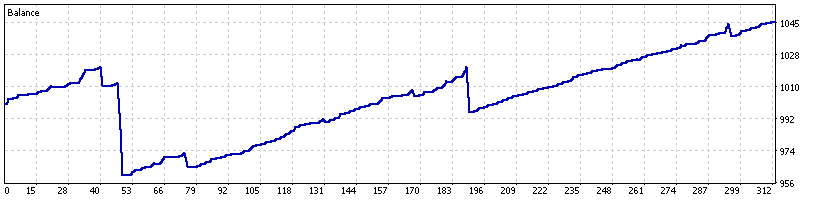
The “120% growth” badge is the figure to ignore: MQL5’s Gain % is distorted by every deposit and withdrawal, so the only clean number is the $620.36 of net trading profit across 798 trades. The shape was strong through late 2025, then choppy in 2026, with losing months in February (-1.6%) and March (-8.7%) and deep equity dips in October 2025 and February 2026, where the recovery baskets were under water.
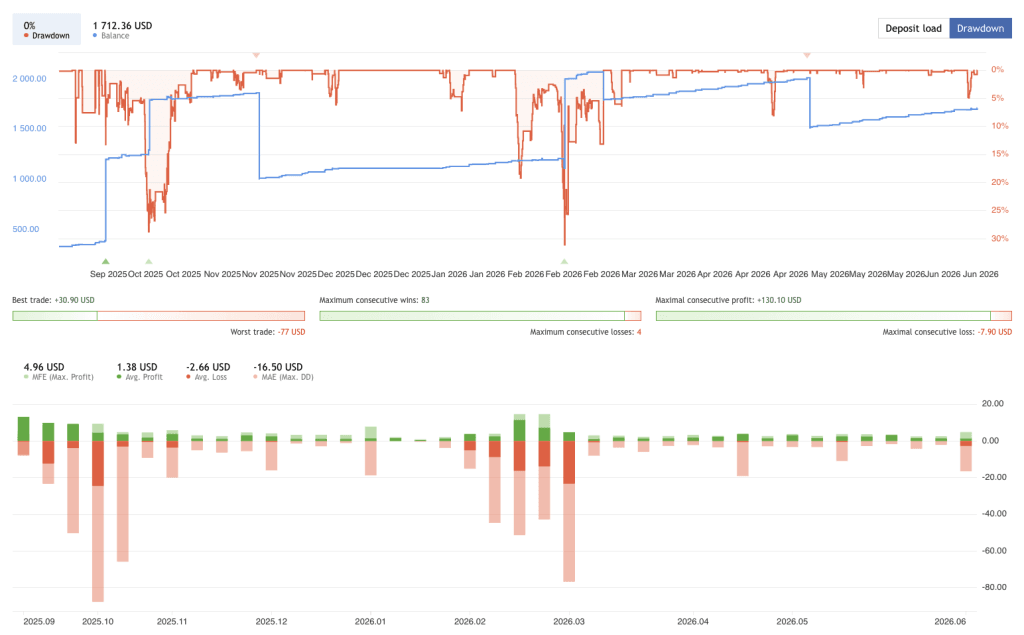
This is where the deposits matter, and it is not reassuring. A 31% equity drawdown on an account that was repeatedly fed cash looks like life support. With a recovery system, money added during a drawdown props up baskets that would otherwise keep growing until margin runs out, so the honest read is that without those top-ups the drawdown would have been deeper and the account could have blown. Our backtest, on a clean fixed lot with no top-ups, only drew down about 7% in equity, because a small fixed lot never lets the recovery baskets grow dangerous. The gap between 7% and 31% is position sizing, and on your own account nobody will be wiring in rescue capital, so size for the worst case.
Set against the first account, the current one is the weaker of the two. The 2024 to 2025 account ran a 2.68 profit factor at a 24% equity drawdown; the current account is at 1.77 on a deeper 31% drawdown. The strategy still works, but on the latest evidence it is earning less per unit of risk than it did a year ago, which is worth knowing before you judge it by the older, prettier numbers.
GBPUSD EA

A free MT4 and MT5 expert advisor that trades GBPUSD on H1 using trade-splitting and a profit-redistribution recovery, backed by a 250-pip hard stop loss. High win rate, a two-account live history that was kept alive with deposits, and recovery-style tail risk you should understand before running it.
Pros
- Roughly 90% win rate on both live accounts and our backtest
- A 250-pip hard stop loss caps the worst case on any single basket
- Trades a single, liquid, low-spread pair (GBPUSD) rather than a wide basket
Cons
- It is a recovery system, not the "no grid, no martingale" safe robot it is often sold as
- The high win rate masks rare but large losses; the average loss is about 5x the average win
- Live equity drawdown reached 31%, and the account needed deposits to ride it out
- The first signal was deleted in 2025, so only our dated screenshots verify that year, and the newer account runs a thinner profit factor (1.77 vs 2.68)
- Broker-sensitive: it needs a low-spread hedging account and the right server time
Summary
The GBPUSD EA is an honest example of a recovery robot once you read past the win rate. It really does close about 90% of its trades green, because losing positions are held and bailed out by winners rather than stopped out small. Two public live accounts since 2024 each show months of net positive trading, but both were heavily topped up with deposits through their drawdowns, and equity drawdown touched 31% on the current one. Our matched backtest confirms the same shape at a smaller scale: high win rate, modest profit factor, and an average loss several times bigger than the average win.
 Built by ForexCrackedWe tested 1,200+ indicators. Then we built our own.Six years of reviewing EAs and indicators went into FXC Fusion: two engines, the seven-panel cockpit, MT4 and MT5, from the team behind this site.
Prefer to place the trades yourself? Meet FXC Fusion
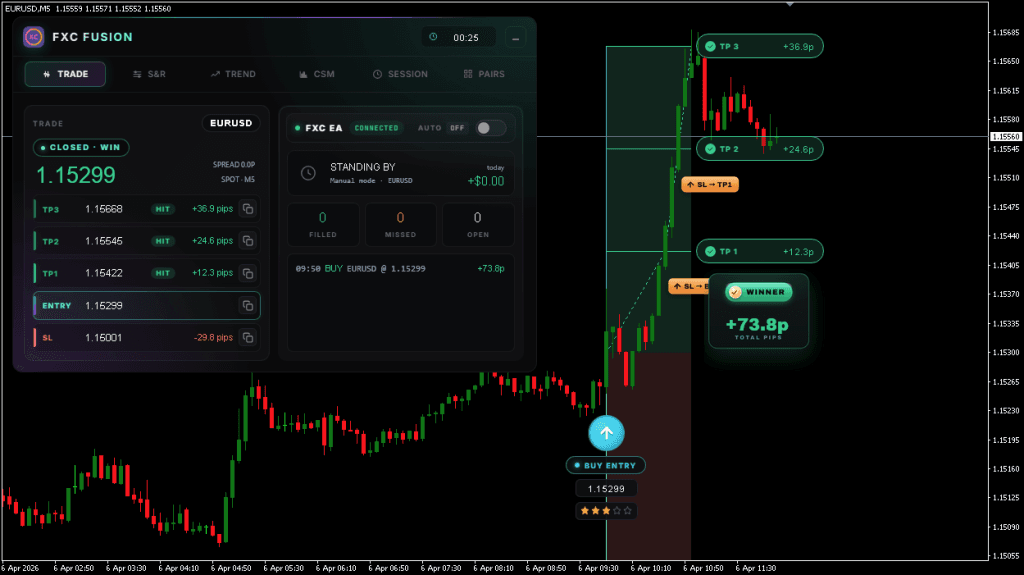
FXC Fusion is ForexCracked’s own breakout indicator for MT4 and MT5: a six-panel cockpit that scores one trade a day from Q1 to Q5 and draws the entry, stop loss and three take-profit targets for you, with no recovery basket holding losers in the background. Drop 1 (the Founding 50 at $247, lifetime, with a 14-day money-back guarantee) is down to its last licence and may already be gone. If it is, you can join the waitlist for Drop 2 at $347. See what a real trading day with it looks like, or view FXC Fusion.
Frequently Asked Questions (FAQ)
Conclusion of this Forex Trading Bot
The GBPUSD EA is a competent recovery robot with a real nine month live record, and it does what it claims: it wins about 90% of its GBPUSD trades on H1. The catch is in how it wins. Losing positions are held and worked off with a size increasing recovery, so the rare loss is large, equity drawdown reached 31%, and the live account leaned on deposits to get through its worst stretches. It is a reasonable free download for MT4 or MT5 if you understand recovery trading and size for the worst case, but it is not the no-martingale safe system it is often sold as, and the trader’s lot size, not the EA, decides whether it stays calm.


Discussion 14 comments
Is this still working?
it doesnt place any trade on live/prop firm account, am i the only one getting this issue?
Go through these:
1. Turn on Algo Trading (AutoTrading) in the terminal.
2. Tick “Allow DLL imports” when you attach the EA.
3. Run it on GBPUSD, H1.
4. It is broker-sensitive. It needs a low-spread hedging account with GMT+2 (DST) server time. Check that your live and prop firm accounts match that.
5. Check your platform build. Newer MT4 builds can stop older files from loading. If that is the case, downgrade to a lower build.
If it still opens nothing, what does the Experts tab show?
I dont understand why this EA is reposted when it contain the old file that it doesnt work in current MT4 version.
After a forced update of MT4, it no longer works: “Invalid license”! Pls fix it. Thx
It’s now version 7.5. Dear admin, what do you think about updating it?
Admin, can i have the .mq4 file?
Dear admin, 6.2 version?
It works well on gbp/usd ,xau/usd and de40 on 1h chart. In settings choose risk level to medium. Don’t go over medium risk, because you get more drawdown. It’s not rich quick bot, but it’s safe with long term. I tested so many bots in couple of years but this one is among best. It’s save and grow slow over time. Tanx for upload admin.
no me funciona que estare haciendo mal?
bro how’s it working?? pls share your review
Ok I tested this ea from July on demo account. From 100 000 usd grows to 203 000 usd today. It doubles account from July.This is around 5-6 months. It is very safe bot. It works for xau/usd, de40, Ustec, us30. I remove gbp/usd pair because it has more drawdawn and it takes longer to recover.
Thanks buddy
I can’t believe it that this bot works well on backtesting gbp/usd 1h chart. Now I will tested 1 month on demo. Then I will go real if I will be in profit in 1 month demo.
Please send me set file?