

SMC Pyramid EA is a free XAUUSD bot for MT5 that trades gold on the H1 chart: it sells or buys when a candle closes beyond the last swing low or high, sets its stop behind the opposite swing, and adds a second trade of the same size once the first is in profit. For this 2026 review we matched our real-tick backtest against its live account, read every trade in the logs and ran each of its risk settings on the same trades. Free download at the bottom.
The strategy is simple and our tests found no grid or martingale in it. The risk setting is the story. The default sizes every trade by the balance, not by the stop, and the stops run from $30 to $600 on gold. On the same 2026 trades the default went through a 72% drawdown, while the lower settings stayed between 1% and 6%.
What’s in this article:
- How it trades, read from our logs
- The settings and what each risk level does
- The live account and our backtests
- Where it goes wrong, and the free download
Key takeaways
What is the SMC Pyramid EA?
SMC Pyramid EA is an MT5 gold robot that trades breaks of market structure on XAUUSD H1. It enters after a candle closes beyond the last swing, puts the stop behind the opposite swing and the target at 1:1, adds one trade of the same size at +$2, and trails both. One trade at a time, no grid, no martingale.
Core Strategy and Logic
Everything below comes from our own tests on the default preset, mainly all of 2026 on Tickmill real ticks at a fixed 0.01 lot (148 trades), with 2020-2025 on generated ticks.
- A break of structure on the H1 close – Every one of the 148 entries in 2026 came at the open of an H1 candle right after the previous candle closed beyond the last confirmed swing high (for a buy) or swing low (for a sell). A swing here is a high or low with 7 lower highs or higher lows on each side. This is what “smart money concepts” means in this EA’s trades: a break of structure, taken at the next bar.
- The stop sits behind the opposite swing – The stop loss goes $1 beyond the swing on the other side, every time. So its distance depends on the chart, not on a setting: in 2026 the median stop was $86, one in ten was wider than $188, and the widest was $602 (30 January).
- A 1:1 target that rarely matters – The take profit is the same distance as the stop. With stops that wide it was almost never reached.
- A trailing stop does the exiting – Once the trade is a few dollars in profit, the trailing stop moves to entry +$2 and then follows the price in steps. In 2026, 146 of the 148 trades closed on it and 2 hit their full stop.
- One add, only to a winner – When the trade is about +$2 (200 points) in profit, the EA opens a second trade of the same lot in the same direction. The add has no stop of its own: it closes when the main trade closes. This is the pyramiding in the name, and it never adds to a losing trade.
- No grid, no martingale – One main trade at a time, lots never grow after a loss, and every main trade has a stop from the moment it opens. The add doubles the size of the bet, though, and both legs hit the same stop.
- Filters – The fair value gap filter removes some breaks (switching it off added 10 trades in the first half of 2026). The order block filter changed nothing in our tests, to the cent. The news filter reads the MT5 economic calendar, which the Strategy Tester doesn’t have, so no backtest shows it working (more in the Performance Review).
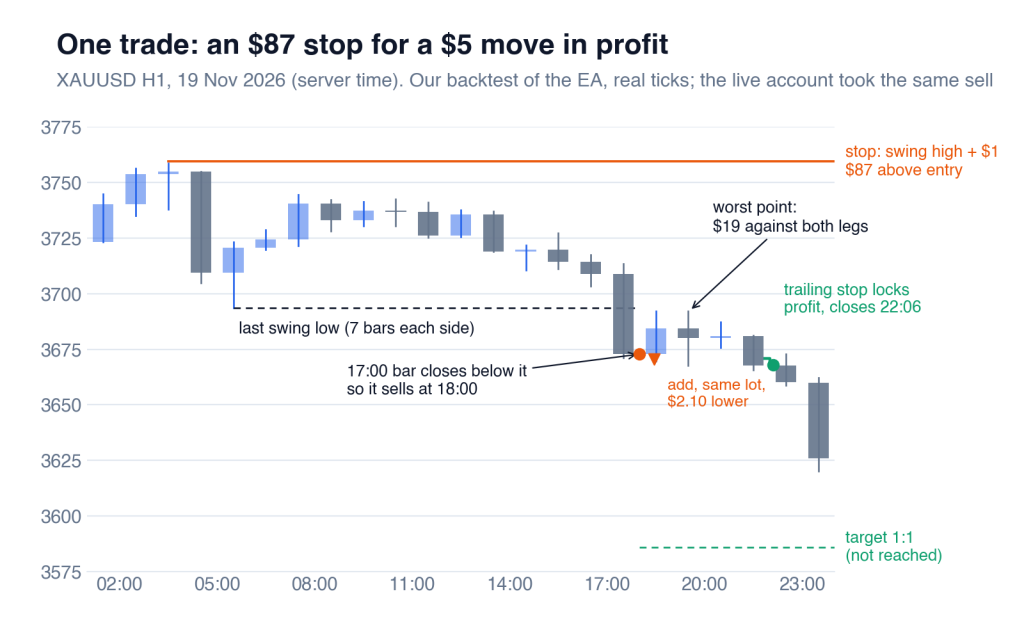
The entry rule is close to what we found in Gold Swing Breakout EA, which also trades through recent swing highs and lows, but that one waits with stop orders on M15 and never adds a second trade. If you want to read the structure yourself, see order blocks explained and our BOS and CHoCH indicator.
Please test in a demo account first for at least a week. Also, please familiarize yourself and understand how this SMC Pyramid EA works, then only use it in a real account.
SMC Pyramid EA Settings
The EA carries its presets inside the file: no .set file is needed for the default. At start-up the Experts tab prints its original name, Institutional SMC Robot, and the preset it loaded. While a preset is on, the strategy inputs (swing length, stop and target modes, trailing, pyramiding) are ignored. Sizing, news, the prop-firm guard and the magic number still come from the inputs.
| Input | Default | What it does |
|---|---|---|
| InpUseSetFile / InpSetInstrument | true / XAUUSD Pyramiding | The built-in preset. XAUUSD Classic is the same strategy without the add |
| InpLotMode | Auto Lot | Fixed lot, Auto Lot (by balance) or Risk % per trade (sized to the stop) |
| InpRiskLevel | EXTREME | Auto Lot on gold: EXTREME 0.01 lot per $150 of balance, VERY HIGH per $300, HIGH per $500, MEDIUM per $1,000, LOW per $2,000, VERY LOW per $5,000. The stop distance plays no part |
| InpRiskPercent | 20.0 | Used only in Risk % mode: the loss at the main trade’s stop as a % of balance. The add doubles it |
| InpFixedLot | 0.01 | Fixed mode only |
| InpUseNewsProtection | true | Pauses around NFP and CPI (30 min before, 60 after) and FOMC (60 before, 150 after) from the MT5 calendar. Does nothing in the Strategy Tester |
| InpUsePropFirmGuard | false | Closes everything at a 4.5% daily or 8% total loss (see the Performance Review) |
| InpAddStepPoints / InpMaxAdditionalTrades | 200 / 1 | Manual mode only: where the add opens and how many |
The other presets cover US100 (three), Bitcoin (two) and a Forex basket (two, run from one EURUSD chart). The XAUUSD presets print a half-year label at start-up (“2026-H2 applied” and so on, back to 2020-H1). We ran every half-year from 2020 to 2026 with the preset on and with it off: the results were identical to the cent, so the label changes nothing you can measure.
Set files in the download (each loaded in the Strategy Tester and checked against the same inputs set by hand):
- smc-pyramid-ea-xauusd-default-extreme-risk.set – The defaults as shipped, named for what they are: EXTREME, 0.01 lot per $150 of balance whatever the stop. For reference, not for a live account.
- smc-pyramid-ea-xauusd-very-low-risk.set – Auto Lot VERY LOW, 0.01 lot per $5,000. The setting we would start a gold account on.
- smc-pyramid-ea-xauusd-risk-1-percent.set – Risk % at 1%: the lot shrinks when the stop is wide. Best from about $10,000, because below that most trades fall to the 0.01 minimum anyway.
Recommendations for the SMC Pyramid EA
- Risk setting first – Do not run the default EXTREME level on money you need. On the same 2026 trades, VERY LOW and Risk % at 1% kept the worst trade under 2% of $10,000, and LOW (0.01 lot per $2,000) under 5%. Risk % is the only mode that shrinks the lot when the stop is wide, and the lot size optimizer shows what a given stop means for your account.
- Deposit – About $5,000 per 0.01 lot at today’s gold prices. With the median 2026 stop of $86, one 0.01 lot and its add lose about $170 at a full stop, and about $1,200 on the widest stop of the year. On $200, the smallest possible trade already puts most of the account on one median stop. Risk % cannot go below 0.01 lot either: on $10,000 at 1%, a third of 2026’s trades had stops wider than $100 and traded the minimum, up to 12% on the widest one.
- Pair and timeframe – XAUUSD on H1 with the default preset. The other presets are covered in the Performance Review.
- Leverage – Margin is small next to the stop risk (about $7 per 0.01 lot at 1:500 with gold near $3,500), so leverage is not the limit. The stop is.
- Backtesting – Use real ticks or generated ticks. 1-minute OHLC understated the result in our checks.
- News – Keep the news filter on. It works only on a live chart, and it closes trades at a loss as well as protecting them (Performance Review, section 2).
- VPS – SMC Pyramid EA should run on a VPS continuously, since entries come at any hour except the first two after the daily open.
- Broker – A low-spread ECN account with a hedging account type: the add needs hedging, and on a netting account the EA runs one position only. Compare forex brokers here.
Performance Review: Is This XAUUSD Bot Profitable?
1. The live account
The live account runs the EA on XAUUSD at Vantage with 1:500 leverage, in euros. It started on 1 September 2026 with €100. After that €420 went in and €270 came out.
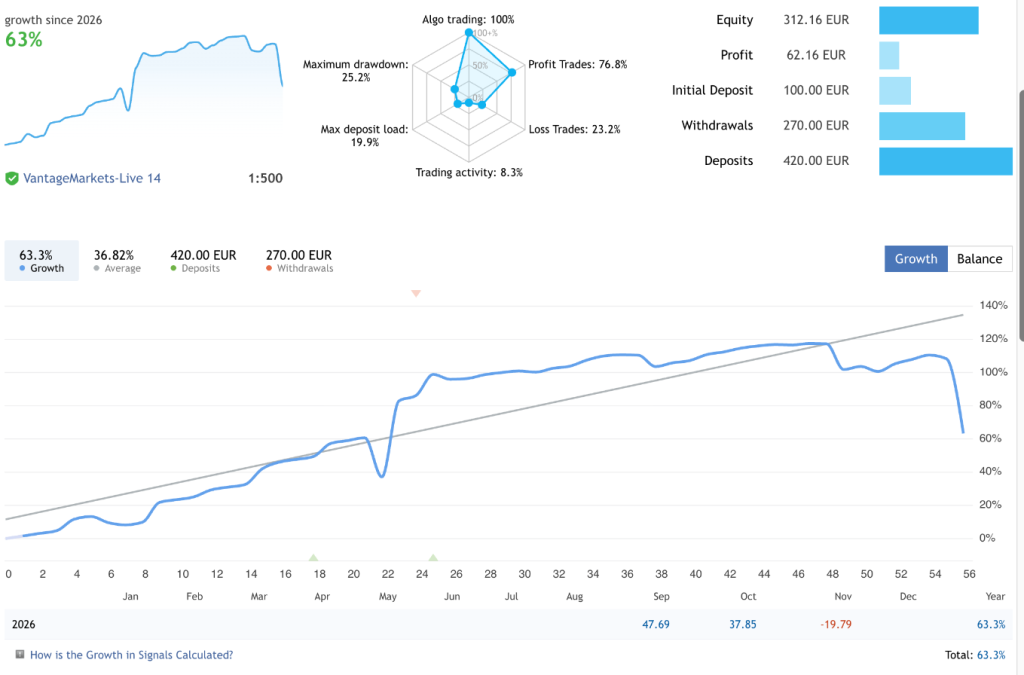
- The profit is small next to the money moved – €62 over 13 weeks on €250 net deposited, with a profit factor of 1.31. Most of the growth came from a few days in early October.
- It runs the default risk – From the margin it used, the live account traded 0.02-0.03 lot per leg on about €400: exactly the EXTREME level’s 0.01 lot per $150.
- One trade can undo a month – On 25 November one sell lost €86.08, 21.6% of the balance, and three trades between 20 and 25 November cut the profit from about €147 to €62.
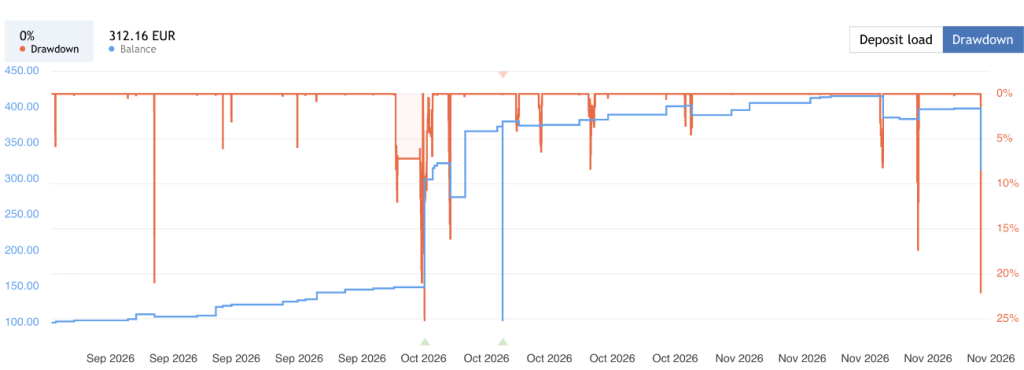
A second live account runs the Forex preset, which has been rebuilt since and takes some manual trades, so it tells us little about the gold default. There is no live account for the US100 or Bitcoin presets.
2. Does our backtest match the live account?
On entries, yes. We ran our file on Tickmill real ticks over the live account’s whole life (1 September to 24 November) at a fixed 0.01 lot. 47 of the 52 live entries came within five minutes of ours, although the account ran older versions of the EA before November.
On results, no. Our run made a profit factor of 15.97 over those weeks, against 1.31 live. The difference is in a handful of closes our tester never made:
| Live loss | What happened live | Our backtest |
|---|---|---|
| 7 Oct, -€47.30 (14.7%) | Closed 30 minutes before high-impact news | No matching trade |
| 16 Nov, -€29.58 (7.1%) | Closed at a loss on the first day | Same sell held two more days and closed +$2.58 |
| 25 Nov, -€86.08 (21.6%) | Closed one hour before the 13:30 UTC US data, $32 under water | Outside our window: the tester stops before the current day |
The tester has no economic calendar, so the news filter never runs in a backtest. On a live account it closes trades early, at a loss or a profit, around high-impact news. Every backtest of this EA, ours included, leaves that out. To estimate it, we exported the MT5 calendar’s high-impact US events and replayed our 2026 trades against them. The rule in the version we post (NFP, CPI and FOMC only) changed little: six entries skipped, profit about 2% lower. The newer rule, which closes everything around every high-impact US release (weekly jobless claims and oil stocks included), cut 2026’s profit by about a quarter and the live account’s window by about 70%.
The 25 November close also shows the live account had already moved to the newest version, whose news rule closes all positions from one hour before to one hour after any high-impact event. The version we post (3.50) pauses for NFP, CPI and FOMC only.
3. Our 2026 real-tick test at a fixed lot
| Metric | Fixed 0.01 lot, 2026 |
|---|---|
| Window | 2 Jan – 24 Nov 2026, Tickmill real ticks |
| Net profit | +$1,348.05 on $10,000 |
| Profit factor | 7.46 |
| Largest equity drawdown | 1.09% |
| Trades | 148, plus 138 adds |
At 0.01 lot the EA is calm: the median closed trade made $4.80, and the two full stops (16 April, 22 May) cost $48 and $59, ten to twelve median wins each. The add earned 37% of the year’s profit: the Classic preset, which skips it, made +$848.72 on the same entries with a 0.94% drawdown.
4. The risk setting decides the outcome
We ran the same 2026 trades on $10,000 at every risk setting. Nothing changed but the lot size.
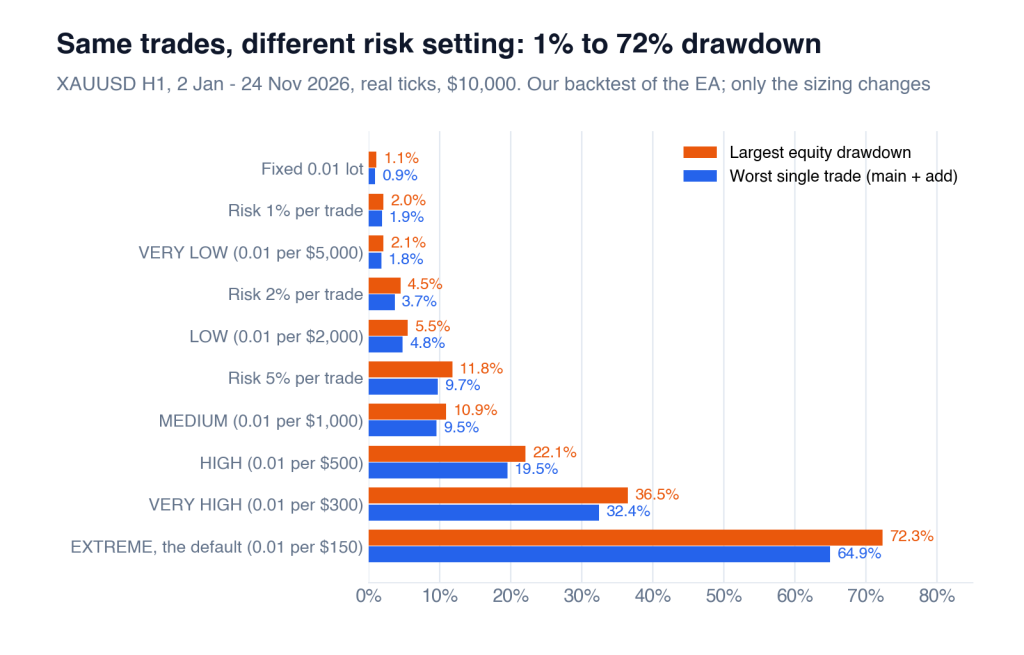
- The default (EXTREME) went through a 72% drawdown – The 16 April trade alone took 65% of the account. Its stop was $48 away, narrower than most.
- VERY HIGH halves that, and it is still 36% – Both levels compound fast in the tester, and the end balances run into the millions. Those numbers are a tester effect, not something to expect: the lot hit the broker’s 100-lot cap in the default run.
- MEDIUM and Risk 5% land near 11% – Risk % sized to the stop kept the worst trade at 9.7%.
- HIGH still reaches 22% – One full stop took a fifth of the account.
- LOW, VERY LOW and Risk 1-2% stay between 2% and 6% – These are the settings we would start from.
The reason is in the sizing rule. Auto Lot gives a narrow stop and a $600 stop the same lot, so the loss at the stop grows with the stop distance:
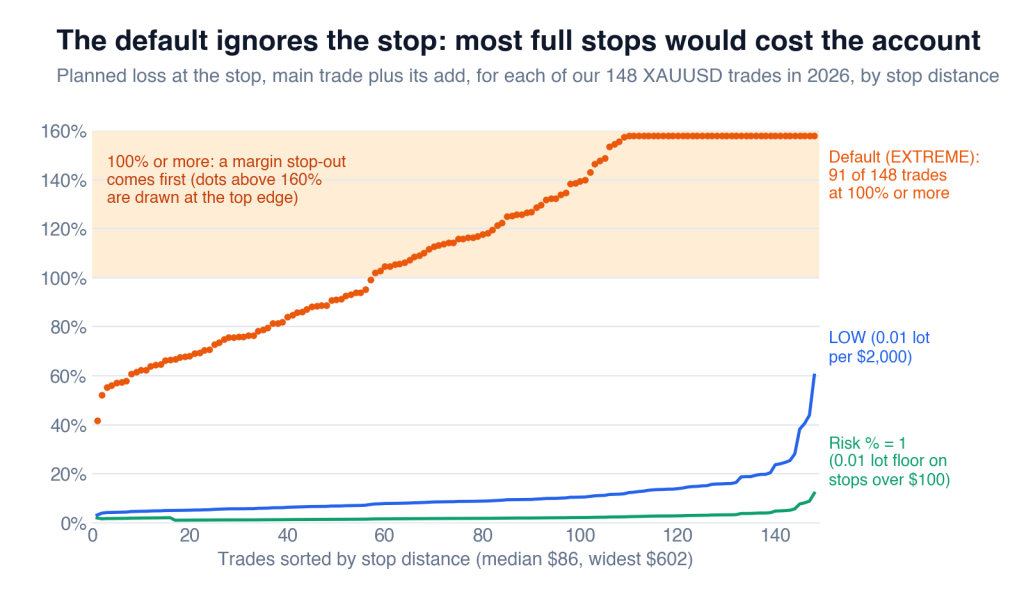
Small accounts do not escape this. On $200 and $300 the default still trades 0.01-0.02 lot from the first day, and both test accounts went through a 70% drawdown. The 16 April trade took 57% of the $200 account.
5. Earlier years
Real ticks on our broker start in January 2026, so for 2020-2025 we used generated ticks, after checking that they agree with real ticks on 2026 (+$1,381 against +$1,348, drawdown 1.13% against 1.09%).
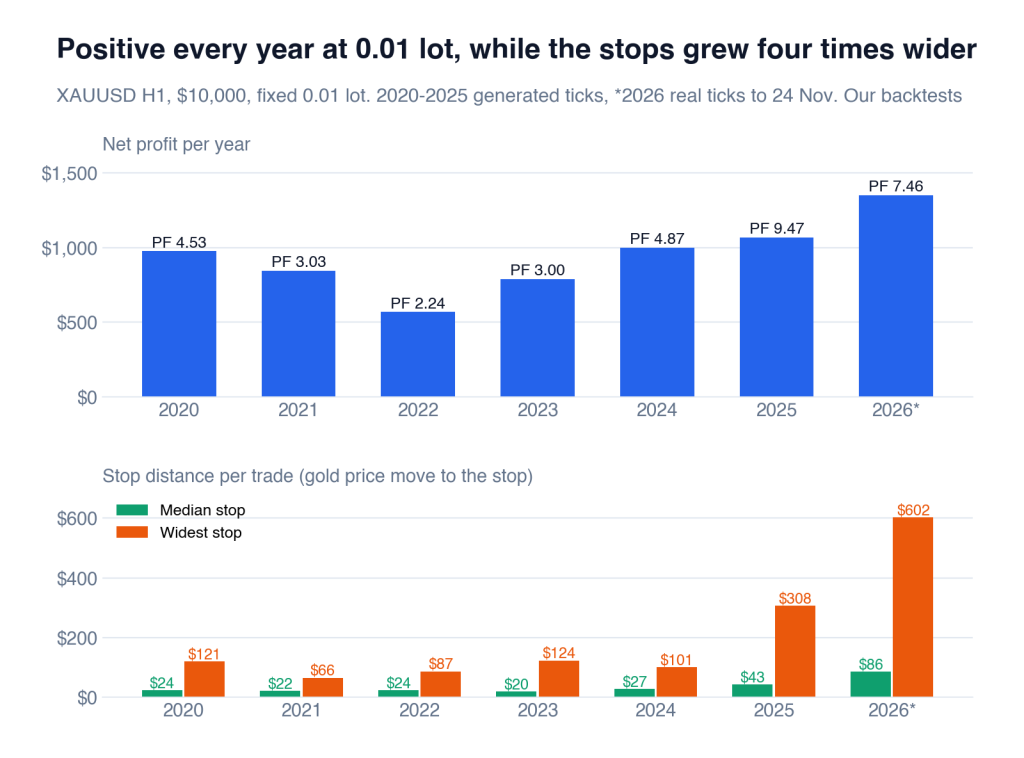
- Every year was positive at 0.01 lot – From +$569 in 2022 (profit factor 2.24) to +$1,348 in 2026, and the equity drawdown never passed 1.5% of $10,000.
- The stops grew four times wider – The median stop was $20-27 from 2020 to 2024, $43 in 2025 and $86 in 2026. A lot sized by balance therefore carries about four times the risk per trade it did in 2022, which is why the default looks far worse on 2026 than on older data.
We also ran every year at the default and at the two low settings, $10,000 each:
| Year | Default (EXTREME): drawdown / worst trade | LOW: drawdown / worst trade | Risk 1%: drawdown / worst trade |
|---|---|---|---|
| 2020 | 61.0% / -27.2% | 4.5% / -2.1% | 4.2% / -2.1% |
| 2021 | 60.9% / -39.2% | 5.3% / -2.5% | 7.7% / -2.1% |
| 2022 | 54.7% / -34.1% | 4.7% / -2.5% | 7.0% / -2.3% |
| 2023 | 95.1% / -38.9% | 7.0% / -2.5% | 5.0% / -2.1% |
| 2024 | 50.1% / -38.3% | 3.7% / -2.5% | 3.9% / -2.1% |
| 2025 | 61.4% / -45.1% | 5.0% / -3.0% | 2.6% / no loss |
| 2026* | 72.3% / -64.9% | 5.5% / -4.8% | 2.0% / -1.9% |
Drawdown is the largest equity drop; the worst trade is a main trade plus its add, as a share of the balance before it. 2026 on real ticks to 24 November.
- The default had a deep drawdown every year – Between 50% and 95%, and in 2023 equity fell to 5% of its peak before the trades recovered. Its single worst trades took 27% to 65% of the account.
- The low settings stayed under 8% – LOW and Risk 1% kept every year’s worst trade under 5%.
6. The other presets
The other presets are meant for Risk % sizing, so we ran each at 1% on $10,000 over 2026 with real ticks (Tickmill’s Nasdaq symbol is USTEC).
| Preset | Chart | Net 2026 | Profit factor | Largest equity drawdown |
|---|---|---|---|---|
| BTCUSD (two strategies) | BTCUSD M15 | +$12,318 | 2.78 | 7.3% |
| Bitcoin 2 | BTCUSD M15 | -$490 | 0.94 | 15.3% |
| US100 | USTEC M30 | +$1,928 | 5.15 | 2.5% |
| US100 Pyramiding | USTEC M30 | +$2,948 | 4.16 | 3.4% |
| Nasdaq 3 | USTEC M30 | +$448 | 1.29 | 3.9% |
| FOREX (six pairs) | EURUSD H1 | +$110,614 | 1.21 | 50.3% |
| FOREX2 (six pairs) | EURUSD H1 | +$8,306 | 2.18 | 8.2% |
- US100 was the steadiest – Both US100 presets stayed under 3.5% drawdown at 1%.
- The FOREX preset multiplies the risk – It trades six pairs from one chart and each signal can take three adds of the same size, so “1% per trade” became a 50% drawdown. The live Forex account showed the same pattern, and the newest version rebuilt this preset to one trade per signal with no adds.
- Bitcoin 2 and FOREX2 are gone in the newest version – They are still in the file we post. Bitcoin 2 lost money in our test.
None of these presets has a live account to check against, so treat this table as a starting point for a demo, not a result.
7. Prop firm accounts
The prop-firm guard closes all trades and pauses at a 4.5% daily or 8% total loss. It reacts after the loss is booked: at the default risk, in our January 2026 test, it stepped in at 4.81%, 4.55% and 6.10% daily losses, then stopped the EA for good at an 8.33% total loss after eight trades. On a prop account the guard only makes sense with Risk % at 0.5-1% on a balance large enough that the 0.01 minimum lot is rarely hit (about $20,000 and up at 2026 stops), so one full stop with its add stays near 1-2%.
Our verdict and the download
SMC Pyramid EA
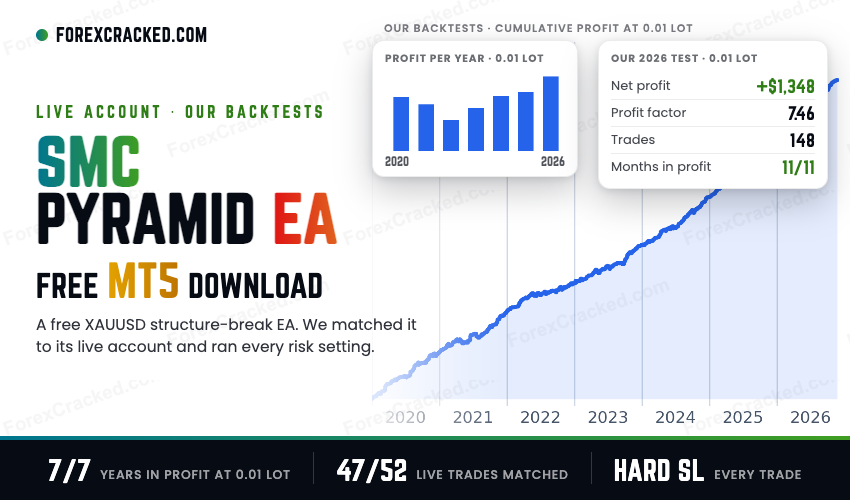
An MT5 XAUUSD bot that buys and sells breaks of H1 structure, stops behind the opposite swing, adds one same-size trade at +$2 and trails both. Our 2026 real-tick test made +$1,348 at 0.01 lot with a 7.46 profit factor. The default risk level took the same trades to a 72% drawdown.
Pros
- One readable entry rule: an H1 close beyond the last swing
- A stop on every trade, no grid, no martingale
- Adds only to a trade already in profit
- Our backtest matched 47 of 52 live entries
Cons
- The default risk level can lose most of the account on one trade
- Stops run from $30 to $600, so the size of a loss is hard to predict
- Live news closes cut results below any backtest
- The order block filter does nothing
Summary
The entries are one clear rule and our backtest matched most of the live account's trades. However, the default risk level gives a $600 stop the same lot as a $50 one, so a single full stop can take most of the account, and the live account's news closes cost more than any backtest shows. Start from VERY LOW or Risk 1%, with about $5,000 per 0.01 lot.

 Built by ForexCrackedWe tested 1,200+ indicators. Then we built our own.Six years of reviewing EAs and indicators went into FXC Fusion: two engines, the seven-panel cockpit, MT4 and MT5, from the team behind this site.
How it compares to other gold robots we have tested
| SMC Pyramid EA | Gold Trading SMC EA | Gold Swing Breakout EA | Channel Breakout EA | |
|---|---|---|---|---|
| Platform | MT5 | MT4 | MT5 | MT5 |
| Entry | H1 close beyond the last swing | Impulse, then the pullback | Stop orders at M15 swings | Stacked stop orders at channel highs and lows |
| Stop | Opposite swing + $1 | Fixed stop on every trade | Stop on every order | Stop on every leg |
| Adds to a trade | One add at +$2 | No | No | Up to six legs at one price |
| Our 2026 test, 0.01 lot | +$1,348, PF 7.46 | (live only: PF 1.10, Jan-Jun 2026) | +$729, PF 1.37 | +$1,791, PF 6.52 |
Frequently Asked Questions (FAQ)
Conclusion
SMC Pyramid EA trades one clear rule, a close beyond the last H1 swing with a stop behind the opposite swing, and our backtest matched most of its live account’s entries. However, its default risk level sizes every trade by the balance, so the stop distance alone decides whether a losing trade costs 40% or the whole account, and the live account shows news closes eat into what the backtest promises. As a free XAUUSD bot for MT5 it is worth a demo run on one of the low settings in our set files, never on the default.


Discussion no comments yet
Is this still working?
Nothing here yet
No one has asked anything about SMC Pyramid EA yet. First question gets answered.